True Greatness
זכרון יעקב | January 16, 2025
Print This Article
View Original PDF

True Greatness

זכרון יעקב | June 27, 2025

And the king of Egypt said to the midwives, one of whom was named Shifrah and the other Puah. (1:15)

When Pharaoh decreed that all newborn Jewish boys should be drowned, two heroic midwives saved the day. One was named Shifrah and the other Puah. Rashi explains that these two women were none other than Yocheved, Moshe's mother, and Miriam, his sister. Why then were they called Shifrah and Puah? Yocheved was called Shifrah because she was meshaferes es havlad, she beautified the infants and smoothed their limbs. Miriam was called Puah because she was poah umedaberes livlad, she cooed and whispered to the infants.

It seems strange that the special names the Torah gives Yocheved and Miriam memorialize the care they showed to the infants. These women actually saved their lives. If it weren't for them, those infants would have been drowned. Shouldn't they then have been given names that memorialize their heroic rescue of the Jewish children? Wouldn't it have been more appropriate to name them Hatzalah and Teshuah, for example?

My Rosh Yeshivah, Rav Yaakov Yitzchak Ruderman, always used to say that true greatness is manifested in the little things, the low-profile actions that reveal the depth of character and commitment. It is not enough to perform heroic acts that grab the headlines, so to speak. People of lesser worth can also find it within themselves to rise to the occasion for that one moment of heroism and perform acts of greatness. But it is a superficial greatness, because after the deed is done, they revert to ordinariness. They pat themselves on the back and say, "All right, I've done my duty. I've risked my life and saved the world, and now it's time to go home and get on with my life." A meteoric rise and a descent to earth. True greatness, however, is expressed in small but extraordinary deeds. These two heroic women, Shifrah and Puah, were pulling Jewish children to safety in a time of mortal danger, yet they had the sensitivity and the presence of mind to take the time to beautify their little bodies and to soothe their little souls with coos and whispers. This was true greatness.

The Talmud reports (Avodah Zarah 18a) that Rabbi Yosi ben Kisma taught Torah in public despite a Roman decree forbidding anyone to do so under the penalty of death. One day, Rabbi Chanina ben Teradion visited him.

"Don't you know," asked Rabbi Chanina ben Teradion, "that Heaven granted [the Romans] their power? How can you flaunt their decrees?"

"I rely on the mercy of Heaven," Rabbi Yosi ben Kisma replied. "Tell me, will I have a share in the next world?"

"Have you ever done anything outstanding?" asked Rabbi Chanina ben Teradion.

"Yes, I have," said Rabbi Yosi ben Kisma responded. "I once had charity as well as my own money in the same pocket. They got mixed up, and I didn't know which was which. So I gave everything to charity."

"If so," said Rabbi Chanina ben Teradion, "may my own portion be as great as your portion, and may my destiny be as great as yours."

What can we make of this conversation? Rabbi Yosi ben Kisma is risking his life to teach Torah in public. He will probably die a horrible death at the hands of the Romans if he is apprehended. Yet this great act of heroism doesn't seem to guarantee him a share in the next world. What worthy act convinces Rabbi Chanina ben Teradion that Rabbi Yosi ben Kisma has earned a share in the next world? That he gave his own money to charity when it got mixed up with charity money! Amazing!

We see clearly from this Gemara how true greatness is measured. Headline-grabbing acts of heroism are not absolute proof of true greatness. On the other hand, giving away one's own money when it gets mixed up with charity money will never get a headline. In fact, no one will ever know about it. Such an act shows what a person is really made of. Such an act is a sure sign of true greatness.
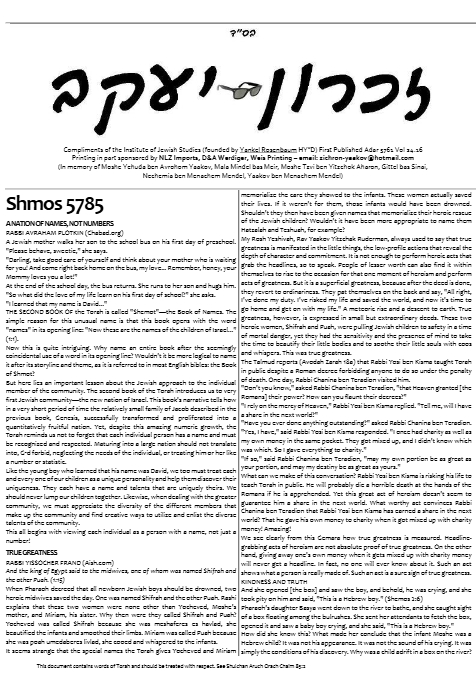
And the king of Egypt said to the midwives, one of whom was named Shifrah and the other Puah. (1:15)

When Pharaoh decreed that all newborn Jewish boys should be drowned, two heroic midwives saved the day. One was named Shifrah and the other Puah. Rashi explains that these two women were none other than Yocheved, Moshe's mother, and Miriam, his sister. Why then were they called Shifrah and Puah? Yocheved was called Shifrah because she was meshaferes es havlad, she beautified the infants and smoothed their limbs. Miriam was called Puah because she was poah umedaberes livlad, she cooed and whispered to the infants.

It seems strange that the special names the Torah gives Yocheved and Miriam memorialize the care they showed to the infants. These women actually saved their lives. If it weren't for them, those infants would have been drowned. Shouldn't they then have been given names that memorialize their heroic rescue of the Jewish children? Wouldn't it have been more appropriate to name them Hatzalah and Teshuah, for example?

My Rosh Yeshivah, Rav Yaakov Yitzchak Ruderman, always used to say that true greatness is manifested in the little things, the low-profile actions that reveal the depth of character and commitment. It is not enough to perform heroic acts that grab the headlines, so to speak. People of lesser worth can also find it within themselves to rise to the occasion for that one moment of heroism and perform acts of greatness. But it is a superficial greatness, because after the deed is done, they revert to ordinariness. They pat themselves on the back and say, "All right, I've done my duty. I've risked my life and saved the world, and now it's time to go home and get on with my life." A meteoric rise and a descent to earth. True greatness, however, is expressed in small but extraordinary deeds. These two heroic women, Shifrah and Puah, were pulling Jewish children to safety in a time of mortal danger, yet they had the sensitivity and the presence of mind to take the time to beautify their little bodies and to soothe their little souls with coos and whispers. This was true greatness.

The Talmud reports (Avodah Zarah 18a) that Rabbi Yosi ben Kisma taught Torah in public despite a Roman decree forbidding anyone to do so under the penalty of death. One day, Rabbi Chanina ben Teradion visited him.

"Don't you know," asked Rabbi Chanina ben Teradion, "that Heaven granted [the Romans] their power? How can you flaunt their decrees?"

"I rely on the mercy of Heaven," Rabbi Yosi ben Kisma replied. "Tell me, will I have a share in the next world?"

"Have you ever done anything outstanding?" asked Rabbi Chanina ben Teradion.

"Yes, I have," said Rabbi Yosi ben Kisma responded. "I once had charity as well as my own money in the same pocket. They got mixed up, and I didn't know which was which. So I gave everything to charity."

"If so," said Rabbi Chanina ben Teradion, "may my own portion be as great as your portion, and may my destiny be as great as yours."

What can we make of this conversation? Rabbi Yosi ben Kisma is risking his life to teach Torah in public. He will probably die a horrible death at the hands of the Romans if he is apprehended. Yet this great act of heroism doesn't seem to guarantee him a share in the next world. What worthy act convinces Rabbi Chanina ben Teradion that Rabbi Yosi ben Kisma has earned a share in the next world? That he gave his own money to charity when it got mixed up with charity money! Amazing!

We see clearly from this Gemara how true greatness is measured. Headline-grabbing acts of heroism are not absolute proof of true greatness. On the other hand, giving away one's own money when it gets mixed up with charity money will never get a headline. In fact, no one will ever know about it. Such an act shows what a person is really made of. Such an act is a sure sign of true greatness.

PDF Preview