Trust in G-d and the Example of Yaakov and Moshe
The following is the rationale for both opinions:
- Their fear was praiseworthy. Although these righteous individuals were guaranteed by the Almighty that they would experience no harm, they did not rely on this assurance due to their humility. Yaakov and Moshe each thought that perhaps they had sinned and were no longer worthy of G-d’s protection.
- They should have trusted G-d. When G-d tells a person that they need not fear and that He will be with them, the individual should trust in G-d no matter what.
Why not fear?
The commentators who believe that Yaakov and Moshe were justified in being fearful, believe, that a person’s humility will bring about fear. When a person sees their own faults, they will view themselves unworthy Divine kindness. The divergent opinion differs, saying that one should trust in G-d—regardless if they view themselves as deserving.
This, however, is not understood: It does indeed seem correct to fear that due to one’s sins they may not be deserving of a miracle. What then was wrong with the actions of Yaakov and Moshe?
Chassidic thought indeed suggests that Yaakov’s fear was justified:
This (humility) is also the trait of Yaakov, and therewith he justified himself for his fear of Esav, and did not rely on the promise given to him—"And, behold, I am with you..," (That is), because Yaakov regarded himself as utterly insignificant [because of the multitude of favors, "for with my staff..." ], and as unfit and unworthy to be saved ... and as the saying of our Sages, of blessed memory, "maybe sin will cause ...." for it appeared to him that he had sinned.
Tanya, Igeres Hakodesh, Epistle 2
Seemingly, their fear does not express a deficit in their faith, it rather exemplifies their extreme humility. If so, what was wrong in Yaakov and Moshe’s belief that perhaps they did not merit special salvation?
Trust in G-d
This question is extremely pertinent in our lives as well. Similar to Yaakov and Moshe, we too are given a similar mandate not to fear:
“When you go out to war against your enemies, and you see horse and chariot, a people more numerous than you, you shall not be afraid of them.”
We were commanded in this, that if a person sees any suffering approaching, he should, in his heart, trust in the salvation of G-d. As it says in the verse, “Truly, His salvation is near those who fear Him,” and it says as well, “Who are you that you fear man, who will die?”
Sha-arei Teshuvah 3:32
Even when a person is at war with a powerful enemy, he is entreated to put his trust in the Almighty and not to fear. The concept of trust in G-d is that a person has absolute confidence that G-d will save him from all troubles. As such, he has no reason to fear anything that comes his way. Trust in G-d is not only the belief that G-d can save him from his woes, but it is the conviction that He will. The person who has trust in G-d is so firm in this belief, that he does not have even a shred of worry, no matter what comes his way.
What is trust? Peace of mind of the one who trusts. That one relies in his heart that the one he trusts in will do what is good and proper for him on the matter he has trusted him with, according to his ability and his understanding of what will further his good. But the main factor, which leads one to trust in the one trusted, and without which trust cannot exist, is for one's heart to be confident that the one trusted will keep his word and will do what he pledged, and that he will also think to do what is good for him even on what he did not pledge, out of pure generosity and kindness.
Chovas HaLevavos, Sha-ar Habitachon, Ch. 1
The person who has trust in the Almighty relies on Him completely. He is absolutely confident that G-d will be generous and kind to him, even when G-d did not pledge to do so. He is sure that G-d will deal with him generously even though he may have imperfections and sin.
How can we be sure?
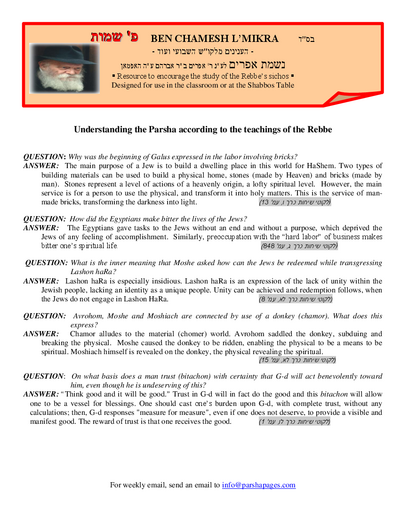
This concept however, that a person is to trust G-d no matter what, requires clarification as to the reason that he does so. The individual is at peace of mind, though he has never received any promise from G-d—but why? From whence does the certitude come? If a person does not have any assurance from the Almighty, how can he be sure that he will be saved from his troubles as a punishment for his sins? If, when a person does have an assurance from G-d—as with Yaakov and Moshe—can they still be worried that they no longer deserve Divine intervention due to sin, all the more when the person has no such guarantee should a person be worried! Why then should he place his absolute trust in G-d that He will show him kindness? Every individual has misdeeds that can perhaps prevent Divine intervention:
For there is no righteous man on earth who does good and sins not.
Koheles 7:20
If Yaakov was worried that he had sinned and was not deserving of salvation all the more so should we.