Two Heroines
In the Torah, it is parents who give a child their name, and in the case of a special individual, G-d Himself. It is G-d who gives the name Isaac to the first Jewish child, G-d’s angel who gives Jacob the name Israel, G-d who changes the names of Abram and Sarai to Abraham and Sarah. We have already encountered one adoptive name, Tzafenat Pa’neah, the name by which Joseph was known in Egypt, yet Joseph remains Joseph. How surpassingly strange that the hero of the Exodus, the greatest of all the prophets, should bear not the name Amram and Yocheved have undoubtedly used thus far, but the one given to him by his adoptive mother, an Egyptian princess.
A Midrash draws our attention to the fact. “This is the reward for those who do kindness. Although Moshe had many names, the only one by which he is known in the whole Torah is the one given to him by the daughter of Pharaoh. Even the Holy One, blessed be He, did not call him by any other name.” (Shemot Rabba 1:26)
Indeed, Moshe – Meses – is an Egyptian name, meaning “child,” as in Ramses (which means child of Ra; Ra was the greatest of the Egyptian gods.).
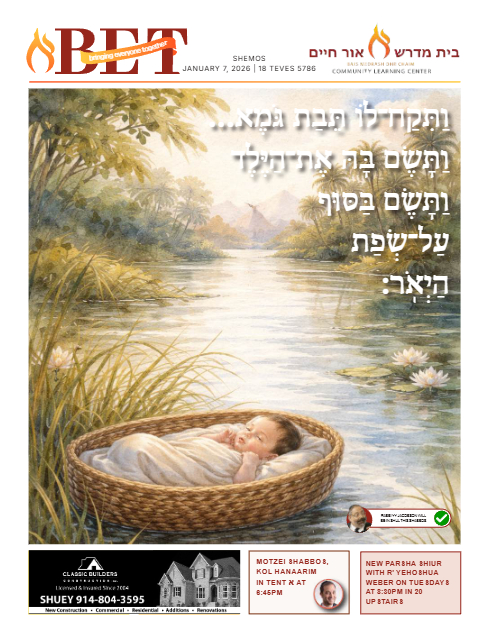
Who then was Pharaoh’s daughter? Nowhere is she explicitly named. However, the First Book of Chronicles (4:18) mentions a daughter of Pharaoh, named Bitya, and it was she whom the Sages identified as the woman who saved Moshe. The name Bitya (sometimes rendered as Batya) means “the daughter of G-d.” From this, the Sages drew one of their most striking lessons: “The Holy One, blessed be He, said to her: ‘Moshe was not your son, yet you called him your son. You are not My daughter, but I shall call you My daughter.’” (Vayikra Raba 1:3) They added that she was one of the few people (tradition enumerates nine) who were so righteous that they entered paradise in their lifetime.
Instead of “Pharaoh’s daughter,” read “Hitler’s daughter” or “Stalin’s daughter,” and we see what is at stake. Tyranny cannot destroy humanity. Moral courage can sometimes be found in the heart of darkness. That the Torah itself tells the story the way it does has enormous implications. It means that when it comes to people, we must never generalize, never stereotype. The Egyptians were not all evil; even from Pharaoh himself, a heroine was born. Nothing could signal more powerfully that the Torah is not an ethnocentric text, that we must recognize virtue wherever we find it, even among our enemies, and that the basic core of human values – humanity, compassion, courage – is truly universal. Holiness may not be; goodness is.
Outside Yad Vashem, the Holocaust Memorial in Jerusalem, is an avenue dedicated to righteous gentiles. Pharaoh’s daughter is a supreme symbol of what they did and what they were. I, for one, am profoundly moved by that encounter on the banks of the Nile between an Egyptian princess and a young Israelite child, Moshe’s sister Miriam. The contrast between them in terms of age, culture, status, and power could not be greater. Yet their deep humanity bridges all the differences, all the distance. Two heroines. May they inspire us.
RABBI JONATHAN SACKS Z”L