Understanding the Parsha according to the teachings of the Rebbe
Parsha Pages | January 17, 2025
Print This Article
View Original PDF

Understanding the Parsha according to the teachings of the Rebbe

Parsha Pages | June 27, 2025

Understanding the Parsha according to the teachings of the Rebbe

QUESTION: Why was the beginning of Galus expressed in the labor involving bricks?

ANSWER: The main purpose of a Jew is to build a dwelling place in this world for HaShem. Two types of building materials can be used to build a physical home, stones (made by Heaven) and bricks (made by man). Stones represent a level of actions of a heavenly origin, a lofty spiritual level. However, the main service is for a person to use the physical, and transform it into holy matters. This is the service of man-made bricks, transforming the darkness into light.

QUESTION: How did the Egyptians make bitter the lives of the Jews?

ANSWER: The Egyptians gave tasks to the Jews without an end and without a purpose, which deprived the Jews of any feeling of accomplishment. Similarly, preoccupation with the “hard labor” of business makes bitter one’s spiritual life.

QUESTION: What is the inner meaning that Moshe asked how can the Jews be redeemed while transgressing Lashon haRa?

ANSWER: Lashon haRa is especially insidious. Lashon haRa is an expression of the lack of unity within the Jewish people, lacking an identity as a unique people. Unity can be achieved and redemption follows, when the Jews do not engage in Lashon HaRa.

QUESTION: Avrohom, Moshe and Moshiach are connected by use of a donkey (chamor). What does this express?

ANSWER: Chamor alludes to the material (chomer) world. Avrohom saddled the donkey, subduing and breaking the physical. Moshe caused the donkey to be ridden, enabling the physical to be a means to be spiritual. Moshiach himself is revealed on the donkey, the physical revealing the spiritual.

QUESTION: On what basis does a man trust (bitachon) with certainty that G-d will act benevolently toward him, even though he is undeserving of this?

ANSWER: “Think good and it will be good.” Trust in G-d will in fact do the good and this bitachon will allow one to be a vessel for blessings. One should cast one’s burden upon G-d, with complete trust, without any calculations; then, G-d responses "measure for measure", even if one does not deserve, to provide a visible and manifest good. The reward of trust is that one receives the good.
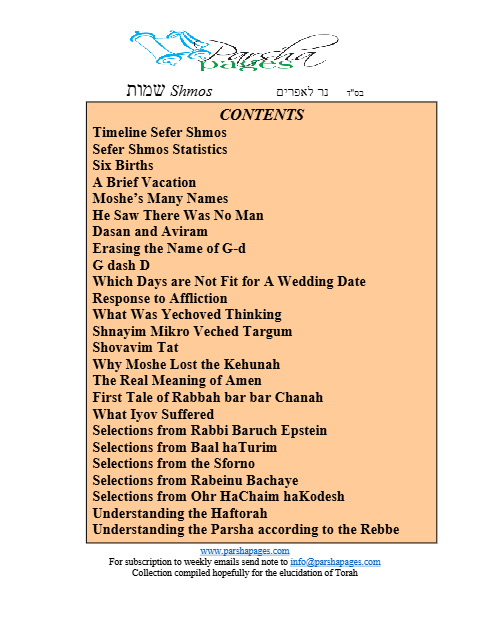

Understanding the Parsha according to the teachings of the Rebbe

QUESTION: Why was the beginning of Galus expressed in the labor involving bricks?

ANSWER: The main purpose of a Jew is to build a dwelling place in this world for HaShem. Two types of building materials can be used to build a physical home, stones (made by Heaven) and bricks (made by man). Stones represent a level of actions of a heavenly origin, a lofty spiritual level. However, the main service is for a person to use the physical, and transform it into holy matters. This is the service of man-made bricks, transforming the darkness into light.

QUESTION: How did the Egyptians make bitter the lives of the Jews?

ANSWER: The Egyptians gave tasks to the Jews without an end and without a purpose, which deprived the Jews of any feeling of accomplishment. Similarly, preoccupation with the “hard labor” of business makes bitter one’s spiritual life.

QUESTION: What is the inner meaning that Moshe asked how can the Jews be redeemed while transgressing Lashon haRa?

ANSWER: Lashon haRa is especially insidious. Lashon haRa is an expression of the lack of unity within the Jewish people, lacking an identity as a unique people. Unity can be achieved and redemption follows, when the Jews do not engage in Lashon HaRa.

QUESTION: Avrohom, Moshe and Moshiach are connected by use of a donkey (chamor). What does this express?

ANSWER: Chamor alludes to the material (chomer) world. Avrohom saddled the donkey, subduing and breaking the physical. Moshe caused the donkey to be ridden, enabling the physical to be a means to be spiritual. Moshiach himself is revealed on the donkey, the physical revealing the spiritual.

QUESTION: On what basis does a man trust (bitachon) with certainty that G-d will act benevolently toward him, even though he is undeserving of this?

ANSWER: “Think good and it will be good.” Trust in G-d will in fact do the good and this bitachon will allow one to be a vessel for blessings. One should cast one’s burden upon G-d, with complete trust, without any calculations; then, G-d responses "measure for measure", even if one does not deserve, to provide a visible and manifest good. The reward of trust is that one receives the good.

PDF Preview