HaMekoshesh
Parsha Pages | June 25, 2024
Print This Article
View Original PDF

HaMekoshesh

Parsha Pages | June 27, 2025

HaMekoshesh

The Sin of Comparing Trees by the “Wood-gatherer”

Based on Rabbi Yosef Y. Jacobson

BeMidbar Chapter 15, Verses 32-36

32. When the children of Israel were in the desert, they found a man gathering wood (mekoshesh eitzim) on the Sabbath day.
33. Those who found him gathering wood presented him before Moses and Aaron and before the entire congregation.
34. They put him under guard, since it was not specified what was to be done to him
35. The L-rd said to Moses, “The man shall be put to death; the entire congregation shall pelt him with stones outside the camp.”
36. So the entire congregation took him outside the camp, and they pelted him to death with stones, as the L-rd had commanded Moses.

Who was this person?

  1. Our Rabbis taught (Shabbos 96b-97a): The ‘wood-gatherer’ (mekoshesh) was Tzelofchad. And thus, it is said (Numbers 15:32): “And while the children of Israel were in the wilderness, they found a man gathering wood, etc.”; and elsewhere it is said (Numbers 27:3): “Our father died in the wilderness;” just as there [it refers to] Tzelofchad, so too here Tzelofchad is meant. This is R. Akiva's view.
  2. R. Yehudah b. Basayra said to him, 'Akiva! In either case you will have to give an account for your words: If you are right, the Torah shielded his identity and you revealed it; and if not, you cast a stigma upon a righteous man!' Then of which [sinners] was Tzelofchad? — Of those who 'presumed [to go up to the top of the mountain] (Numbers 14:44).'

When did this incident happen?

  1. Occurred on the second Shabbos (21st of Iyar) after receiving the commandment at Marah (Malbim)
  2. Occurred on the Shabbos after Matan Torah (which was given on Shabbos)
  3. Shabbos after the incident with the Spies (possibly occurring the same time as the Blasphemer in VaYirka 24) Yalkut Shimoni; Tosefos Bava Basra 119a

What Shabbos prohibition occurred?

  1. Shabbos 96b: Rabbi Yehuda in the name of Shmuel: Gathered (eitzim) sticks and carried them in four amos within Reshus haRabim.
  2. Baraisa states that he cut branches off a tree (eitzum); Sefrei states that pulled wood from the ground.
  3. Abarvanel: cutting large sticks into small chips of word
  4. Shabbos 96b: Rabbi Acha ben Yaacov: He gathered and tied the branches together into bundles.
  5. Rabeinu Bacheya: He asks why the word ‘mekoshesh’ is used, it should have said the more common word ‘melaket’, ‘gatherer’?’ Therefore, he explains that ‘mekoshesh’ is actually a conjunction of two words, ‘meko shesh’, which means ‘separating the six,’ referring to the six directions of the world, the six supernal attributes. Similarly, when it is written, “Moses tarried,” boshesh, it is a conjuction of ‘ba’oo shesh’, six hours arrived, yet Moses did not come.
  6. Zohar: R. Chiya said: It is written, “They found a man gathering trees on the Sabbath day." What are the trees doing here, and who is the man? The man is Tzelafchad and he was inquiring about the trees [the Tree of Knowledge and the Tree of Life] which one is greater than the other, and he was not cautious for the glory of his Master, he exchanged one Shabbos [of the Tree of Knowledge] for another Shabbos [of the Tree of Life]. This is what it is written בחטאו "in his own sin he died," "in the sin of vuv” (בחטא ו), in the sin of six [the six faculties] did he die.
  7. Chabad Chassidus explains that Tzelafchad was comparing and contrasting the two trees. The Tree of Life is the existential life of only spirituality, one’s spiritual core. The Tree of Knowledge is the tree of good and bad, light and darkness, the struggle to find and reveal the spirituality from the physical nature of the world. The Spies wish to live in the desert with all their physical needs being met, and only deal with the Tree of Life, seeking spirituality. The Mekoshesh went to the other extreme, and wished to uproot every physical thing from its natural source, to make it to feel as an independent and separate existence, no longer dependent on its Divine source that is creating it. On Shabbos, the Tree of Knowledge unites with the Tree of Life and existence becomes nullified in its Divine source. Therefore, one who uproots something from this source is liable for desecrating Shabbos.
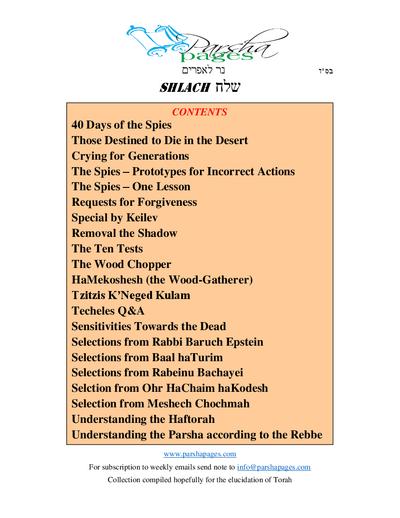
HaMekoshesh

The Sin of Comparing Trees by the “Wood-gatherer”

Based on Rabbi Yosef Y. Jacobson

BeMidbar Chapter 15, Verses 32-36

32. When the children of Israel were in the desert, they found a man gathering wood (mekoshesh eitzim) on the Sabbath day.
33. Those who found him gathering wood presented him before Moses and Aaron and before the entire congregation.
34. They put him under guard, since it was not specified what was to be done to him
35. The L-rd said to Moses, “The man shall be put to death; the entire congregation shall pelt him with stones outside the camp.”
36. So the entire congregation took him outside the camp, and they pelted him to death with stones, as the L-rd had commanded Moses.

Who was this person?

  1. Our Rabbis taught (Shabbos 96b-97a): The ‘wood-gatherer’ (mekoshesh) was Tzelofchad. And thus, it is said (Numbers 15:32): “And while the children of Israel were in the wilderness, they found a man gathering wood, etc.”; and elsewhere it is said (Numbers 27:3): “Our father died in the wilderness;” just as there [it refers to] Tzelofchad, so too here Tzelofchad is meant. This is R. Akiva's view.
  2. R. Yehudah b. Basayra said to him, 'Akiva! In either case you will have to give an account for your words: If you are right, the Torah shielded his identity and you revealed it; and if not, you cast a stigma upon a righteous man!' Then of which [sinners] was Tzelofchad? — Of those who 'presumed [to go up to the top of the mountain] (Numbers 14:44).'

When did this incident happen?

  1. Occurred on the second Shabbos (21st of Iyar) after receiving the commandment at Marah (Malbim)
  2. Occurred on the Shabbos after Matan Torah (which was given on Shabbos)
  3. Shabbos after the incident with the Spies (possibly occurring the same time as the Blasphemer in VaYirka 24) Yalkut Shimoni; Tosefos Bava Basra 119a

What Shabbos prohibition occurred?

  1. Shabbos 96b: Rabbi Yehuda in the name of Shmuel: Gathered (eitzim) sticks and carried them in four amos within Reshus haRabim.
  2. Baraisa states that he cut branches off a tree (eitzum); Sefrei states that pulled wood from the ground.
  3. Abarvanel: cutting large sticks into small chips of word
  4. Shabbos 96b: Rabbi Acha ben Yaacov: He gathered and tied the branches together into bundles.
  5. Rabeinu Bacheya: He asks why the word ‘mekoshesh’ is used, it should have said the more common word ‘melaket’, ‘gatherer’?’ Therefore, he explains that ‘mekoshesh’ is actually a conjunction of two words, ‘meko shesh’, which means ‘separating the six,’ referring to the six directions of the world, the six supernal attributes. Similarly, when it is written, “Moses tarried,” boshesh, it is a conjuction of ‘ba’oo shesh’, six hours arrived, yet Moses did not come.
  6. Zohar: R. Chiya said: It is written, “They found a man gathering trees on the Sabbath day." What are the trees doing here, and who is the man? The man is Tzelafchad and he was inquiring about the trees [the Tree of Knowledge and the Tree of Life] which one is greater than the other, and he was not cautious for the glory of his Master, he exchanged one Shabbos [of the Tree of Knowledge] for another Shabbos [of the Tree of Life]. This is what it is written בחטאו "in his own sin he died," "in the sin of vuv” (בחטא ו), in the sin of six [the six faculties] did he die.
  7. Chabad Chassidus explains that Tzelafchad was comparing and contrasting the two trees. The Tree of Life is the existential life of only spirituality, one’s spiritual core. The Tree of Knowledge is the tree of good and bad, light and darkness, the struggle to find and reveal the spirituality from the physical nature of the world. The Spies wish to live in the desert with all their physical needs being met, and only deal with the Tree of Life, seeking spirituality. The Mekoshesh went to the other extreme, and wished to uproot every physical thing from its natural source, to make it to feel as an independent and separate existence, no longer dependent on its Divine source that is creating it. On Shabbos, the Tree of Knowledge unites with the Tree of Life and existence becomes nullified in its Divine source. Therefore, one who uproots something from this source is liable for desecrating Shabbos.
PDF Preview