Sidra Shelach Lecha
1.When HaShem first appeared to Mosheh at the Burning Bush, He told him to return to Egypt, so as to eventually lead us out to freedom from the slavery of the Egyptians and into the Land that He had promised to Avrohom, Yitzchok and Yaakov to give to us, their descendants. HaShem had told Mosheh then that on our way to the Promised Land we were to receive the Torah—our Constitution as a People—and within a few weeks after that we would be in Eretz Yisroel.
2.Exactly as HaShem had said, seven weeks after our Deliverance from Egypt, we stood at Mount Sinai.There, in the most stupendous revelation of HaShem’s Glory ever witnessed by a multitude of people, we heard the Voice of HaShem as He proclaimed, “I am HaShem your Lord Who took you out from the land of Egypt...” followed by the other Commandments of the Decalogue. We then remained at the foot of Mount Sinai while Mosheh ascended the mountain to learn from HaShem the Torah in its entirety, to teach it to us, each Mitzvah as and when He would direct “... speak to the Jewish People and tell them ...”.
3.But then the tragedy of the Golden Calf delayed our taking possession of Eretz Yisroel directly.While Mosheh our Teacher entreated HaShem to forgive us for our unfaithfulness, we did Teshuvah, until HaShem graciously granted us His pardon on the tenth day of Tishrei (later commanded by HaShem to be for all time Yom Kippur, the Day of Atonement). To show that He had indeed accepted us back as His People as Mosheh asked, HaShem commanded that we should build a smaller, transportable version of that Beis HaMikdash that we were to build in Eretz Yisroel. Through this Mishkan built by us in the Wilderness, it would be seen that HaShem indeed dwells amongst us. So, for a whole year, while we were at Mount Sinai, we constructed the Mishkan with its sacred furniture as HaShem directed, and in the month of Nissan in the year 2449 after Creation, in the year following our Deliverance from Egypt, the Mishkan was completed.
4.At last, we were ready to continue on our way into Eretz Yisroel—eleven days’ journey from Mount Sinai. But then the People clamoured around Mosheh, asking him to send men ahead of them to bring back a report of what Eretz Yisroel is like and also to learn how best we should plan our tactics for taking it back from the unlawful squatters that were there. But this demand showed a lack of trust in HaShem, Who had told us (even while we were still in Egypt) that it was a good land, “a land flowing with milk and honey.” HaShem had said then that we would indeed take possession of the land, but not through our own efforts. In the same way that we did not battle the Egyptians, but HaShem fought for us, so too will HaShem drive out the people that were there in the Land. But by asking to send men ahead of them, therefore, the Jewish People clearly showed a lack of trust in HaShem. Nevertheless, HaShem told Mosheh, if this is what the people want, then let them send men as they asked, and thus HaShem gave His permission for the mission to go ahead. But, HaShem warned Mosheh, no good would come of it.
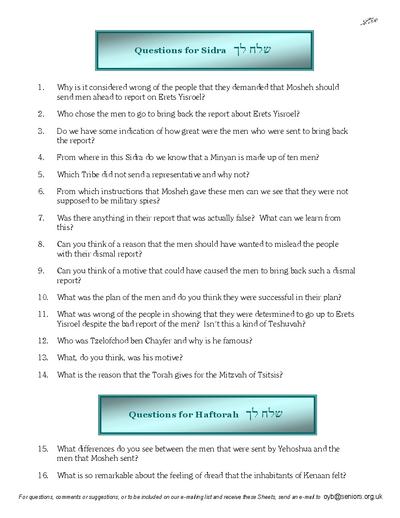
5.Sure enough, when these men returned after forty days they slandered the Land—and, by implication, HaShem Himself.Without actually telling outright lies, they nevertheless painted a picture that was untrue and warned the people that it would be well-nigh impossible to overcome the present inhabitants amongst whom, they warned, were also the dreaded warlike Ammolaykites. Almost all the men (but not the women) believed these bad reports and they wept bitterly at their fate, complaining that HaShem intended their death “because He was unable to overcome the inhabitants of the Land.” After the various other backslidings—which HaShem was willing to forgive—this faithlessness proved to be the final lapse which showed that this generation was not worthy of HaShem’s favour any longer and He decreed that the Jewish People indeed remain in the Wilderness until all that treacherous generation of men had died out. Eleven days had become forty years. It is this episode of “the spies” that is the first part of this week’s Sidra.
6.The twelve men whom Mosheh sent to tour the Promised Land were great people: each one was a Prince of his Tribe. Included among them were also Yehoshua bin Noone and Kolayv ben Yefuneh—the only two out of the twelve who remained loyal to HaShem—and the others were of a similar great stature. With the exception of Levi, each Tribe sent its representative to tour the Land, to report on its extraordinary goodness and to assure them how Eretz Yisroel suited their particular requirements and disposition, for each Tribe of Israel has its own distinct characteristics. But instead of keeping their report to these matters, the tourists became spies. They returned with frightening tales of the mighty inhabitants, backing-up their report with half-truths and finally they even implied that HaShem Himself could not conquer the inhabitants. What went wrong? Why did they so mislead the people? And what was their motive?
7.When the spies saw the supernatural bounty of Eretz Yisroel, they were concerned that the Jewish People would turn to working the land and devote themselves wholeheartedly to realizing its full potential—and be further encouraged in their efforts by its remarkable produce (samples of which they brought back with them). The spies realized that the golden opportunity of the entire Jewish People devoting themselves to nothing else than learning Torah at the feet of Mosheh our Teacher, with all their needs attended to, would come to an end. They felt it to be their sacred duty to discourage the people from wanting to take possession of Eretz Yisroel so quickly, so that their wonderful and supernatural existence in the Wilderness could continue.
8.But they made two fundamental mistakes. Firstly,"ַאְּתלִהַציִדַהיקְרֵּב" , that is, “Do not be too righteous; do not do more than HaShem wants.” If HaShem wants us to come out of the Wilderness and away from our supernatural existence there, to come into Eretz Yisroel and work the Land, to live and develop as a Nation under His protection and guidance and following His Torah, it is not for mere mortals—however great—to try to be holier than HaShem wants. Selected individuals, even a whole Tribe or section of the Nation can dedicate themselves—indeedshoulddedicate themselves—to a life of Torah-study, for these people bring HaShem’s blessing upon His Nation and indeed upon the whole world. In fact, each and every individual Jew is to dedicate himself to learning Torah, and as much Torah, to the best of his ability. But ultimately HaShem wants His Chosen People to live amongst the Nations of the world, separate, yes, but at the same time in contact with them and thus influence all of the world to recognize Him and to live according to His wishes. He does not want His Nation to be shut away in a Wilderness in total seclusion and out of contact with others.
9.And secondly, the spies neglected to inspect their motives for their behaviour. Had they done so in all honesty, they would have realized that their over-zealous concern that the Jewish People should continue to develop in the Wilderness without the diversions that would come when they took to working the Land and all the usual needs of a natural existence (and which over-zealous concern in fact led to blasphemy) was prompted by their own self-importance and the desire to hold on to their powerful, high position. Because once the Jewish People were properly settled in their Land, the Torah advocates the setting-up of a king, and no longer is the leadership of the people solely in the hands of the Princes of the Tribes. Even though they were great men, they were mortal and thus, even though they did not realize it themselves, they were not without human failings. Consequently, had they more honestly inspected their motives they would have seen that in truth their own plan for the Jewish People was wrong if for no other reason that it was not what HaShem commanded. The episode of the spies teaches how one dare not defy HaShem’s wishes and rely on one’s own assessment of what is right and what is wrong. For if it will not subject itself to the Will of HaShem, the human mind is notoriously capable of rationalizing almost anything.
10.Mosheh our Teacher told the people of HaShem’s anger at their treachery and he told them, too, His decree. But instead of contrition and regret, the people, in an impious show of defiance, rose up early the next morning, determined to fight to take possession of the Land. They had not yet learned their lesson that firstly, if one has done wrong, to accept HaShem’s just punishment and secondly, one does not contend with HaShem but one resigns oneself to His Will. Thus, despite Mosheh imploring them to desist from their rebellion (and perhaps, with prayer and repentance, to hope for HaShem’s forgiveness and that He should rescind His decree) they insisted on storming the highlands leading to Eretz Yisroel. Sure enough, the Ammolaykites and Kenaanites that were there came down and destroyed them utterly.
11.Straight after the episode of the spies, HaShem commands us various Mitzvos that shall be observed when we come into Eretz Yisroel—for come there we will. Some of the Laws of Korbonnos are taught; the Laws of Challoh (a part of the dough that is baked into a loaf—a Challoh—and given to the Kohen); the laws of a wrong decision in law by the Beis Din, and how atonement is to be achieved in such a case for a Beis Din; and how atonement is to be achieved for inadvertent idolworship.
12.The Sidra reports the offence of Tzelofchod ben Chayfer who deliberately desecrated the Shabbos, and his punishment. We are taught that his action was prompted by the desire to show that, even though the people of that generation were doomed, the laws of HaShem must be obeyed. Thus he knowingly sacrificed his life to teach the severity of the laws of the holy Shabbos.
13.The Sidra ends with the Mitzvah of Tsitsis: we are commanded to attach special tassels at the four corners of our garments. Garments are the outer covering of a person, they envelope him and perhaps more than any other exterior feature, they help to portray a man as he wishes to be seen. It is upon this exterior representation that Tsitsis are to be attached. The reason for this Mitzvah is stated in the Chumash: so that we shall see the Tsitsis and remember all the Mitzvos of HaShem and do them, and not follow our own desires which could cause us to stray away from the Torah. Thus, we are to remember to do the Mitzvos of HaShem, and become holy to HaShem, for this was the purpose of His taking us out from the land of Egypt—to be our G–d. This Mitzvah shows that we are in the Service of HaShem, and in this respect it is representative of all the Mitzvos of HaShem. (The numerical value of the letters of the wordִצ"ִיצ"יתas it is spoken, together with the eight threads and the five double-knots, add up to 613, the total number of all the Mitzvos of the Torah.) Tsitsis are like the badge of the Jewish People in the Service of HaShem: they should be worn with pride.
For the explanation of the Haftorah of Sidraלךשלחplease go to HAFTORAHS.