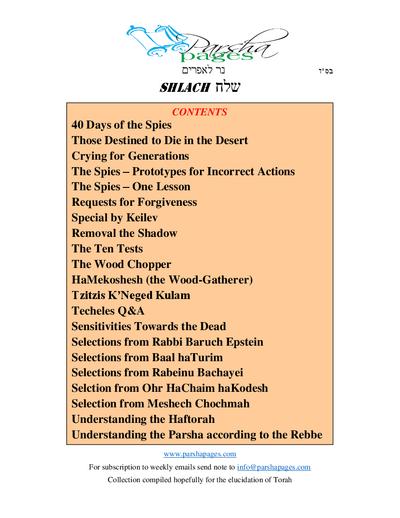
Special by Keilev
Parsha Pages | June 25, 2024
(במדבר יד, כד) אַחֲרָי וַהֲבִיאֹתִיו אֶל־הָאָרֶץ אֲשֶר־בָא שָמָה וְזַרְ עוֹ יוֹרִ שֶנָה:עִמוֹ וַיְמַלֵּא רוּחַ אַחֶרֶת וְעַבְדִ י כָלֵּב עֵּקֶב הָיְתָה
What does רוּחַ אַחֶרֶת (usually translated as “another spirit") mean?
- He displayed one attitude at the beginning of his speaking but actually had a different intention in mind. (Rashi)
- He was different from the rest of the spies. When contrasting one who behaves properly in comparison to one who behaves badly the term "acheir" or "acheres" is used, as we find by Sheis, a good person, being a replacement for Kayin, a bad person, "ki shos li Elokim zera ACHEIR" (Bereishis 4,25). He was different from Kayin who killed him. The term "acheir" when mentioned in contrast with a "rasha" means a righteous person, and the reverse is true as well. This is the meaning of "elohim ACHEIRIM," they are evil as compared to HaShem. (Rabbeinu Bachyei)
- In Koheles 3,21 the verse says, "Who knows the spirit "ruach" of humans that ascends upward, and the spirit "ruach" of the animal that descends downward to the earth?" This verse is discussing man only and refers to both the spiritual and the animalistic aspects of man. Most people are drawn to earthiness, after their animalistic "ruach." Keilev was drawn after the "ruach a'cher'es," that of the human ascending spirit. (Maharsh"a on the gemara Sotah 34b)
- There are righteous people for whom it is better to keep their distance from those who behave improperly, as it is within their nature to easily be influenced negatively. There are others for whom contact with that type of person does not affect adversely, and to the contrary, the righteous person is sometimes able to influence the person on a lower level to improve. Keilev was of the latter sort, as we see that he went along with ten spies who were quite negative about conquering Eretz Yisrael, and yet still stood his ground. His was a "different spirit" from that of the other type of righteous person. (Noam Elimelech)
- Keilev had a different level of "ruach" than Yehoshua had, meaning that Yehoshua had prophecy, called "ruach," as per Bemidbar 27:18, "Yehoshua bin Nun ish asher RUACH bo." Keilev did not have prophecy and was still able to stand up against the spies. (Radak)
- Just mentioned the names of the 4 giants in the area which intimidated the other spies. However, Keilev overcame that fear and went to Hebron and merited to have another spirit (of the Avos) accompany him and assist him not to follow the advice of the other spies. (Iyun Yaacov)
- Keilev was on side with Yehoshua when they set out on their mission. However, once in the land, he was persuaded by the spies to think negatively. He realized that he was swaying and therefore went to Chevron to pray at the gravesite of the Patriarchs that he not fall to their persuasion. He then strengthened himself and came back to the thinking of Yehoshua. He had a different attitude, "ruach a'cheres," that of the spies, and was still able to turn around his thinking. (Ohr HaChaim HaKodesh and Malbim)
Since Yehoshua was also not swayed by the rest of the spies, why wasn't he praised?
- He deserved no praise because he was protected by Moshe's prayer in 13:16, as per the Gemara Sotah 34b. (Paaneiach Roza)
- The praise of Keilev ended with the reward of "v'zaro yorishenah." Since Yehoshua would not have any children, this could not be said about him, so no praise was said. (Paaneiach Roza)
- Keilev's reward of entering and inheriting the land was appropriate to mention, but Yehoshua's reward of taking over the leadership from Moshe when they would enter the land was inappropriate to mention at this time. (Ramban)
- Praise was only given because of quieting the people's complaints. This was done by Keilev only. (Ibn Ezra)
- As per the words of the Radak on "ruach a'cher'es" mentioned above, Keilev deserved special praise because he stood up against the spies even though he did not have the power of prophecy (which Yehoshua had).
View The Full Article (PDF)
Related Articles

The Fruits of the Land
Ben Chamesh L'Mikra • Shlach

Understanding the Parsha according to the Rebbe
Parsha Pages • Shlach

Juxtaposition of the Story of the Spies and Miriam
Parsha Pages • Shlach

Carrying the Fruit of Eretz Yisrael
Parsha Pages • Shlach

Understanding the Parsha according to the Rebbe
Ben Chamesh L'Mikra • Shlach