The Context After the Spies Misleading Report
Project Likkutei Sichos | June 25, 2024
Print This Article
View Original PDF

The Context After the Spies Misleading Report

Project Likkutei Sichos | June 27, 2025

After the spies' misleading report about the Land of Israel and the people’s subsequent refusal to enter it, G-d wanted to destroy the nation and begin with Moshe alone. Moshe defended the people by arguing that the optics would be bad. The surrounding nations will say “Since G-d lacked the ability to bring this nation to the Land which He swore to them, He slaughtered them in the desert.' (Bamidbar 14:13-16)

The Question

Is this the best defense Moshe can muster before G-d? Certainly the eradication of the entire people is a much more severe concern than G-d’s reputation amongst the Egyptians?

The Explanation

Moshe uses an unusual expression in paraphrasing the theoretical observation the Egyptians would make, “He slaughtered them in the desert.” This expression is not used in the Torah to refer to death. G-d did not use the word “slaughter” in His communication to Moshe either.

The spiritual connotation of “slaughter” is to elevate something. To slaughter an animal is to draw it up from its earthly, animal being into a higher form of being, to become fit for human consumption, to affect atonement, to be used to inspire or fuel spiritual efforts.

The punishments of the Torah are not pointless, they are for the good of the person. In this case, the people consistently displayed their lack of faith and trust in G-d, no matter how many opportunities for repentance were afforded to them. Their death would thus be an act of “slaughter” of raising the people up from their faithless state, to the Garden of Eden where clarity would be restored to them.

Moshe argued that even if this would be for the good of the people, the repercussions in the world would be still a greater loss of faith. The nations of the world would attribute the Jewish people’s lack of faith as an indictment of G-d’s power. Thus, in the end, G-d will be less revealed within the world.

This explanation assumes that the spies and the generation of the desert were worthy of the World to Come, this aligns with the position of Rabbi Eliezer in the Talmud (Sanhedrin 110b). This is a lesson for how we are to view every Jew, that G-d is with them always, and they are worthy of the World to Come. As Moshe said in his defense, “You, G-d, are in the midst of this people...You appear to them eye to eye and that Your cloud rests over them.”
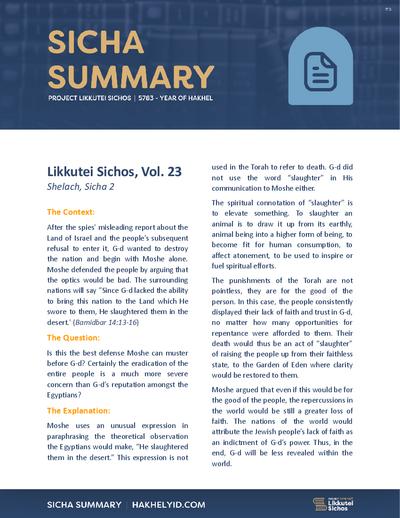

After the spies' misleading report about the Land of Israel and the people’s subsequent refusal to enter it, G-d wanted to destroy the nation and begin with Moshe alone. Moshe defended the people by arguing that the optics would be bad. The surrounding nations will say “Since G-d lacked the ability to bring this nation to the Land which He swore to them, He slaughtered them in the desert.' (Bamidbar 14:13-16)

The Question

Is this the best defense Moshe can muster before G-d? Certainly the eradication of the entire people is a much more severe concern than G-d’s reputation amongst the Egyptians?

The Explanation

Moshe uses an unusual expression in paraphrasing the theoretical observation the Egyptians would make, “He slaughtered them in the desert.” This expression is not used in the Torah to refer to death. G-d did not use the word “slaughter” in His communication to Moshe either.

The spiritual connotation of “slaughter” is to elevate something. To slaughter an animal is to draw it up from its earthly, animal being into a higher form of being, to become fit for human consumption, to affect atonement, to be used to inspire or fuel spiritual efforts.

The punishments of the Torah are not pointless, they are for the good of the person. In this case, the people consistently displayed their lack of faith and trust in G-d, no matter how many opportunities for repentance were afforded to them. Their death would thus be an act of “slaughter” of raising the people up from their faithless state, to the Garden of Eden where clarity would be restored to them.

Moshe argued that even if this would be for the good of the people, the repercussions in the world would be still a greater loss of faith. The nations of the world would attribute the Jewish people’s lack of faith as an indictment of G-d’s power. Thus, in the end, G-d will be less revealed within the world.

This explanation assumes that the spies and the generation of the desert were worthy of the World to Come, this aligns with the position of Rabbi Eliezer in the Talmud (Sanhedrin 110b). This is a lesson for how we are to view every Jew, that G-d is with them always, and they are worthy of the World to Come. As Moshe said in his defense, “You, G-d, are in the midst of this people...You appear to them eye to eye and that Your cloud rests over them.”

PDF Preview

