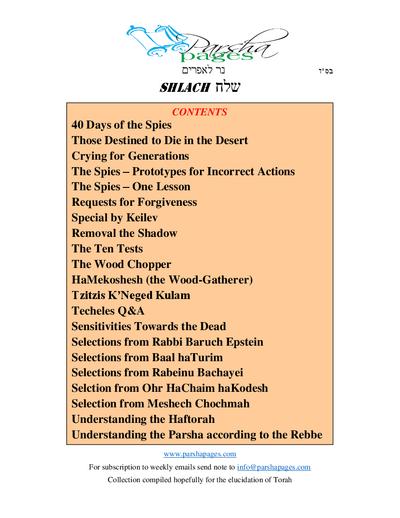
The Sensitivities of the Dead
The Sensitivities of the Dead עובר משום לועג לרש חרף עושהו
Berachos 18a-b
The Alter of Slabodka (brought in the המאורות ספר הגדולים) elaborates and derives a powerful lesson from our Gemara. The verse in Mishlei (17:5) states: “One who mocks a pauper insults his Maker.” The Gemara, and the poskim, rule that when walks within 4 amos of a grave, a person must hide his tzitzis. If he leaves them exposed, he is mocking the dead who can no longer fulfill the mitzvah of tzitzis.
Since the Mishnah Berurah is essentially a halachic work, one might be quite surprised to find in it a reference to the mystical concept of Gilgul Neshamos, (Reincarnation of Souls), as it pertains to one of the laws of Tzitzis, or ritual fringes, (a mitzvah that is mentioned in BeMidbar 15:37-41), and which contains powerful lessons for the living, and for the dead.
The Shulchan Aruch in Orach Chaim 23:1rules that it is forbidden for a person to walk into a cemetery, or within 4 cubits (approx. 7 feet) of a grave, with his Tzitzis sticking out. He can only enter if he tucks his tzitzis into his pants.
This Halachah, generally known as Lo’eg Larash, (Making Fun of the Dead, lit. “mocking the poor”), is based on a verse in Proverbs 17:5 in which King Solomon writes, “He who mocks a poor man blasphemes.” The poor person in the verse is referring to a dead person, whose soul is considered poor and disadvantaged in the sense that it no longer has a body with which to get around in this world and do Mitzvos and good deeds.
For example, one who flaunts his Tzitzis in front of a dead person in the cemetery, is teasing and mocking the dead man’s soul as if to say, “You can’t do this mitzvah anymore”, which causes the soul pain. Out of sensitivity for this poor soul, we tuck in our tzitzis when approaching a grave.
It is important to mention that this Halachah of Lo’eg Larash only applies around dead people who had this mitzvah obligation in their lifetimes, and who are now deprived of that opportunity. Therefore, it is permitted to keep one’s Tzitzis out when standing near the grave of a woman, since women are not commanded in this mitzvah.
The Mishnah Berurah discusses the Halachah with regard to the grave of a minor, i.e. a boy who died before his bar-mitzvah. He rules that even though this boy never had the obligation of Tzitzis in his own lifetime (as he died before becoming legally obligated in the commandments at 13 years old), there is a very likely possibility that he reached legal adulthood and became obligated in the mitzvah of Tzitzis in a previous incarnation, so that the law of Lo’eg Larash would still apply.
There are some important lessons to be learned from this Halachah. First, we see yet another display of the Torah’s incredible sensitivity to others, and not just towards those are alive but even to the dead. How fortunate are we that we have such a special Torah with such beautiful laws in it!
Second, we are reminded of the mystical concept of Reincarnation, which impacts this particular area of Halachah. The truth is, though, that the implications of Reincarnation are profound and far-reaching, well beyond the law of Lo’eg Larash.
After all, if our souls return to this world and reincarnate into different bodies, then it can only mean that our souls are our true essence and not our bodies, and then we should probably be spending at least as much time taking care of our souls’ needs as we do our bodies’ needs. And if we do have to come back again as reincarnated souls, it is likely because we have some flaw that we need to rectify in this world, and that is serious business.
A third lesson to be learned from the Halachah of Lo’eg Larash is that we can only perform Mitzvos when we still have our bodies, because once we die, we become poor and it is simply too late.
It is told that when the Vilna Gaon (1720-1797) was on his deathbed, he held his Tzitzis in his hand and wept. When his disciples asked why he was crying, he replied that he would soon be leaving a world in which a few kopeks would buy a mitzvah such as Tzitzis, and was heading for a world where a mitzvah could not be acquired for a million rubles.