Connection Between Shalosh Regalim and Establishing Judges
Parsha Pages | September 04, 2024
Print This Article
View Original PDF

Connection Between Shalosh Regalim and Establishing Judges

Parsha Pages | June 20, 2025

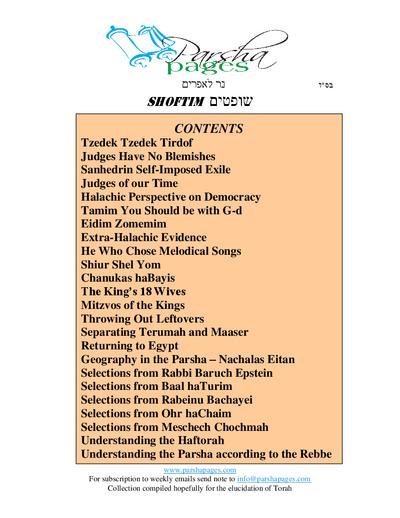
In the Maftir of Parashat Re’eih, last week’s Parashah, we find the Pasuk that we recite during Tefillat Mussaf of the Shalosh Regalim: “Shalosh Pe’amim BaShanah Yeira’eh Kol Zechurecha Et Penei Hashem Elokecha BaMakom Asher Yivchar,” “Three times in the year, every one of your males shall appear before Hashem, your God, in the place He will choose” (Devarim 16:16). Then, in the beginning of Parashat Shofetim, the Torah discusses establishing Shofetim and Shoterim, judges and officers, throughout Eretz Yisrael (16:18). What is the connection between the Shalosh Regalim and the establishing of Shofetim and Shoterim throughout Eretz Yisrael?

To answer this question, the Or HaChaim (ad loc. s.v. Shofetim) notes that during the Shalosh Regalim, when Jews go to Yerushalayim, everybody witnesses the Sanhedrin HaGadol. Because the Sanhedrin HaGadol is the ultimate court, it would be very tempting for Jews to simply rely on it for their cases and delay bringing matters for adjudication until the Shalosh Regalim. However, Hashem does not want Bnei Yisrael to postpone court cases until the Shalosh Regalim; therefore, He mandated that there be courts throughout all of Eretz Yisrael.

Perhaps, the underlying message of this point is that while being in Yerushalayim and witnessing Hashem’s glory and the Sanhedrin HaGadol is inspiring and religiously uplifting, that is not how life is meant to be lived. Day-to-day life does not consist of being directly in God’s presence and having the best court available to us; rather, we have Batei Kenesiyot and local courts to help us pray to Hashem and follow Halachah. So while the Shalosh Regalim and time spent in Yerushalayim may recharge us religiously, that is not meant to be our routine. Therefore, even though the Sanhedrin is the best court, Jewish communities need ordinary courts available to them year round.

The Torah states, “Judges and officers shall you appoint in all your cities...and they shall judge the people with righteous judgment (mishpat tzedek).” Ohr HaChaim HaKadosh explains this verse on an allusionary level, “King David writes in Psalms, ‘He will judge existence with righteousness (tzedek)....’ The Zohar tells us that the heavenly court is referred to as ‘tzedek (righteous). The Gemara tells us in Tractate Beitza that one’s yearly stipend is allocated by G’d from one Rosh Hashanah to the next. If there is a monetary dispute between two defendants and they come before the court, if the ruling of the Rabbinical court concurs with the heavenly court, it is a judgment of “tzedek (righteousness).” court’s ruling is correct and in conformance with the Torah, then the verdict will be allocation of funds will be in conformance with the allocate decreed by G’d on Rosh Hashanah. Thus, it is in conformance with the ruling of the heavenly court, which is referred to as “tzedek.” If however, the court rules in a manner that is not in conformance with the decree of the heavenly court, then G’d must compensate the individual in another manner. This is the reason a judge must have an exceptional level of proficiency and reverence when rendering a verdict because of his ruling is not righteous, it infringes upon G’d Himself.

Ch. 17, v. 1: "Lo sizbach ... asher y'h'yeh vo moom" - You shall not sacrifice .. which WILL HAVE a blemish - The Sifri 16:8 derives from the word "y'h'yeh," future form, that a blemish only disqualifies if it is a permanent one, one that will continue to exist. The Ohr Hachaim Hakodosh suggests that we can also derive that if an organ of the animal has a disorder that can only be rectified by amputation, although the disorder is not yet a blemish in its own right, nevertheless, since the only treatment is amputation, we consider it as if the amputation has already taken place, and the animal is disqualified.

In the Maftir of Parashat Re’eih, last week’s Parashah, we find the Pasuk that we recite during Tefillat Mussaf of the Shalosh Regalim: “Shalosh Pe’amim BaShanah Yeira’eh Kol Zechurecha Et Penei Hashem Elokecha BaMakom Asher Yivchar,” “Three times in the year, every one of your males shall appear before Hashem, your God, in the place He will choose” (Devarim 16:16). Then, in the beginning of Parashat Shofetim, the Torah discusses establishing Shofetim and Shoterim, judges and officers, throughout Eretz Yisrael (16:18). What is the connection between the Shalosh Regalim and the establishing of Shofetim and Shoterim throughout Eretz Yisrael?

To answer this question, the Or HaChaim (ad loc. s.v. Shofetim) notes that during the Shalosh Regalim, when Jews go to Yerushalayim, everybody witnesses the Sanhedrin HaGadol. Because the Sanhedrin HaGadol is the ultimate court, it would be very tempting for Jews to simply rely on it for their cases and delay bringing matters for adjudication until the Shalosh Regalim. However, Hashem does not want Bnei Yisrael to postpone court cases until the Shalosh Regalim; therefore, He mandated that there be courts throughout all of Eretz Yisrael.

Perhaps, the underlying message of this point is that while being in Yerushalayim and witnessing Hashem’s glory and the Sanhedrin HaGadol is inspiring and religiously uplifting, that is not how life is meant to be lived. Day-to-day life does not consist of being directly in God’s presence and having the best court available to us; rather, we have Batei Kenesiyot and local courts to help us pray to Hashem and follow Halachah. So while the Shalosh Regalim and time spent in Yerushalayim may recharge us religiously, that is not meant to be our routine. Therefore, even though the Sanhedrin is the best court, Jewish communities need ordinary courts available to them year round.

The Torah states, “Judges and officers shall you appoint in all your cities...and they shall judge the people with righteous judgment (mishpat tzedek).” Ohr HaChaim HaKadosh explains this verse on an allusionary level, “King David writes in Psalms, ‘He will judge existence with righteousness (tzedek)....’ The Zohar tells us that the heavenly court is referred to as ‘tzedek (righteous). The Gemara tells us in Tractate Beitza that one’s yearly stipend is allocated by G’d from one Rosh Hashanah to the next. If there is a monetary dispute between two defendants and they come before the court, if the ruling of the Rabbinical court concurs with the heavenly court, it is a judgment of “tzedek (righteousness).” court’s ruling is correct and in conformance with the Torah, then the verdict will be allocation of funds will be in conformance with the allocate decreed by G’d on Rosh Hashanah. Thus, it is in conformance with the ruling of the heavenly court, which is referred to as “tzedek.” If however, the court rules in a manner that is not in conformance with the decree of the heavenly court, then G’d must compensate the individual in another manner. This is the reason a judge must have an exceptional level of proficiency and reverence when rendering a verdict because of his ruling is not righteous, it infringes upon G’d Himself.

Ch. 17, v. 1: "Lo sizbach ... asher y'h'yeh vo moom" - You shall not sacrifice .. which WILL HAVE a blemish - The Sifri 16:8 derives from the word "y'h'yeh," future form, that a blemish only disqualifies if it is a permanent one, one that will continue to exist. The Ohr Hachaim Hakodosh suggests that we can also derive that if an organ of the animal has a disorder that can only be rectified by amputation, although the disorder is not yet a blemish in its own right, nevertheless, since the only treatment is amputation, we consider it as if the amputation has already taken place, and the animal is disqualified.

PDF Preview


