Do You Think Your Money is Yours
Gan Hatorah | August 13, 2023
Print This Article
View Original PDF

Do You Think Your Money is Yours

Gan Hatorah | December 31, 2025

16:20 “צדק צדק תרדף, למען תחיה וירשת את הארץ אשר ד' אלקיך נתן לך”
“Justice, justice shall you pursue, so that you may live and take possession of the land which Hashem, your G-d, is giving you.” What is the connection between pursuing righteousness, and inheriting the Land that Hakodosh Boruch Hu is giving us?

15:7 “כי יהיה בך אביון מאחד אחיך באחד שעריך בארצך אשר ד' אלקיך נתן לך, לא תאמץ את לבבך ולא תקפץ את ידך מאחיך האביון” – “If there shall be a destitute person among you, any of your brethren in any of your cities, in your Land that Hashem, your G-d, gives you, you shall not harden your heart or close your hand against your destitute brother.” Why does the Posuk say, “באחד שעריך ” – in one of your cities, when it already told you that if you have a destitute person who is your brother? Additionally, why does the Posuk then go on to say, “בארצך” – “In your land” – which sounds like this Mitzvah is only relevant in the Land of Eretz Yisroel, when we know that it applies even to Chutz La’aretz?

Story – There was a poor person who went door to door collecting money. He walked into a wealthy person’s home, a place where the floors were clean and shiny, and due to the mud and dirt on his shoes, he tracked up the entire beautiful floor. The owner became enraged at the pauper for ruining his beautiful floors, and slapped him across the face. The wealthy man said to the pauper: Leave, you despicable person, from my house immediately, for you dirtied my floors. The wealthy man commanded his servants to remove this pauper from his home immediately. The poor man pleaded with the wealthy individual to allow him to stay for a few minutes so that he can speak to him, and then he will leave peacefully. The wealthy man said to him: speak. The pauper spoke: Every day we recite praise to Hakodosh Boruch Hu in, “ברוך שאמר” and we say, “ברוך מרחם על הארץ, ברוך מרחם על הבריות” – “Blessed is He Who has mercy on the earth, blessed is He who has mercy on the creatures.” We are praising Hakodosh Boruch Hu that He has mercy on the earth and on living creatures. Chazal tell us that we must learn from Hakodosh Boruch Hu, and just as He is merciful, so too we must be merciful. We see from what we are praising Him, that we must have mercy on the earth and on the creatures. I see that you are learning from Hakodosh Boruch Hu, and you have mercy on the earth, as I see how it pained you so that I dirtied your floor. So much so, that you cursed me and hit me because of it. However, you also need to follow the second part from Hakodosh Boruch Hu, and have mercy on the creatures. When you see me, poor and destitute, in desperate need of food and clothes, you should have mercy on me, and provide for me. The wealthy man was embarrassed from the words of this pauper, and gave him what he needed. Hakodosh Boruch Hu gave the wealthy man good land, good fields, and a nice place to live. He takes good care of all of it, and has mercy on it, and he should certainly have mercy on Hakodosh Boruch Hu’s creations – specifically, to his fellow brothers.

There are two types of poor people. One type you can’t tell by looking at them that they are poor, that which he is lacking can only be seen in private, in his home. Then there are poor which is apparent to all that they are destitute, as they go door to door, and all can see that they are severely lacking. “כי יהי ה בך אביון מאחד אחיך” – If you see a fellow Yid who is destitute, one who is like you in his righteousness and his morality, but his Mazel is not good, and he needs to go from door to door, “באחד שעריך” – to ask you for money, and you see that which he is lacking – at that time you should think, “בארצך אשר ד' אלקיך נתן לך ” – how you have so much Rachmanus on your land and all that Hashem gave to you, then, “לא תאמץ את לבבך ולא תקפץ את ידך מאחיך האביון” – You will not end up hardening your heart, or closing your fists to the poor, for you will say that just as Hakodosh Boruch Hu has mercy, so too must I. (עוד יוסף חי )

Chazal say that Tzedakah is great, as it brings the Geulah closer. This is what the Posuk is alluding to here, as the Gematria of, “למען” is the same as, “קץ” – the end – the time of the Geulah – for in the Zechus of Tzedakah, the end – the Geulah will come. “וירשת את הארץ” And Klal Yisroel will receive the Land that is theirs, and the crown will return to its former glory. (נחל קדומים)

Elul

Koheles 7:28 “אדם אחד מאלף מצאתי, ואשה בכל אלה לא מצאתי ” – “I found only one human being in a thousand, and the one I found among so many was never a woman.” The month of Elul is a time for Teshuva; it is a time of acceptance of those who do return to Hakodosh Boruch Hu. Mishlei 18:22 “מצא אשה מצא טוב, ויפק רצון ד'” – “He who finds a wife has found happiness, and has won the favor of Hashem.” The B’nei Yissoschor says on this Posuk, “מצא אשה” – refers to Chodesh Elul; “מצא טוב” – this refers to the second Luchos, as it says in the Posuk in Devorim 5:15 “למען ייטב לך” – so that it will be good for you – Hakodosh Boruch Hu wanted to give Moshe the second Luchos. The Chet of the Eigel was in the month of Tamuz, which caused the first Luchos to be broken. In the month of Elul, Hakodosh Boruch Hu had a desire to give Klal Yisroel the second Luchos, which was due to the Teshuva that Klal Yisroel did for the sin of the Eigel. This is what the Posuk in Koheles is alluding to, “אדם אחד מאלף מצאתי ” – as “אדם” is a reference to the Koach of Teshuva. If you consider the א' of אדם as a thousand, as is known, then the Gematria of, “אדם” is equal to the words, “ימינך פשוטה לקבל שבים” – “For Your (Hakodosh Boruch Hu’s) right hand is extended to accept those who return.” This is in the month of Elul, when Hakodosh Boruch Hu has a great desire for Klal Yisroel to return to Him, and His hand is extended to those who return. Devorim 4:29 “ובקשתם משם את ד' אלקיך ומצאת ” – “If you search there for Hashem, you will find Him.” “ואשה” is the Mazal of a Besulah, which represents there will be a marriage – a connecting between man and Hakodosh Boruch Hu. “בכל אלה לא” – the words, “אלה לא ” is the same Gematria as “אלול”. “מצאתי ” – If one seeks to connect to Hakodosh Boruch Hu, the month of Elul is a month that he will find Him. The Chet of the Eigel was with, “אלה” as the Posuk says, “אלה אלקיך ישראל ” and Chazal Darshen, “גם אלה תשכחנה” – that this refers to Klal Yisroel forgetting Hakodosh Boruch Hu. It says here in Koheles, “אלה לא” – if one will seek out Hakodosh Boruch Hu during the month of Elul, then, “אלה לא ” – there will no longer be, “אלה” – the Chet of the Eigel will no longer be here, and then Hakodosh Boruch Hu will have a desire to give the second Luchos. (ישא ברכה)

It is the month of Elul, a time to reflect on what this world is all about. Why are we here and what is our purpose? Do we really think that the money we have is ours? Do we think that the talents that we were given are ours? We must know without a doubt that it is all Hakodosh Boruch Hu’s. When we give money to the poor, it is Hakodosh Boruch Hu’s money that we are giving away. If we will do the proper Avodah of Elul, and do a proper Teshuva, then we will be prepared for the Yemei Hadin. We will be Zoche to Olam Habah, as well as to the holy Land of Eretz Yisroel down here in this world. May we be Zoche to do a proper Teshuva and be Zoche to see the Geulah Shlaima, and a כתיבה וחתימה טובה.
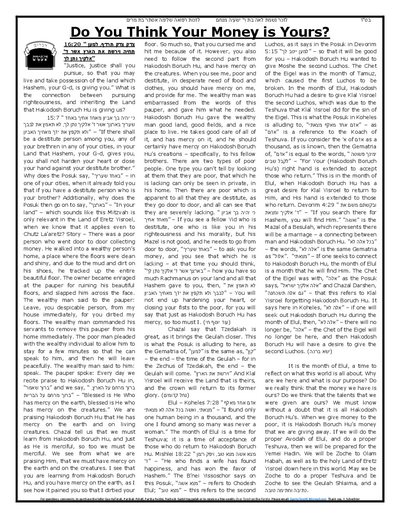
16:20 “צדק צדק תרדף, למען תחיה וירשת את הארץ אשר ד' אלקיך נתן לך”
“Justice, justice shall you pursue, so that you may live and take possession of the land which Hashem, your G-d, is giving you.” What is the connection between pursuing righteousness, and inheriting the Land that Hakodosh Boruch Hu is giving us?

15:7 “כי יהיה בך אביון מאחד אחיך באחד שעריך בארצך אשר ד' אלקיך נתן לך, לא תאמץ את לבבך ולא תקפץ את ידך מאחיך האביון” – “If there shall be a destitute person among you, any of your brethren in any of your cities, in your Land that Hashem, your G-d, gives you, you shall not harden your heart or close your hand against your destitute brother.” Why does the Posuk say, “באחד שעריך ” – in one of your cities, when it already told you that if you have a destitute person who is your brother? Additionally, why does the Posuk then go on to say, “בארצך” – “In your land” – which sounds like this Mitzvah is only relevant in the Land of Eretz Yisroel, when we know that it applies even to Chutz La’aretz?

Story – There was a poor person who went door to door collecting money. He walked into a wealthy person’s home, a place where the floors were clean and shiny, and due to the mud and dirt on his shoes, he tracked up the entire beautiful floor. The owner became enraged at the pauper for ruining his beautiful floors, and slapped him across the face. The wealthy man said to the pauper: Leave, you despicable person, from my house immediately, for you dirtied my floors. The wealthy man commanded his servants to remove this pauper from his home immediately. The poor man pleaded with the wealthy individual to allow him to stay for a few minutes so that he can speak to him, and then he will leave peacefully. The wealthy man said to him: speak. The pauper spoke: Every day we recite praise to Hakodosh Boruch Hu in, “ברוך שאמר” and we say, “ברוך מרחם על הארץ, ברוך מרחם על הבריות” – “Blessed is He Who has mercy on the earth, blessed is He who has mercy on the creatures.” We are praising Hakodosh Boruch Hu that He has mercy on the earth and on living creatures. Chazal tell us that we must learn from Hakodosh Boruch Hu, and just as He is merciful, so too we must be merciful. We see from what we are praising Him, that we must have mercy on the earth and on the creatures. I see that you are learning from Hakodosh Boruch Hu, and you have mercy on the earth, as I see how it pained you so that I dirtied your floor. So much so, that you cursed me and hit me because of it. However, you also need to follow the second part from Hakodosh Boruch Hu, and have mercy on the creatures. When you see me, poor and destitute, in desperate need of food and clothes, you should have mercy on me, and provide for me. The wealthy man was embarrassed from the words of this pauper, and gave him what he needed. Hakodosh Boruch Hu gave the wealthy man good land, good fields, and a nice place to live. He takes good care of all of it, and has mercy on it, and he should certainly have mercy on Hakodosh Boruch Hu’s creations – specifically, to his fellow brothers.

There are two types of poor people. One type you can’t tell by looking at them that they are poor, that which he is lacking can only be seen in private, in his home. Then there are poor which is apparent to all that they are destitute, as they go door to door, and all can see that they are severely lacking. “כי יהי ה בך אביון מאחד אחיך” – If you see a fellow Yid who is destitute, one who is like you in his righteousness and his morality, but his Mazel is not good, and he needs to go from door to door, “באחד שעריך” – to ask you for money, and you see that which he is lacking – at that time you should think, “בארצך אשר ד' אלקיך נתן לך ” – how you have so much Rachmanus on your land and all that Hashem gave to you, then, “לא תאמץ את לבבך ולא תקפץ את ידך מאחיך האביון” – You will not end up hardening your heart, or closing your fists to the poor, for you will say that just as Hakodosh Boruch Hu has mercy, so too must I. (עוד יוסף חי )

Chazal say that Tzedakah is great, as it brings the Geulah closer. This is what the Posuk is alluding to here, as the Gematria of, “למען” is the same as, “קץ” – the end – the time of the Geulah – for in the Zechus of Tzedakah, the end – the Geulah will come. “וירשת את הארץ” And Klal Yisroel will receive the Land that is theirs, and the crown will return to its former glory. (נחל קדומים)

Elul

Koheles 7:28 “אדם אחד מאלף מצאתי, ואשה בכל אלה לא מצאתי ” – “I found only one human being in a thousand, and the one I found among so many was never a woman.” The month of Elul is a time for Teshuva; it is a time of acceptance of those who do return to Hakodosh Boruch Hu. Mishlei 18:22 “מצא אשה מצא טוב, ויפק רצון ד'” – “He who finds a wife has found happiness, and has won the favor of Hashem.” The B’nei Yissoschor says on this Posuk, “מצא אשה” – refers to Chodesh Elul; “מצא טוב” – this refers to the second Luchos, as it says in the Posuk in Devorim 5:15 “למען ייטב לך” – so that it will be good for you – Hakodosh Boruch Hu wanted to give Moshe the second Luchos. The Chet of the Eigel was in the month of Tamuz, which caused the first Luchos to be broken. In the month of Elul, Hakodosh Boruch Hu had a desire to give Klal Yisroel the second Luchos, which was due to the Teshuva that Klal Yisroel did for the sin of the Eigel. This is what the Posuk in Koheles is alluding to, “אדם אחד מאלף מצאתי ” – as “אדם” is a reference to the Koach of Teshuva. If you consider the א' of אדם as a thousand, as is known, then the Gematria of, “אדם” is equal to the words, “ימינך פשוטה לקבל שבים” – “For Your (Hakodosh Boruch Hu’s) right hand is extended to accept those who return.” This is in the month of Elul, when Hakodosh Boruch Hu has a great desire for Klal Yisroel to return to Him, and His hand is extended to those who return. Devorim 4:29 “ובקשתם משם את ד' אלקיך ומצאת ” – “If you search there for Hashem, you will find Him.” “ואשה” is the Mazal of a Besulah, which represents there will be a marriage – a connecting between man and Hakodosh Boruch Hu. “בכל אלה לא” – the words, “אלה לא ” is the same Gematria as “אלול”. “מצאתי ” – If one seeks to connect to Hakodosh Boruch Hu, the month of Elul is a month that he will find Him. The Chet of the Eigel was with, “אלה” as the Posuk says, “אלה אלקיך ישראל ” and Chazal Darshen, “גם אלה תשכחנה” – that this refers to Klal Yisroel forgetting Hakodosh Boruch Hu. It says here in Koheles, “אלה לא” – if one will seek out Hakodosh Boruch Hu during the month of Elul, then, “אלה לא ” – there will no longer be, “אלה” – the Chet of the Eigel will no longer be here, and then Hakodosh Boruch Hu will have a desire to give the second Luchos. (ישא ברכה)

It is the month of Elul, a time to reflect on what this world is all about. Why are we here and what is our purpose? Do we really think that the money we have is ours? Do we think that the talents that we were given are ours? We must know without a doubt that it is all Hakodosh Boruch Hu’s. When we give money to the poor, it is Hakodosh Boruch Hu’s money that we are giving away. If we will do the proper Avodah of Elul, and do a proper Teshuva, then we will be prepared for the Yemei Hadin. We will be Zoche to Olam Habah, as well as to the holy Land of Eretz Yisroel down here in this world. May we be Zoche to do a proper Teshuva and be Zoche to see the Geulah Shlaima, and a כתיבה וחתימה טובה.

PDF Preview