Eating In a Place Where It Is Normal to Eat
Limuday Moshe | September 04, 2024
Print This Article
View Original PDF

Eating In a Place Where It Is Normal to Eat

Limuday Moshe | June 20, 2025

The Shu”t Siach Yitzchok (479) writes: If many people gather together to eat in the marketplace there is no concern. He basis himself on the Gemara in Berachos (42b) which relates, that when Rav passed away, his talmidim went to the leveyah [funeral]. When they returned they said: ניזל ניכל לחמא אנהר דנק - “Let’s go and eat bread by the river Denak”.

However, he subsequently retracts from this proof, as there is a big difference between gathering together in a marketplace and travelling on the road and stopping off, and the talmidim of Rav were travelling on the road.

The truth is, the prohibition of eating in the marketplace is because it’s not normal to eat there, and if one does, he is degrading himself and showing a lack of self-respect. If, however, one eats in a place which is normal to eat, then there is no lack of self-respect. Therefore, if one eats by the picnic area in the park, or my benches near the seaside, there is no problem.

Therefore, in the case of the chasunah, which is being held in a big garden with chairs and tables set up, it would seem that there is no problem to eat there.

Incredible Story With the Shoel U’Meishiv

The Shu”t Mishneh Halachos (15:62) brings an incredible story which he heard from the Shoel U’Meishiv:

There was a certain big sale taking place, and the Shoel U’Meishiv who lived nearby opened his window to see what was going on. When looking out the window, he saw a certain person in the marketplace, and he called him to come inside. He asked him where he was from, and he said he was from Krakow. The Shoel U’Meishiv then asked him if he knew the Rov of Krakow and he said “yes”. The Shoel U’Meishiv said, if so, would you please be able to give him a letter on my behalf. The person replied that he was more than happy to do so. The Shoel U’Meishiv then added, that there was one condition attached – he wasn’t allowed to open the letter. The person happily accepted. The Shoel U’Meishiv gave him the letter and he went back to the marketplace. All his friend asked him what connection he had with the Shoel U’Meishiv and he haughtily said, “What do you mean, I am more superior than all of you, see, I can just go in and out of the Shoel U’Meishiv’s house. And not only that, he gave me a letter to take to the Rov of Krakow, and there also I go in and out.” The friends were all jealous, and this person was on cloud nine.

They came to Krakow, and this person went straight to the Rov. He told him that he has an important letter from the Shoel U’Meishiv. The Rov of Krakow who knew this particular individual thought that it was strange that the Shoel U’Meishiv would have sent a letter with him, however, he thought that perhaps due to the urgency of the issue the Shoel U’Meishiv sent it with the first person he could find. The Rov of Krakow quickly opened the letter and inside it read: “In honor of my dear friend, the Gaon of Krakow. To avoid causing anyone to stumble, I am writing to tell you that the carrier of this letter was seen eating in the street, therefore, he is disqualified from giving any testimony. Signed, the Shoel U’Meishiv.”

But Everyone Else Does It?

Nowadays most of the world eats in the street, however it doesn’t make a difference. If most of the world steals, does it become allowed? If one steals even less than a perutah, and he does it constantly he is disqualified from giving testimony. If the streets and marketplaces are full of greedy people who have no self-control and eat on the street, such as in New York and the like, it doesn’t make it better. One who copies still degrades himself and shows a lack of self-respect. If more people do it, it just means that there are more disqualified people out there.

The Gemara in Ta’anis (22a) relates how Rav Broka Chuzah would often walk through the marketplace. One time he met Eliyohu HaNavi and he asked him: איכא בהאי שוקא בר עלמא דאתי - “Is there anyone here, fitting for the next world” and they struggled to find anyone. Rav Broka frequented the marketplace and he struggled to find anyone, and that was in those days, imagine what would be if he was alive today walking through the marketplaces of New York and Paris and even Yerusholayim.

The HiGyonei HaParsha (R’ Aryeh Dovid Wasserman) writes that he saw in a certain sefer written by one of the Achronim a limud zechus [validation] for what goes on today. This sefer writes, today the custom is to be זולל וסובא, therefore, doing so is כבוד ולא בזיון. I.e. today people act in an undignified manner, therefore, it’s honourable and respectful to act accordingly. Understandably so, R’ Wasserman writes that it’s obvious that such an argument is heavily floored and he concludes: ויהי רצון שנזכה לקדש שמו באכילה ושתיה ולא נהיה נגררים חס ושלום אחרי זוללי בשר וסיבאי יין – “May it be His will, that we merit to sanctify Hashems name with our eating and drinking, and not to get dragged down G-d forbid, after those people that run after meat and wine”.

At this point, it’s worth mentioning the words of the Noam Elimelech (Chukas, d.h. vaykichu eilecha) the pasuk says: ועשי ת לו זר זהב סביב – “You shall make for it, a golden crown around its top”. The Noam Elimelech explains: “A tzaddik eats with kedusha and taharah, and with holy thoughts, if possible, he would avoid eating all together. Tzadikim eat in private as they are embarrassed that they must eat, ideally, they want to the be like malochim who don’t need to eat. However, because it’s impossible, they make a זר זהב סביב, i.e. they make sure to eat with tremendous kedusha.

Based on the above, the Mishneh Halachos explains a diyuk in the first Mishnah in Shas. The Mishnah says: מאימתי קורי ן את שמע בערבית משעה שהכהנים נכנסים לאכול בתרומתן - “From when do we read the night time shema, from the time kohanim enter to eat their terumah”. Everyone asks: What is the Mishnah adding with the word נכנסין, where did the kohanim go out from that they needed to enter? The Mishnah should have simply said “from the time kohanim eat terumah”, or “from the time kohanim are allowed to eat terumah”? Based on the above, however, we can understand the Mishnah very well. Kohanim are tzadikim and holy people, and כשנכנסו לאכול תרו מה נכנסים לאכול בסתר – “when they go to eat terumah, they go into a private room and eat in private”.

Children Eating on The Way to School

R’ Yom Tov Sanger (vol. 2, Yoreh De’ah 58) points out, that many people send their children to school before they have eaten breakfast, and they eat cake and biscuits on the street on the way to school. Besides for the chinuch aspect of Hilchos Berachos, the idea that they are being taught to eat on the street at such a young age, is not fitting for a family of Bnei Torah, who are trying to bring up their children to be talmiday chachomim and the next gedolei hador.

(Both this week and last week’s halachah section is mostly based on a write-up from R’ Aryeh Dovid Wasserman, in HiGyonei HaParsha)
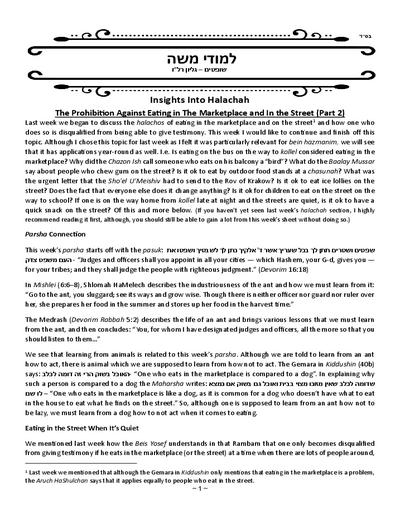
The Shu”t Siach Yitzchok (479) writes: If many people gather together to eat in the marketplace there is no concern. He basis himself on the Gemara in Berachos (42b) which relates, that when Rav passed away, his talmidim went to the leveyah [funeral]. When they returned they said: ניזל ניכל לחמא אנהר דנק - “Let’s go and eat bread by the river Denak”.

However, he subsequently retracts from this proof, as there is a big difference between gathering together in a marketplace and travelling on the road and stopping off, and the talmidim of Rav were travelling on the road.

The truth is, the prohibition of eating in the marketplace is because it’s not normal to eat there, and if one does, he is degrading himself and showing a lack of self-respect. If, however, one eats in a place which is normal to eat, then there is no lack of self-respect. Therefore, if one eats by the picnic area in the park, or my benches near the seaside, there is no problem.

Therefore, in the case of the chasunah, which is being held in a big garden with chairs and tables set up, it would seem that there is no problem to eat there.

Incredible Story With the Shoel U’Meishiv

The Shu”t Mishneh Halachos (15:62) brings an incredible story which he heard from the Shoel U’Meishiv:

There was a certain big sale taking place, and the Shoel U’Meishiv who lived nearby opened his window to see what was going on. When looking out the window, he saw a certain person in the marketplace, and he called him to come inside. He asked him where he was from, and he said he was from Krakow. The Shoel U’Meishiv then asked him if he knew the Rov of Krakow and he said “yes”. The Shoel U’Meishiv said, if so, would you please be able to give him a letter on my behalf. The person replied that he was more than happy to do so. The Shoel U’Meishiv then added, that there was one condition attached – he wasn’t allowed to open the letter. The person happily accepted. The Shoel U’Meishiv gave him the letter and he went back to the marketplace. All his friend asked him what connection he had with the Shoel U’Meishiv and he haughtily said, “What do you mean, I am more superior than all of you, see, I can just go in and out of the Shoel U’Meishiv’s house. And not only that, he gave me a letter to take to the Rov of Krakow, and there also I go in and out.” The friends were all jealous, and this person was on cloud nine.

They came to Krakow, and this person went straight to the Rov. He told him that he has an important letter from the Shoel U’Meishiv. The Rov of Krakow who knew this particular individual thought that it was strange that the Shoel U’Meishiv would have sent a letter with him, however, he thought that perhaps due to the urgency of the issue the Shoel U’Meishiv sent it with the first person he could find. The Rov of Krakow quickly opened the letter and inside it read: “In honor of my dear friend, the Gaon of Krakow. To avoid causing anyone to stumble, I am writing to tell you that the carrier of this letter was seen eating in the street, therefore, he is disqualified from giving any testimony. Signed, the Shoel U’Meishiv.”

But Everyone Else Does It?

Nowadays most of the world eats in the street, however it doesn’t make a difference. If most of the world steals, does it become allowed? If one steals even less than a perutah, and he does it constantly he is disqualified from giving testimony. If the streets and marketplaces are full of greedy people who have no self-control and eat on the street, such as in New York and the like, it doesn’t make it better. One who copies still degrades himself and shows a lack of self-respect. If more people do it, it just means that there are more disqualified people out there.

The Gemara in Ta’anis (22a) relates how Rav Broka Chuzah would often walk through the marketplace. One time he met Eliyohu HaNavi and he asked him: איכא בהאי שוקא בר עלמא דאתי - “Is there anyone here, fitting for the next world” and they struggled to find anyone. Rav Broka frequented the marketplace and he struggled to find anyone, and that was in those days, imagine what would be if he was alive today walking through the marketplaces of New York and Paris and even Yerusholayim.

The HiGyonei HaParsha (R’ Aryeh Dovid Wasserman) writes that he saw in a certain sefer written by one of the Achronim a limud zechus [validation] for what goes on today. This sefer writes, today the custom is to be זולל וסובא, therefore, doing so is כבוד ולא בזיון. I.e. today people act in an undignified manner, therefore, it’s honourable and respectful to act accordingly. Understandably so, R’ Wasserman writes that it’s obvious that such an argument is heavily floored and he concludes: ויהי רצון שנזכה לקדש שמו באכילה ושתיה ולא נהיה נגררים חס ושלום אחרי זוללי בשר וסיבאי יין – “May it be His will, that we merit to sanctify Hashems name with our eating and drinking, and not to get dragged down G-d forbid, after those people that run after meat and wine”.

At this point, it’s worth mentioning the words of the Noam Elimelech (Chukas, d.h. vaykichu eilecha) the pasuk says: ועשי ת לו זר זהב סביב – “You shall make for it, a golden crown around its top”. The Noam Elimelech explains: “A tzaddik eats with kedusha and taharah, and with holy thoughts, if possible, he would avoid eating all together. Tzadikim eat in private as they are embarrassed that they must eat, ideally, they want to the be like malochim who don’t need to eat. However, because it’s impossible, they make a זר זהב סביב, i.e. they make sure to eat with tremendous kedusha.

Based on the above, the Mishneh Halachos explains a diyuk in the first Mishnah in Shas. The Mishnah says: מאימתי קורי ן את שמע בערבית משעה שהכהנים נכנסים לאכול בתרומתן - “From when do we read the night time shema, from the time kohanim enter to eat their terumah”. Everyone asks: What is the Mishnah adding with the word נכנסין, where did the kohanim go out from that they needed to enter? The Mishnah should have simply said “from the time kohanim eat terumah”, or “from the time kohanim are allowed to eat terumah”? Based on the above, however, we can understand the Mishnah very well. Kohanim are tzadikim and holy people, and כשנכנסו לאכול תרו מה נכנסים לאכול בסתר – “when they go to eat terumah, they go into a private room and eat in private”.

Children Eating on The Way to School

R’ Yom Tov Sanger (vol. 2, Yoreh De’ah 58) points out, that many people send their children to school before they have eaten breakfast, and they eat cake and biscuits on the street on the way to school. Besides for the chinuch aspect of Hilchos Berachos, the idea that they are being taught to eat on the street at such a young age, is not fitting for a family of Bnei Torah, who are trying to bring up their children to be talmiday chachomim and the next gedolei hador.

(Both this week and last week’s halachah section is mostly based on a write-up from R’ Aryeh Dovid Wasserman, in HiGyonei HaParsha)

PDF Preview