Heart of Fire
Print This Article
View Original PDF

Heart of Fire

Chayus | June 27, 2025

An angel of G-d appeared to him in a flame of fire from within the thorn bush, and behold, the thorn bush was burning with fire, but the thorn bush was not being consumed (Shemos 3:2).

The Torah compares mortals to trees, but there are various kinds of trees. A Torah scholar is a fruit-bearing tree. A thorn bush represents those lacking any spiritual achievement.

Torah scholars are aflame with Divine fire, because the Torah is spiritual fire, but it can easily burn itself out when their passion for G-dliness is quenched by the satisfaction of spiritual accomplishments due to the novel Torah insights they uncover.

By contrast, the passionate thirst for G-dliness experienced by ordinary, unlearned Jews is compared to the fire in the thorn bush that is never consumed. The Torah describes it as labat eish, “a flame of fire,” but labat comes from the word leiv, heart. Ordinary Jews have hearts of fire; their sincere and simple prayers and recital of Psalms—despite their unfamiliarity with the meaning of the phrases they recite—flow forth with pure and uncomplicated faith. Their hearts of fire are never consumed, meaning that their passion never wavers, because they lack the satisfaction of spiritual accomplishments that the Torah scholars enjoy. Instead, they are constantly aflame with yearning for G-dliness, for Torah and mitzvot.

Focus: G-d seeks a passionate relationship with you.
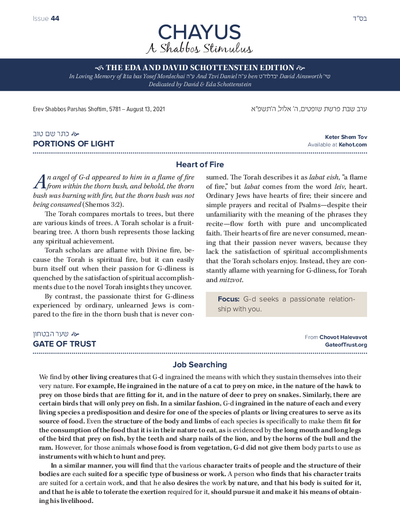
An angel of G-d appeared to him in a flame of fire from within the thorn bush, and behold, the thorn bush was burning with fire, but the thorn bush was not being consumed (Shemos 3:2).

The Torah compares mortals to trees, but there are various kinds of trees. A Torah scholar is a fruit-bearing tree. A thorn bush represents those lacking any spiritual achievement.

Torah scholars are aflame with Divine fire, because the Torah is spiritual fire, but it can easily burn itself out when their passion for G-dliness is quenched by the satisfaction of spiritual accomplishments due to the novel Torah insights they uncover.

By contrast, the passionate thirst for G-dliness experienced by ordinary, unlearned Jews is compared to the fire in the thorn bush that is never consumed. The Torah describes it as labat eish, “a flame of fire,” but labat comes from the word leiv, heart. Ordinary Jews have hearts of fire; their sincere and simple prayers and recital of Psalms—despite their unfamiliarity with the meaning of the phrases they recite—flow forth with pure and uncomplicated faith. Their hearts of fire are never consumed, meaning that their passion never wavers, because they lack the satisfaction of spiritual accomplishments that the Torah scholars enjoy. Instead, they are constantly aflame with yearning for G-dliness, for Torah and mitzvot.

Focus: G-d seeks a passionate relationship with you.

PDF Preview