Riddles of the Week Part 1
למודי משה | August 28, 2025
Riddles of the Week (Part 1)
(For answers see below pg. 25 and on)
- In this week’s parsha we learn that it is forbidden for a dayan [judge] to take a bribe (Devorim 16:19). What’s the halachah if one has a din Torah in front of a particular rav, and some time before the din Torah the one going to court is davening for the amud, is it ok for him to wait for the rav before starting chazoras hashatz, or would this perhaps be considered shochad [bribery]?
- In this week’s parsha we have the commandment: שום תשים עליך מלך – “You shall place over yourself a king” (17:15). The Gemara in Ta’anis (17a) teaches: A king must have a haircut every single day, what is the reason? Because it says in the pasuk: מלך ביפיו תחזינה עיניך – “A king in his beauty, he shall appear to your eyes.” (Yeshayohu 33) The Taz (Orach Chaim 260, s.k. 1) in the name of the Maharshal brings that one shouldn’t cut his nails on Thursday. The Taz then brings: I heard that the reason is, because it is the way of cut hair and nails to start growing back after three days, and we want to avoid this happening on Shabbos, therefore, for the same reason one shouldn’t cut his hair on Thursday either. The Machatzis HaShekel and the Elyah Rabbah explain: Since for kavod Shabbos one shortens his hair and nails, it’s not fitting and nice, that exactly on the day of Shabbos itself, they start to regrow.” The question is, from the Gemara which teaches that a king has a haircut every single day, it would seem hair grows back every single day, so why does the Taz say it takes three days? (The Shulchan Aruch HaRav, Kuntros Achron, Orach Chaim 260 asks this)
- The Mishnah in Yoma (73b) teaches that a king is allowed to wash his face even on Yom Kippur. The Gemara explains, this is due to concept we mentioned above: מלך ביפיו תחזינה עיניך – “A king in his beauty, he shall appear to your eyes.” (Yeshayohu 33). The question is, why don’t we find that a king is allowed to wear shoes on Yom Kippur as well, surely this should be included in מלך ביפיו תחזינה עיניך ?
- In this week’s parsha we learn about how Klal Yisroel go out to war. When deciding who should go out to fight, the pasuk says that they would announce:מי האיש הירא ורך הלבב ילך וישוב אל ביתו – “Anyone who is fearful and faint hearted should return home” (20:8). The Gemara in Sotah (44b) brings a machlokes who this pasuk refers to, R’ Akiva learns simply that if one is scared of the sword he may return home, however, R’ Yosi HaGlili learns that it means one who is scared מעבירות שבידו – from the sins in his hand.
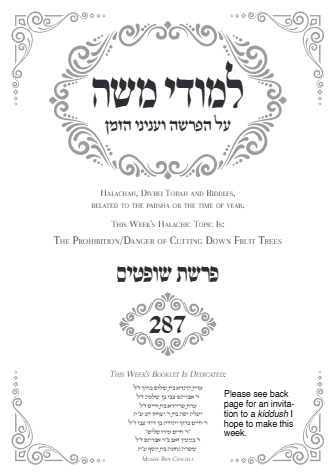
View The Full Article (PDF)
Related Articles

Bris Timing
The Weekly Farbrengen • Tazria-Metzora

Why Is Going to Listen to the Reading of the Megillah Considered Bitul Torah
למודי משה • Tetzaveh

Is It Permitted to Use the Name 'Amalek' for Torah Purposes
למודי משה • Tetzaveh

Summary of the Dinim That Come Out
למודי משה • Tetzaveh

Lying About Not Knowing the Difference Between Arur Haman and Baruch Mordechai
למודי משה • Tetzaveh