The virtue of learning Mussar
טיב הקהילה English | August 29, 2025
Print This Article
View Original PDF

The virtue of learning Mussar

טיב הקהילה English | December 10, 2025

וְהָיְתָה עִמּוֹ וְקָרָא בוֹ כָּל יְמֵי חַיָּיו לְמַעַן יִלְמַד לְיִרְאָה אֶת ה’ אֱלֹקָיו לִשְׁמֹר אֶת כָּל דִּבְרֵי הַתּוֹרָה הַזֹּאת וְאֶת הַחֻקִּים הָאֵלֶּה לַעֲשׂתָם: (יז, יט)
It shall be with him, and he shall read from all the days of his life, so that he will learn to fear Hashem, his G-d, to observe all the words of this Torah and these decrees, to perform them. ) 17:19(

Sifri: So that he will learn to fear – this teaches that study brings one to fear.

And similar to the words of the Sifri, you find in greater expansion in the introduction to the sefer Ma’alos HaTorah (by Rebbe Avraham, the brother of the Vilna Gaon), and these are his words: “It is impossible to reach any level, or good character trait, or anything of fear [of Heaven], except through the Torah”!

However, examine carefully the language of the Sifri, that it did not say “that there is a study which brings to fear,” but rather “that the study brings to fear,” meaning, every study brings to fear.

The words of the Sifri compel us to conclude and to say things as hard as sinews, that if a person sees that his Torah does not bring him to fear, it is a sign that his study is not called “study,” for if that were truly its name, certainly he would be aroused to fear through it.

To our dismay, there are many who study Torah, but their fear is not visible upon their faces. And this is because their exertion in Torah is not for the sake of HaKadosh Baruch Hu, but rather for other purposes. Sometimes his Torah is for the sake of money, sometimes for the sake of honor, and sometimes for the sake of both, but not for the sake of Hashem. And since the Merciful One desires the heart [Rachmana liba baiy], therefore such Torah is not considered “Torah,” and therefore it does not arouse fear.

This indeed is the balance in a person’s hand, to know if his Torah is desirable to HaKadosh Baruch Hu or chalilah not. If his Torah brings him to fear, it is a sign that he studies it for the sake of Heaven, and this is what is called “study.” And if not, it is a sign that his learning is with negative intention, and he has not yet merited true study.

And what is his advice? He should study the sifrei Mussar! For besides that the sifrei Mussar arouse fear, they also bring a person to simplify the crookedness of the heart, and his study of Torah will then be only for the sake of Heaven, and such Torah will certainly increase in him fear upon fear.

This is the intention of Rabbah bar Rav Huna (Shabbos 31a), who said: “Any person who has Torah but does not have fear of Heaven, is like a treasurer to whom they gave the keys to the inner chambers, but the keys to the outer chambers they did not give him. How shall he enter?!” And Rashi explained: “Fear of Heaven is like the outer doors, for through them one enters the inner ones. So too, if he has fear of Heaven, he becomes careful to guard and to do. And if not, he does not care about his Torah.” End quote. Meaning, when a person does what is necessary to arouse fear within him, which is that he studies the sifrei Mussar, then he elevates himself above the vanities of the world, and his desires become purified, and then he no longer studies Torah out of ulterior motives, but rather for its main purpose, which is to guard and to do. This is not the case when he does not merit fear, for he does not strive to arouse it, then he does not care about his Torah. Meaning, he does not set his mind to the purpose of the commandment of Torah study, and he does not purify his intention that it should be for the sake of Heaven, to guard and to do, and to be in awe and fear of Hashem Yisbarach.

In light of the above, there would be room to say that one who has not yet merited to purify his ulterior motives is forbidden to open a Gemara or Shulchan Aruch without studying the sifrei Mussar. For behold, it is known the contradiction in the words of Chazal, that in one place (Sotah 22b) it is stated: “Rebbe Yehudah said in the name of Rav: A person should always engage in Torah and mitzvos even not for their own sake, for out of [learning] not for its own sake, he will come to [learning] for its own sake.” And this implies from this saying that there is not so much blemish in learning not for its own sake. On the contrary, beginners should be encouraged to study initially not for its own sake, for only through this will they come to for its own sake.

However, on the other hand, there are statements in the words of Chazal regarding the severity of studying Torah not for its own sake. As it says in the Gemara (Taanis 7a): “Anyone who engages in Torah not for its own sake, his Torah becomes for him a deadly poison.” And in another place (Berachos 17a) they expressed themselves in a very harsh manner, saying: “Anyone who does [mitzvos] not for its own sake, it would have been better had he not been created.” And in the Midrash (Vayikra Rabbah, Parashas Bechukosai) it is stated: “Rebbe Yochanan said: One who learns not in order to practice, it would have been better had his placenta been turned over upon his face.” And see Tosafos (Pesachim 50b, s.v. V’kan) who were also troubled by this contradiction and sought to distinguish between study with the intent to provoke and between study for other ulterior motives. And others said to resolve that there is to distinguish between one whose entire intention is not for its own sake, and one whose ultimate desire is to merit Torah for its own sake, but so long as he has not yet merited to ascend and to reach the purification of intention, he engages not for its own sake with the desire that this Torah will bring him to the level of for its own sake.

However, according to what is proven from the above words of the Sifri, that Torah studied not for its own sake does not cause elevation and fear, it is no longer possible to resolve and to say that Torah study not for its own sake brings to ‘for its own sake’. We must necessarily explain that the intention of Chazal when they said “out of [learning] not for its own sake, he will come to [learning] for its own sake,” is with the addition of studying seforim of fear, which straighten the crookedness of the heart. And you thus find yourself saying that one who does not study sifrei Mussar is also not fitting to study Gemara, for concerning such study they did not say at all “out of not for its own sake, he will come to for its own sake.” And there is room to say that HaKadosh Baruch Hu has no satisfaction from his Torah...

However, there is no doubt that in our times it is impossible to rule so in practice, and even those who have no portion in the Torah of Mussar are obligated to study Torah, and especially the Torah of Halachah, so that he will know what is permitted and what is forbidden. And still, these words are fitting to be said, so that one who is lax in Mussar should understand how Chazal viewed him. Also, those who do study Mussar must know that the study of Mussar is not a cure that endures long-term, unless it is with consistency. As reality proves, even if a person merited to be aroused by words of Mussar, his feeling cools after a short while. Only if he persists with consistency will he accustom himself to fear, and his Torah will also be with a more desirable intention, and he will merit to elevate himself through it.

And who is greater for us than our master, the holy Chasam Sofer zy ”a, who testified about himself that on the day he did not learn Mussar, he felt weakness in his service of the Creator. And if this great cedar, the teacher of all the exile, testified this about himself, what shall we answer, we, who are like weeds of the wall, people of our lowly level? Certainly, without studying Mussar each and every day, we will feel coldness in the fear of Heaven.

Therefore, every man who desires eternal life should choose for himself a Mussar sefer that arouses his heart, and he should study it each and every day without missing even one day, and then he will merit to elevate himself in the levels of Torah, and the fear of Hashem will be upon his face, so that he will not sin.
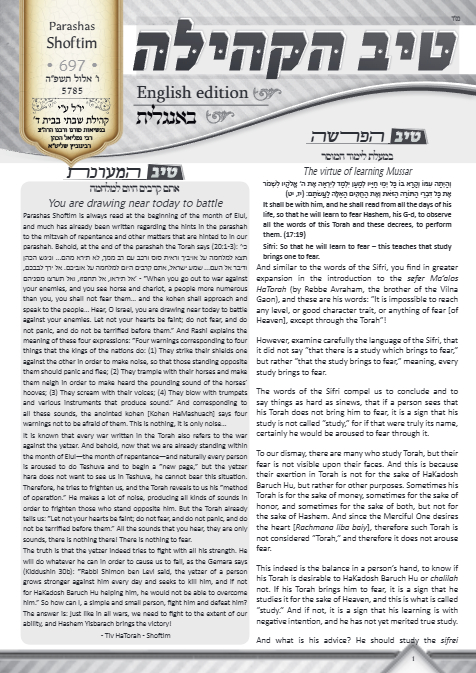
וְהָיְתָה עִמּוֹ וְקָרָא בוֹ כָּל יְמֵי חַיָּיו לְמַעַן יִלְמַד לְיִרְאָה אֶת ה’ אֱלֹקָיו לִשְׁמֹר אֶת כָּל דִּבְרֵי הַתּוֹרָה הַזֹּאת וְאֶת הַחֻקִּים הָאֵלֶּה לַעֲשׂתָם: (יז, יט)
It shall be with him, and he shall read from all the days of his life, so that he will learn to fear Hashem, his G-d, to observe all the words of this Torah and these decrees, to perform them. ) 17:19(

Sifri: So that he will learn to fear – this teaches that study brings one to fear.

And similar to the words of the Sifri, you find in greater expansion in the introduction to the sefer Ma’alos HaTorah (by Rebbe Avraham, the brother of the Vilna Gaon), and these are his words: “It is impossible to reach any level, or good character trait, or anything of fear [of Heaven], except through the Torah”!

However, examine carefully the language of the Sifri, that it did not say “that there is a study which brings to fear,” but rather “that the study brings to fear,” meaning, every study brings to fear.

The words of the Sifri compel us to conclude and to say things as hard as sinews, that if a person sees that his Torah does not bring him to fear, it is a sign that his study is not called “study,” for if that were truly its name, certainly he would be aroused to fear through it.

To our dismay, there are many who study Torah, but their fear is not visible upon their faces. And this is because their exertion in Torah is not for the sake of HaKadosh Baruch Hu, but rather for other purposes. Sometimes his Torah is for the sake of money, sometimes for the sake of honor, and sometimes for the sake of both, but not for the sake of Hashem. And since the Merciful One desires the heart [Rachmana liba baiy], therefore such Torah is not considered “Torah,” and therefore it does not arouse fear.

This indeed is the balance in a person’s hand, to know if his Torah is desirable to HaKadosh Baruch Hu or chalilah not. If his Torah brings him to fear, it is a sign that he studies it for the sake of Heaven, and this is what is called “study.” And if not, it is a sign that his learning is with negative intention, and he has not yet merited true study.

And what is his advice? He should study the sifrei Mussar! For besides that the sifrei Mussar arouse fear, they also bring a person to simplify the crookedness of the heart, and his study of Torah will then be only for the sake of Heaven, and such Torah will certainly increase in him fear upon fear.

This is the intention of Rabbah bar Rav Huna (Shabbos 31a), who said: “Any person who has Torah but does not have fear of Heaven, is like a treasurer to whom they gave the keys to the inner chambers, but the keys to the outer chambers they did not give him. How shall he enter?!” And Rashi explained: “Fear of Heaven is like the outer doors, for through them one enters the inner ones. So too, if he has fear of Heaven, he becomes careful to guard and to do. And if not, he does not care about his Torah.” End quote. Meaning, when a person does what is necessary to arouse fear within him, which is that he studies the sifrei Mussar, then he elevates himself above the vanities of the world, and his desires become purified, and then he no longer studies Torah out of ulterior motives, but rather for its main purpose, which is to guard and to do. This is not the case when he does not merit fear, for he does not strive to arouse it, then he does not care about his Torah. Meaning, he does not set his mind to the purpose of the commandment of Torah study, and he does not purify his intention that it should be for the sake of Heaven, to guard and to do, and to be in awe and fear of Hashem Yisbarach.

In light of the above, there would be room to say that one who has not yet merited to purify his ulterior motives is forbidden to open a Gemara or Shulchan Aruch without studying the sifrei Mussar. For behold, it is known the contradiction in the words of Chazal, that in one place (Sotah 22b) it is stated: “Rebbe Yehudah said in the name of Rav: A person should always engage in Torah and mitzvos even not for their own sake, for out of [learning] not for its own sake, he will come to [learning] for its own sake.” And this implies from this saying that there is not so much blemish in learning not for its own sake. On the contrary, beginners should be encouraged to study initially not for its own sake, for only through this will they come to for its own sake.

However, on the other hand, there are statements in the words of Chazal regarding the severity of studying Torah not for its own sake. As it says in the Gemara (Taanis 7a): “Anyone who engages in Torah not for its own sake, his Torah becomes for him a deadly poison.” And in another place (Berachos 17a) they expressed themselves in a very harsh manner, saying: “Anyone who does [mitzvos] not for its own sake, it would have been better had he not been created.” And in the Midrash (Vayikra Rabbah, Parashas Bechukosai) it is stated: “Rebbe Yochanan said: One who learns not in order to practice, it would have been better had his placenta been turned over upon his face.” And see Tosafos (Pesachim 50b, s.v. V’kan) who were also troubled by this contradiction and sought to distinguish between study with the intent to provoke and between study for other ulterior motives. And others said to resolve that there is to distinguish between one whose entire intention is not for its own sake, and one whose ultimate desire is to merit Torah for its own sake, but so long as he has not yet merited to ascend and to reach the purification of intention, he engages not for its own sake with the desire that this Torah will bring him to the level of for its own sake.

However, according to what is proven from the above words of the Sifri, that Torah studied not for its own sake does not cause elevation and fear, it is no longer possible to resolve and to say that Torah study not for its own sake brings to ‘for its own sake’. We must necessarily explain that the intention of Chazal when they said “out of [learning] not for its own sake, he will come to [learning] for its own sake,” is with the addition of studying seforim of fear, which straighten the crookedness of the heart. And you thus find yourself saying that one who does not study sifrei Mussar is also not fitting to study Gemara, for concerning such study they did not say at all “out of not for its own sake, he will come to for its own sake.” And there is room to say that HaKadosh Baruch Hu has no satisfaction from his Torah...

However, there is no doubt that in our times it is impossible to rule so in practice, and even those who have no portion in the Torah of Mussar are obligated to study Torah, and especially the Torah of Halachah, so that he will know what is permitted and what is forbidden. And still, these words are fitting to be said, so that one who is lax in Mussar should understand how Chazal viewed him. Also, those who do study Mussar must know that the study of Mussar is not a cure that endures long-term, unless it is with consistency. As reality proves, even if a person merited to be aroused by words of Mussar, his feeling cools after a short while. Only if he persists with consistency will he accustom himself to fear, and his Torah will also be with a more desirable intention, and he will merit to elevate himself through it.

And who is greater for us than our master, the holy Chasam Sofer zy ”a, who testified about himself that on the day he did not learn Mussar, he felt weakness in his service of the Creator. And if this great cedar, the teacher of all the exile, testified this about himself, what shall we answer, we, who are like weeds of the wall, people of our lowly level? Certainly, without studying Mussar each and every day, we will feel coldness in the fear of Heaven.

Therefore, every man who desires eternal life should choose for himself a Mussar sefer that arouses his heart, and he should study it each and every day without missing even one day, and then he will merit to elevate himself in the levels of Torah, and the fear of Hashem will be upon his face, so that he will not sin.

PDF Preview