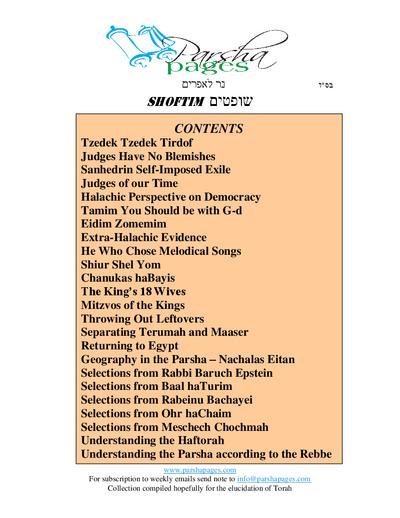
Videos, DNA and Polygraph: Are Extra-Halachic Means of Evidence Admissible in Beis Din?
Parsha Pages | September 04, 2024
Videos, DNA and Polygraph: Are Extra-Halachic Means of Evidence Admissible in Beis Din?
Based upon Rabbi Joshua Flug
I. Introduction
In two places in Parashas Shoftim, (Devarim 17,6; 19,15), the Torah states that in order to verify a fact in a court proceeding, two witnesses are required. In modern times, technological advances have allowed for new methods of determining facts such as video surveillance, DNA testing and polygraphs tests. In this shiur outline, we will explore what role these technologies play in a beis din. The following resources are helpful:
- Two teshuvos from R. Tzvi Yehuda Ben Yaakov’s Mispatecha L’Yaakov Vol. IV, one on DNA and one on use of a polygraph.
- A psak din from the Beis Din HaGadol of the Rabbanut on polygraph (From Piskei Din Vol. XIII)
- A piece from Rabbi Yitzchak Zilberstein in Chashukei Chemed, Sanhedrin on use of video surveillance for evidence.
II. May a dayan use extra-halachic means of collecting evidence?
- The pasuk in Koheles 12,10, states בקש קהלת למצא דברי חפץ וכתוב ישר דברי אמת. The Gemara comments that Koheles wanted to use extra-halachic means, trying people without eidim and without formal warning. A bas kol came out and said וכתוב ישר דברי אמת, that one can only judge based on what it says in the Torah — על פי שנים עדים וגו'. (Rosh haShana 21b)
- We nevertheless find that Shlomo HaMelech employed some sort of polygraph device:
- The Yalkut Shimoni (Esther 646) records that the throne of Shlomo had roaring lions and flying eagles on it in order to intimidate witnesses to tell the truth.
- The Zohar (Parshas Yisro) has a different version of what the throne did. According to the Zohar, if the witnesses lied, the animals on the throne would animate themselves.
- The difference between the Yalkut Shimoni and the Zohar is that the Yalkut’s account sees this as a tool to ensure that the witnesses speak truthfully. According to the Zohar’s account, this was an extra-halachic method of determining the truth. Tosafos (Yoma 54b), in addressing a different question, present the account found in the Yalkut.
III. Do the Witnesses Need to Actually See the Event?
- The Mishna states that before witnesses on a capital case testify, we give them a warning and ask them if perhaps their testimony is based on an estimate (and therefore invalid). (Sanhedrin 37a)
- The Gemara gives an example of an estimate: the witnesses see Reuven chasing Shimon and they both go into a destroyed structure. The witnesses followed them in and saw Reuven holding a sword with blood dripping from it and Shimon on the ground bleeding to death. That is not enough to testify.
- The Gemara states according to R. Acha, this type of estimate would be sufficient for monetary law. If they saw a camel running wild among the camels and then they saw a dead camel, they can testify that the wild camel killed the dead camel.
- The Gemara in Shavuos (34a) presents these issues with the following assumption: there are three different types of testimony that a witness might want to offer: yedia (knowledge), re’iyah (direct sight of the event) and omed (what we call circumstantial evidence). R. Yosi HaGelili requires either yedia or re’iyah both for dinei mamonos and dinei nefashos and therefore, he must disagree with R. Acha who allows omed for mamonos and not for nefashos. The Gemara then suggests that perhaps R. Acha allows omed even for nefashos. If that’s the case, it is possible that R. Yosi HaGelili’s yedia is the same thing as R. Acha’s omed.
- The Gemara (Shavous 46b) gives a concrete example of yedia/omed working in dinei mamonos. If a person goes into another room and comes out with a bite mark on his neck, there is no way that the bite could have happened if the other person didn’t bite him. However, if the wound is elsewhere (such that wound may have been self-inflicted), or there were multiple people in the room, we can’t assume that the other person did it.
d. Yedia and Re’iyah in Practical Halacha
- The Gemara (Gittin 81b) explains that the opinion of Beis Hillel — that if a divorced couple enters a hotel room together, they need a new get — is based on הן הן עדי יחוד הן הן עדי ביאה. The witnesses don't need to see the ביאה itself, it is sufficient if they see the two go into a secluded room together.
- The Rishonim discuss how this relate to kiddushin:
- Mordechai (c. 1250-1298) writes that if the eidim don't see the actual transfer of the ring, but they saw groom holding it and now they see it in her hand, it is sufficient that they know that the kiddushin took place as we see regarding הן הן עדי יחוד. (Kidushin 531)
- Rashba (1235-1310) writes that if the witnesses heard the groom say "I am giving you this esrog as kiddushin" but they don't see him give it to her, it is not a valid kiddushin even if they see her holding the esrog because for kiddushin, we need ראיה וידיעה. (Shu”t 1193)
- Rama (Even Ezer 42,4) codifies the opinion of Rashba and concludes ואין הולכין בזה אחר אומדנות והוכחות.
- R. Shmuel Feivish (Beis Shmuel, 17th century) notes that Mordechai disagrees with Rashba.
- R. Pinchas Horowitz (c. 1734-1804) writes that there isn’t a dispute. In Mordechai’s case, the yedia is compelling. It would have been virtually impossible for the ring to go from the groom to the bride without him giving it to her. In Rashba’s case, it is possible that he gave it to her before he mentioned kiddushin or he gave it to her as a gift. (Sefer haMakneh)
- R. Yonasan Eibeschitz (1690-1764) writes that there is in fact a dispute among the rishonim on the matter:
- Tosafos ask: even if we don’t accept R. Acha’s premise, we know that in the case of the individual with a bite on his neck, we treat that is solid evidence. Tosafos don’t distinguish between nefashos and mamonos, implying that the real distinction is between different levels of knowledge.
- Rashba himself hold that knowledge is insufficient for nefashos and therefore insufficient for kiddushin. Mordechai holds like Tosafos.
- It should be noted that the psakim of Rambam (1138-1204) also seem to follow Tosafos’ point Nizkei Mamon 14):
- Rambam rules that omed doesn’t work for dinei mamonos in the case of the wild camel.
- Rambam rules that in the case of the individual with the bite mark on his neck, that the other individual is responsible.
- It must be that there are different levels of knowledge and omed.
- R. Yaakov Chagiz (1620-1674) discusses whether one can testify based on something that was seen in the mirror. He notes that perhaps we can resolve this question based on the Gemara that states that if one sees the new moon in a reflection of the water, one cannot testify.
- R. Chaim Yosef David Azulai (Chida, 1724-1806) writes that perhaps one cannot compare this case to the case in the Gemara. The problem with seeing the new moon in a reflection is that one does not know exactly what one is seeing. However, perhaps if one knows for sure that the reflection in the mirror is clear, then the testimony could be used. (Bircai Yosef Chosen Mishpat, 35,11)
- The case of testimony through mirror is the closest case we have to video evidence. However, like the case of the reflection in the water, if there are questions about the reliability of the video evidence, then it certainly cannot be used as actual evidence. These questions might include whether the video was doctored, whether the images are clear enough to positively identify the individual and the act in question, and whether the video evidence presents the whole story, not just a piece of the puzzle.
IV. Other Considerations
- Can these extra-halachic means be employed even if they don’t qualify as actual evidence?
- Rambam (1138-1204) writes that if a dayan feels that a certain idea is true, even if no evidence was presented to prove it, he may make a determination based on his understanding of the case. However, he notes that as batei din started to emerge that weren't judging properly, it was decided not to allow the dayanim to use their instincts to determine the facts of the case. (Hil’ Sanhendrin 24 1-2)
- R. Yaakov of Lisa (Nesivos 15,2, 1760-1832) asks: if a dayan can judge based on his understanding of the truth, why do we have specific rules regarding eidus and why do we assume אין עד נעשה דיין? If he saw the incident himself, that should be even better than an assessment. Based on this question, Nesivos suggests that the ability of a dayan to make assessments is limited to nullifying a document or to an assessment that is based on universal knowledge. If the dayan concludes something that everyone knows or would have known had they seen the proceedings, but no specific evidence was presented to prove it, the dayan can judge based on that type of assessment.
- R. Meir Auerbach (1815-1878) notes that Rambam doesn't seem to limit the dayan's ability to use assessment to shtaros or clear cut assessments. Rather, one must answer that אין עד נעשה דיין only applies in situations where the judges compelled the parties to appear before them. In that case, the ability for a judge to make assessments is limited. However, if both parties willingly appear before the dayan, he is free to judge based on assessments. (Imrei Binah 15,2)
- R. Tzvi Ashkenazi (1656-1718) writes that assessments can be employed but the dayan must be absolutely sure that the assessment is true and that there is no other explanation for the sequence of events. (Chachum Tzvi 135)
- Can both parties agree to extra-halachic means of evidence?
- The Mishna (Sanhedrin 24a) states that if both parties agree to allow a relative to testify or become a dayan, the request is valid.
- Rambam writes that both parties can even accept upon themselves that an individual who is pasul l’eidus can be believed like two witnesses. (Hilchos Sanhedrin 7,2)
- R. Tzvi Ben-Yaakov notes that one cannot necessarily prove from here that both parties can accept upon themselves the use of extra-halachic means of evidence. Accepting actual testimony from someone who is pasul and treating that testimony with a greater degree of reliability is not the same as creating a new method of ascertaining the facts of the case. (Mishpetecha L’Yaacov 4,23)
- Application to specific methods
- Video evidence- As noted earlier, there is a question regarding video evidence and whether that is considered direct re’iyah. Usually, surveillance video doesn’t capture the whole event and it could only be used as an assessment.
- DNA and polygraph are almost always used as circumstantial evidence and as such it would be categorized as something that a dayan can use as part of an assessment.
- It should be added that if both parties agree to use of polygraph, then it could be used as a deterrent to ensure that the witnesses aren’t lying, as we find in the Yalkut’s depiction of Shlomo’s throne.
View The Full Article (PDF)