Dishes Used with Food
Chukai Chaim | April 11, 2024
Print This Article
View Original PDF

Dishes Used with Food

Chukai Chaim | June 27, 2025

Dishes Used with Food [‘Klei Seudoh’]

23. The dishes that require teviloh are those used at meals, (שו"ע שם ס"א), meaning dishes used at meals with food, e.g., plates, bowls, knives, spoons, forks, cups and the like, as well as dishes used in the preparation of food, e.g., pots, saucepans, pans and the like, as well as pot covers (רמ"א ס"ה). If they are made of materials requiring teviloh with a brochoh, they are toveled with a brochoh.

24. Shechitoh knife. The Mechaber holds that a shechitoh knife, as well as a knife used to skin an animal before cooking or a butcher’s knife (פר"ח) does not require teviloh at all (שו"ע שם ס"ה). The Rama, however, cites differing opinions and writes that they should be toveled without a brochoh (רמ"א שם ).

25. A skewer used to roast meat (שו"ע ס"ד ) as well as a barbecue's or grill's cooking grate upon which food is placed requires teviloh with a brochoh. Therefore, when one buys a reusable barbecue, he must tovel the grate with a brochoh but not the container itself which holds the coals, like the halochoh regarding a stovetop grate (שם ). A barbecue intended for one-time use does not require teviloh (see above, 10).

26. A fruit/vegetable peeler designated to peel fruits/vegetables eaten raw, e.g., apples, pears, carrots, etc., should be toveled with a brochoh. If it is designated for vegetables unfit to be eaten raw, e.g., potatoes or squash, it should be toveled without a brochoh.

27. Kitchen scissors designated for food unfit to be eaten raw should be toveled without a brochoh since it is a matter of dispute (ט"ז סק"ז, ש"ך סקי"א, פר"ח סקי"ג, פר"ת סק"ז). However, if they are designated for edible food, such as lettuce or fried schnitzel, they should be toveled with a brochoh (קובץ מבית לוי יו"ד עמ' קמ"ד ס"ה).

28. A bottle opener or can opener does not need teviloh even though it sometimes touches food since its use is for the container, not for the food (הגר"ש וואזנר, שו"ת חיי הלוי ח"ד סי' נ"ו).

29. Food thermometer. Likewise a food thermometer which is commonly used in cooking especially with meats does not need teviloh. Even if it comes in contact with the food, it is not considered a meal utensil, it is only used as an indirect tool in preparation of the food.

30. Some say a nutcracker does not require teviloh since it touches the shell, not the food (הגר"מ פיינשטיין, הגר"נ קרליץ ); others say it requires teviloh with a brochoh since nuts are brought to the table in their shells (שו"ת מנחת שלמה ח"ב סי' ס"ו אות ו'). Therefore, one should tovel them without a brochoh (שו"ת שבט הלוי ח"ו סי' רמ"ה אות ד', הגריש"א, אהל יעקב טבילת כלים אות נ"ט).

31. Storage containers designated to store food but which are not brought to the table, e.g., a spice or sugar container kept in the kitchen, are a matter of dispute among the poskim: some say they require teviloh (בן איש חי פ' צו סט"ו ); others say they do not (הג' רע"א בשו"ע ריש סי' ק"כ בשם שו"ת בית יהודה סי' נ"ב ). Therefore, one should tovel them without a brochoh (דרכי תשובה סק"ו ). All agree, however, that small containers containing salt or sugar that are brought to the table must be toveled.
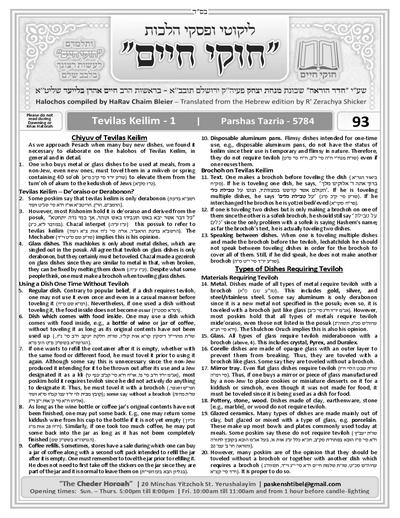
Dishes Used with Food [‘Klei Seudoh’]

23. The dishes that require teviloh are those used at meals, (שו"ע שם ס"א), meaning dishes used at meals with food, e.g., plates, bowls, knives, spoons, forks, cups and the like, as well as dishes used in the preparation of food, e.g., pots, saucepans, pans and the like, as well as pot covers (רמ"א ס"ה). If they are made of materials requiring teviloh with a brochoh, they are toveled with a brochoh.

24. Shechitoh knife. The Mechaber holds that a shechitoh knife, as well as a knife used to skin an animal before cooking or a butcher’s knife (פר"ח) does not require teviloh at all (שו"ע שם ס"ה). The Rama, however, cites differing opinions and writes that they should be toveled without a brochoh (רמ"א שם ).

25. A skewer used to roast meat (שו"ע ס"ד ) as well as a barbecue's or grill's cooking grate upon which food is placed requires teviloh with a brochoh. Therefore, when one buys a reusable barbecue, he must tovel the grate with a brochoh but not the container itself which holds the coals, like the halochoh regarding a stovetop grate (שם ). A barbecue intended for one-time use does not require teviloh (see above, 10).

26. A fruit/vegetable peeler designated to peel fruits/vegetables eaten raw, e.g., apples, pears, carrots, etc., should be toveled with a brochoh. If it is designated for vegetables unfit to be eaten raw, e.g., potatoes or squash, it should be toveled without a brochoh.

27. Kitchen scissors designated for food unfit to be eaten raw should be toveled without a brochoh since it is a matter of dispute (ט"ז סק"ז, ש"ך סקי"א, פר"ח סקי"ג, פר"ת סק"ז). However, if they are designated for edible food, such as lettuce or fried schnitzel, they should be toveled with a brochoh (קובץ מבית לוי יו"ד עמ' קמ"ד ס"ה).

28. A bottle opener or can opener does not need teviloh even though it sometimes touches food since its use is for the container, not for the food (הגר"ש וואזנר, שו"ת חיי הלוי ח"ד סי' נ"ו).

29. Food thermometer. Likewise a food thermometer which is commonly used in cooking especially with meats does not need teviloh. Even if it comes in contact with the food, it is not considered a meal utensil, it is only used as an indirect tool in preparation of the food.

30. Some say a nutcracker does not require teviloh since it touches the shell, not the food (הגר"מ פיינשטיין, הגר"נ קרליץ ); others say it requires teviloh with a brochoh since nuts are brought to the table in their shells (שו"ת מנחת שלמה ח"ב סי' ס"ו אות ו'). Therefore, one should tovel them without a brochoh (שו"ת שבט הלוי ח"ו סי' רמ"ה אות ד', הגריש"א, אהל יעקב טבילת כלים אות נ"ט).

31. Storage containers designated to store food but which are not brought to the table, e.g., a spice or sugar container kept in the kitchen, are a matter of dispute among the poskim: some say they require teviloh (בן איש חי פ' צו סט"ו ); others say they do not (הג' רע"א בשו"ע ריש סי' ק"כ בשם שו"ת בית יהודה סי' נ"ב ). Therefore, one should tovel them without a brochoh (דרכי תשובה סק"ו ). All agree, however, that small containers containing salt or sugar that are brought to the table must be toveled.

PDF Preview