From Pale to Passion
זכרון יעקב | April 11, 2024
Print This Article
View Original PDF

From Pale to Passion

זכרון יעקב | June 27, 2025

FROM PALE TO PASSION

RABBI AHARON LOSCHAK (Chabad.org)

I’ll never forget that morning.

My father never had a particularly quiet voice, but this time, he was positively booming. So much so, all my friends were giving me strange stares.

It was a Sunday morning in my yeshivah, and he had come to join the annual “father and son weekend.” Part of the program was for the fathers to study with their sons on Sunday morning. As sleepy teenagers, we were used to slogging our way through the early morning study session.

But here I was, sitting across from my relatively even-keeled father, and not a soul in that room was able to sleep as we learned the text together and his naturally loud voice reached ear-splitting levels. My bemused friends later told me about my father disrupting their morning naps, and I must say, I was quite proud of my enthusiastic dad.

He taught me a valuable lesson that day: get excited about your Judaism!

WHITE = BAD?

The parsha is largely devoted to the laws of tzaraat, a mysterious rash of white lesions that appeared on the skin in Temple times. According to Torah law, this rash renders a person ritually impure.

The Torah prescribes an elaborate system, but generally speaking, if a person spots a white lesion on their skin, they go to a priest in the Temple for inspection. If the priest declares the lesion impure, the person quarantines for seven days, before returning for reinspection. If the spot has diminished, they are OK. But if it has spread, they are expelled from the camp and must sit outside the city with no human contact. Thereafter, they bring an offering and undergo a purification procedure.

Let’s read some of that:

And the kohen shall see him on the seventh day a second time. And the lesion has become dimmer, and the lesion has not spread on the skin, the kohen shall pronounce him clean . . . However, if the lesion spreads on the skin after it has been shown to the kohen . . . the kohen shall pronounce him unclean. It is tzara'at. (13:6-8)

In other words, the more the white lesion spreads, the more impure they are.

Why? What is the significance behind the fact that white symbolizes impurity? And why must it be brought to the kohen specifically? Why can’t a person self-diagnose, or go to a friend to take a look? Why must it be a priest in the Temple?

RED IS FOR LIFE, WHITE IS FOR...

Generally speaking, a white or pale complexion is not a good sign. It’s usually when a person is feeling faint or weak that they turn white, indicating an acute lack of energy, and to some degree, a loss of life.

In contrast, one who is full of energy is usually flush with color, even ruddy. After all, red is the color of blood, and blood is life. So, when a person is feeling animated and full of life, blood rushes around the body, lending the flesh a vibrant hue.

As with everything in this world, these physical characteristics represent a spiritual reality.

According to Jewish thought, life flows from the soul that animates the body. The Kabbalists taught of a soul that is a literal piece of G‑d that was injected into each human being, and it is this soul that animates the body every second. When the soul departs from the body it leaves behind a lifeless corpse. That’s why death is associated with impurity, for the G‑dly energy has left, leaving a coarse, physical entity behind.

Spiritually speaking, when is a person full of energy and life? It is when they follow G‑d’s word and plug into the G‑dly energy that is their soul. But when they cut themselves off from the source of life, i.e., they sin against G‑d, they actively damage their own soul, their own life.

THE TZARA’AT BAROMETER

Now, we don’t usually get to see an actual physical manifestation of this spiritual reality. When we lose our temper, don’t pray the right way, or say something nasty, we don’t actively feel or see that loss of spiritual life.

Tzara’at is a spiritual ailment that reflects this inner reality. As the Talmud famously tells us, this unusual ailment comes from the grave sin of lashon hara, speaking ill of others. And so, the rash is white—indicating the loss of life that occurs when one sins.

That’s why tzaraat causes impurity, because it’s more than just a punishment for doing something bad. The lesion indicates a loss of spiritual life due to sin, and it is that loss of life that causes impurity.

But the thing is that tzara’at can be very small, a tiny white blotch—so much so, that not always does the person even discern that something is amiss. And when they do, it’s not always readily diagnosable. “Perhaps it’s not really so big, maybe it’s not really so bad, who knows?” The challenge of admitting and recognizing
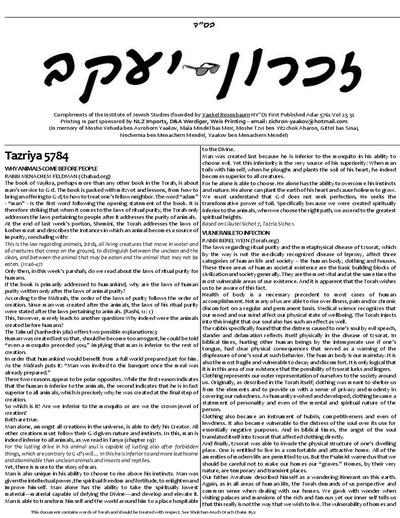

FROM PALE TO PASSION

RABBI AHARON LOSCHAK (Chabad.org)

I’ll never forget that morning.

My father never had a particularly quiet voice, but this time, he was positively booming. So much so, all my friends were giving me strange stares.

It was a Sunday morning in my yeshivah, and he had come to join the annual “father and son weekend.” Part of the program was for the fathers to study with their sons on Sunday morning. As sleepy teenagers, we were used to slogging our way through the early morning study session.

But here I was, sitting across from my relatively even-keeled father, and not a soul in that room was able to sleep as we learned the text together and his naturally loud voice reached ear-splitting levels. My bemused friends later told me about my father disrupting their morning naps, and I must say, I was quite proud of my enthusiastic dad.

He taught me a valuable lesson that day: get excited about your Judaism!

WHITE = BAD?

The parsha is largely devoted to the laws of tzaraat, a mysterious rash of white lesions that appeared on the skin in Temple times. According to Torah law, this rash renders a person ritually impure.

The Torah prescribes an elaborate system, but generally speaking, if a person spots a white lesion on their skin, they go to a priest in the Temple for inspection. If the priest declares the lesion impure, the person quarantines for seven days, before returning for reinspection. If the spot has diminished, they are OK. But if it has spread, they are expelled from the camp and must sit outside the city with no human contact. Thereafter, they bring an offering and undergo a purification procedure.

Let’s read some of that:

And the kohen shall see him on the seventh day a second time. And the lesion has become dimmer, and the lesion has not spread on the skin, the kohen shall pronounce him clean . . . However, if the lesion spreads on the skin after it has been shown to the kohen . . . the kohen shall pronounce him unclean. It is tzara'at. (13:6-8)

In other words, the more the white lesion spreads, the more impure they are.

Why? What is the significance behind the fact that white symbolizes impurity? And why must it be brought to the kohen specifically? Why can’t a person self-diagnose, or go to a friend to take a look? Why must it be a priest in the Temple?

RED IS FOR LIFE, WHITE IS FOR...

Generally speaking, a white or pale complexion is not a good sign. It’s usually when a person is feeling faint or weak that they turn white, indicating an acute lack of energy, and to some degree, a loss of life.

In contrast, one who is full of energy is usually flush with color, even ruddy. After all, red is the color of blood, and blood is life. So, when a person is feeling animated and full of life, blood rushes around the body, lending the flesh a vibrant hue.

As with everything in this world, these physical characteristics represent a spiritual reality.

According to Jewish thought, life flows from the soul that animates the body. The Kabbalists taught of a soul that is a literal piece of G‑d that was injected into each human being, and it is this soul that animates the body every second. When the soul departs from the body it leaves behind a lifeless corpse. That’s why death is associated with impurity, for the G‑dly energy has left, leaving a coarse, physical entity behind.

Spiritually speaking, when is a person full of energy and life? It is when they follow G‑d’s word and plug into the G‑dly energy that is their soul. But when they cut themselves off from the source of life, i.e., they sin against G‑d, they actively damage their own soul, their own life.

THE TZARA’AT BAROMETER

Now, we don’t usually get to see an actual physical manifestation of this spiritual reality. When we lose our temper, don’t pray the right way, or say something nasty, we don’t actively feel or see that loss of spiritual life.

Tzara’at is a spiritual ailment that reflects this inner reality. As the Talmud famously tells us, this unusual ailment comes from the grave sin of lashon hara, speaking ill of others. And so, the rash is white—indicating the loss of life that occurs when one sins.

That’s why tzaraat causes impurity, because it’s more than just a punishment for doing something bad. The lesion indicates a loss of spiritual life due to sin, and it is that loss of life that causes impurity.

But the thing is that tzara’at can be very small, a tiny white blotch—so much so, that not always does the person even discern that something is amiss. And when they do, it’s not always readily diagnosable. “Perhaps it’s not really so big, maybe it’s not really so bad, who knows?” The challenge of admitting and recognizing

PDF Preview