Demolition and Ritual Purification of a Defiled House
Project Likkutei Sichos | April 26, 2025
Print This Article
View Original PDF

Demolition and Ritual Purification of a Defiled House

Project Likkutei Sichos | June 27, 2025

Leviticus 14:45-49

45 He must demolish the house, its stones, its wood, and all the mortar-dust of the house, and he must take them outside the city, to a defiled place.

46 Anyone entering the house during any of the days of one of its ‘initial’ quarantines—i.e., a quarantine that is not preceded by purging—will become ritually defiled until the evening.

47 The garments that this person is wearing, however, do not become ritually defiled unless he lies down in the house or otherwise tarries there, in which case he must immerse his garments in a mikveh—but only if he tarries in the house for the amount of time usually taken by someone eating half a loaf of bread (approximately 4 minutes). Only in such a case must he immerse his garments in a mikveh.

In contrast, a person who enters the house during a ‘successional’ quarantine—i.e., one that is preceded by purging—is not rendered ritually defiled. Nonetheless, anyone entering a house that has been declared defiled becomes ritually defiled, even if for some reason the house was purged before being demolished.

48 If the priest comes and examines the house after the first week of quarantine and finds that the tzara’at-lesion has not spread, and then, after having the house quarantined for a second week, the priest comes again and examines the lesion a second time, and the lesion again did not spread in the house from the time that the house had been re-plastered at the end of the first week, then the procedure to be followed is the same as if the lesion had spread during the second week of quarantine: the affected stones must be removed, the area around them scraped, all that was removed deposited in a place designated for defilement outside the city, the wall re-plastered with unaffected stones, and the house quarantined for a third week. If the lesion reappears after this, the house is defiled and must be demolished. If the lesion does not reappear after the third week of quarantine, the priest must pronounce the house rid of this defilement, because the lesion has healed.

49 To ritually purify the house, he must take the same items as must a person being purified from tzara’at: two fowl, a cedar stick, a strip of scarlet wool, and some hyssop. The cedar stick and hyssop must be bound together using the strip of scarlet wool.

Chasidic Insights

41 In order to purify the house: The elaborate purification ritual for a house that has contracted tzara’at is quite similar to that for a person who has contracted tzara’at on his skin. In contrast, the purification process for an article of clothing that has contracted tzara’at is quite perfunctory: simple immersion in a mikveh suffices. This similarity between skin- and house-tzara’at (as emphasized by their shared dissimilarity to clothing-tzara’at) leads us to expect that the presentation of their laws should be likewise similar. Conspicuously, however, their respective laws are presented quite differently, as is revealed if we analyze the order in which the Torah presents the subject matter of tzara’at:

Parashat Tazria

  • The diagnostic process for tzara’at on the skin (13:1-46).
  • The diagnostic process for tzara’at on clothing (and its purification) (13:47-59).

Parashat Metzora

  • The purification process for tzara’at on the skin (14:1-32).
  • The diagnostic process for tzara’at on homes and its purification (14:33-57).

We see that the rules for the diagnosis and purification of tzara’at on the skin are not only separated into discontinuous sections but appear in two separate parashiot, whereas the rules for tzara’at on homes are given together, in one sequence (similar to the rules of tzara'at on clothing, which are given together simply because the rules for their purification are not complex enough to warrant being given separately).

The reason for this dichotomy is that, as we have seen, the home, being the most external of the three “venues” for tzara’at—skin, clothing, and home—is the physical correlate of the yechidah, the aspect of the soul most removed from our normative consciousness. It is specifically from the perspective of this level of the soul that tzara’at is clearly seen as a tool for spiritual refinement. From the perspective of the lower levels of the soul, which define our normative consciousness and whose physical correlates are our clothing and bodies, tzara’at appears more as the severe form of ritual impurity it is. From this perspective, the experiential side of tzara’at and its potential as a tool for spiritual refinement are entirely separate, and therefore these aspects of it are treated in separate sections of the Torah. Tzara’at of homes is covered in one contiguous section because in it the experiential aspect of this condition is most openly seen in the context of its beneficial purpose.

With this perspective in mind, we can understand that the purpose of the destruction of God’s “house,” the Temple, was in order to reveal the “hidden treasures” of Divine consciousness that will be manifest with the restoration of the Temple in the messianic Redemption.
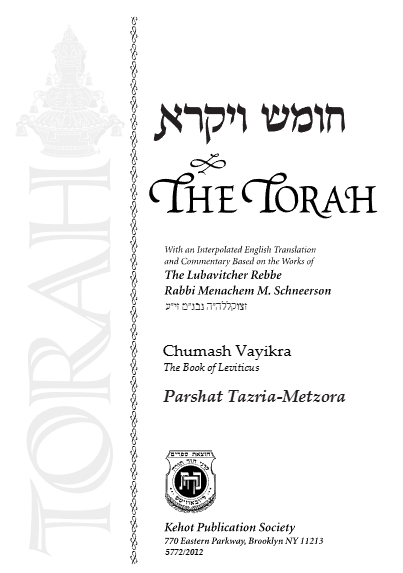
Leviticus 14:45-49

45 He must demolish the house, its stones, its wood, and all the mortar-dust of the house, and he must take them outside the city, to a defiled place.

46 Anyone entering the house during any of the days of one of its ‘initial’ quarantines—i.e., a quarantine that is not preceded by purging—will become ritually defiled until the evening.

47 The garments that this person is wearing, however, do not become ritually defiled unless he lies down in the house or otherwise tarries there, in which case he must immerse his garments in a mikveh—but only if he tarries in the house for the amount of time usually taken by someone eating half a loaf of bread (approximately 4 minutes). Only in such a case must he immerse his garments in a mikveh.

In contrast, a person who enters the house during a ‘successional’ quarantine—i.e., one that is preceded by purging—is not rendered ritually defiled. Nonetheless, anyone entering a house that has been declared defiled becomes ritually defiled, even if for some reason the house was purged before being demolished.

48 If the priest comes and examines the house after the first week of quarantine and finds that the tzara’at-lesion has not spread, and then, after having the house quarantined for a second week, the priest comes again and examines the lesion a second time, and the lesion again did not spread in the house from the time that the house had been re-plastered at the end of the first week, then the procedure to be followed is the same as if the lesion had spread during the second week of quarantine: the affected stones must be removed, the area around them scraped, all that was removed deposited in a place designated for defilement outside the city, the wall re-plastered with unaffected stones, and the house quarantined for a third week. If the lesion reappears after this, the house is defiled and must be demolished. If the lesion does not reappear after the third week of quarantine, the priest must pronounce the house rid of this defilement, because the lesion has healed.

49 To ritually purify the house, he must take the same items as must a person being purified from tzara’at: two fowl, a cedar stick, a strip of scarlet wool, and some hyssop. The cedar stick and hyssop must be bound together using the strip of scarlet wool.

Chasidic Insights

41 In order to purify the house: The elaborate purification ritual for a house that has contracted tzara’at is quite similar to that for a person who has contracted tzara’at on his skin. In contrast, the purification process for an article of clothing that has contracted tzara’at is quite perfunctory: simple immersion in a mikveh suffices. This similarity between skin- and house-tzara’at (as emphasized by their shared dissimilarity to clothing-tzara’at) leads us to expect that the presentation of their laws should be likewise similar. Conspicuously, however, their respective laws are presented quite differently, as is revealed if we analyze the order in which the Torah presents the subject matter of tzara’at:

Parashat Tazria

  • The diagnostic process for tzara’at on the skin (13:1-46).
  • The diagnostic process for tzara’at on clothing (and its purification) (13:47-59).

Parashat Metzora

  • The purification process for tzara’at on the skin (14:1-32).
  • The diagnostic process for tzara’at on homes and its purification (14:33-57).

We see that the rules for the diagnosis and purification of tzara’at on the skin are not only separated into discontinuous sections but appear in two separate parashiot, whereas the rules for tzara’at on homes are given together, in one sequence (similar to the rules of tzara'at on clothing, which are given together simply because the rules for their purification are not complex enough to warrant being given separately).

The reason for this dichotomy is that, as we have seen, the home, being the most external of the three “venues” for tzara’at—skin, clothing, and home—is the physical correlate of the yechidah, the aspect of the soul most removed from our normative consciousness. It is specifically from the perspective of this level of the soul that tzara’at is clearly seen as a tool for spiritual refinement. From the perspective of the lower levels of the soul, which define our normative consciousness and whose physical correlates are our clothing and bodies, tzara’at appears more as the severe form of ritual impurity it is. From this perspective, the experiential side of tzara’at and its potential as a tool for spiritual refinement are entirely separate, and therefore these aspects of it are treated in separate sections of the Torah. Tzara’at of homes is covered in one contiguous section because in it the experiential aspect of this condition is most openly seen in the context of its beneficial purpose.

With this perspective in mind, we can understand that the purpose of the destruction of God’s “house,” the Temple, was in order to reveal the “hidden treasures” of Divine consciousness that will be manifest with the restoration of the Temple in the messianic Redemption.

PDF Preview