Further Inner Dimensions of Tzaraat
Project Likkutei Sichos | April 26, 2025
Print This Article
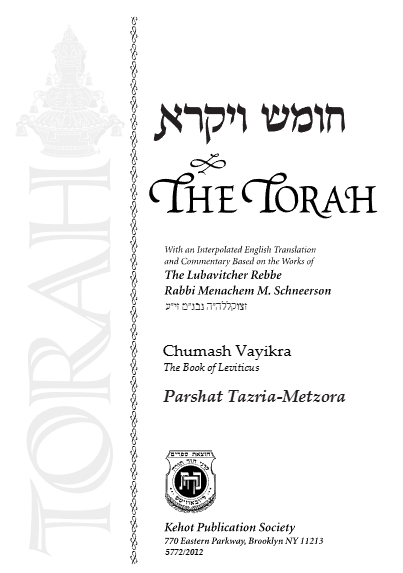
View Original PDF

Further Inner Dimensions of Tzaraat

Project Likkutei Sichos | June 27, 2025

Inner Dimensions

[2] The following is the law: As we have explained previously, tzara’at indicates the presence of an overabundance of spiritual “light,” which overflows its “vessel.” This imbalance is manifest experientially as a rapturous desire to experience Divinity (ratzo) unmitigated by a concomitant humble devotion to accomplishing God’s will (shov). Divine rapture is an expression of our love of God, whereas humble devotion to His will is an expression of our fear of God. Love and fear of God are in turn expressions of the soul’s powers of loving-kindness (chesed) and restraint (gevurah). As we have seen, these are reflections of the supernal sefirot of the same names, which are organized into a structural hierarchy in which chesed is situated on the right axis and gevurah on the left axis. Thus, favoring one propensity over the other—rapture over devotion or vice versa—upsets the balance between these axes of the soul.

The “cure” for tzara’at, then, is the harmonization of these two opposing drives. In order to harmonize opposing forces, a third force, which transcends them both, must be invoked. The harmonizing force between chesed and gevurah is always tiferet, which, due to its direct root in keter, is able to transcend and include both. This, in fact, is the meaning of the word tiferet (“beauty”), the harmonious combination of different colors into a pleasing picture or design.

The sages teach us that the world metaphorically stands on three pillars: the study of the Torah, the sacrifices (for which prayer substitutes nowadays), and acts of loving-kindness. These three pillars correspond to the three sefirot of tiferet, gevurah, and chesed, respectively. It follows that the harmonization of rapture and devotion (ratzo and shov) is effected by the study of the Torah. This is because true study of the Torah must be undertaken out of a sense of self-nullification to God, and by nullifying ourselves to God, we can, like Him, harmonize opposites.

The Torah therefore states, “The following is the law [literally, ‘the Torah’] regarding the person afflicted with tzara’at,” intimating that the cure for tzara’at, the harmonization of ratzo and shov, is the selfless study of the Torah.

However, in order that our study of the Torah indeed elicit Divine energy and infuse it into creation, we must study it with pure motives—fulfilling God’s will and disseminating Divine consciousness. Therefore, “he must be brought to the priest,” for the priest personifies the sefirah of chochmah, whose inner dimension and corresponding soul-attribute is self-nullification (bitul).

Inner Dimensions

[2] The following is the law: As we have explained previously, tzara’at indicates the presence of an overabundance of spiritual “light,” which overflows its “vessel.” This imbalance is manifest experientially as a rapturous desire to experience Divinity (ratzo) unmitigated by a concomitant humble devotion to accomplishing God’s will (shov). Divine rapture is an expression of our love of God, whereas humble devotion to His will is an expression of our fear of God. Love and fear of God are in turn expressions of the soul’s powers of loving-kindness (chesed) and restraint (gevurah). As we have seen, these are reflections of the supernal sefirot of the same names, which are organized into a structural hierarchy in which chesed is situated on the right axis and gevurah on the left axis. Thus, favoring one propensity over the other—rapture over devotion or vice versa—upsets the balance between these axes of the soul.

The “cure” for tzara’at, then, is the harmonization of these two opposing drives. In order to harmonize opposing forces, a third force, which transcends them both, must be invoked. The harmonizing force between chesed and gevurah is always tiferet, which, due to its direct root in keter, is able to transcend and include both. This, in fact, is the meaning of the word tiferet (“beauty”), the harmonious combination of different colors into a pleasing picture or design.

The sages teach us that the world metaphorically stands on three pillars: the study of the Torah, the sacrifices (for which prayer substitutes nowadays), and acts of loving-kindness. These three pillars correspond to the three sefirot of tiferet, gevurah, and chesed, respectively. It follows that the harmonization of rapture and devotion (ratzo and shov) is effected by the study of the Torah. This is because true study of the Torah must be undertaken out of a sense of self-nullification to God, and by nullifying ourselves to God, we can, like Him, harmonize opposites.

The Torah therefore states, “The following is the law [literally, ‘the Torah’] regarding the person afflicted with tzara’at,” intimating that the cure for tzara’at, the harmonization of ratzo and shov, is the selfless study of the Torah.

However, in order that our study of the Torah indeed elicit Divine energy and infuse it into creation, we must study it with pure motives—fulfilling God’s will and disseminating Divine consciousness. Therefore, “he must be brought to the priest,” for the priest personifies the sefirah of chochmah, whose inner dimension and corresponding soul-attribute is self-nullification (bitul).

PDF Preview