How Far Must a Kohen Go In Order to Tend to The Metzora
Zera Shimshon | April 30, 2025
Print This Article
View Original PDF

How Far Must a Kohen Go In Order to Tend to The Metzora

Zera Shimshon | June 27, 2025

All the days that the infliction is upon him he shall remain impure; he is impure. He shall stay in isolation; his dwelling shall be outside the camp.

The Torah commands the metzora to remain in isolation outside of the camp as long as he is impure. The metzora is required to remain outside of the camp even during the course of the purification process, as the Torah clearly establishes that instead of the metzora going to the Kohen, it is the Kohen who must go out to the metzora.

ויצא הכהן אל מחוץ למחנה וראה הכהן והנה נרפא נגע הצרעת מן הצרוע. - The Kohen shall go forth to the outside of the camp; the Kohen shall look, and behold! the tzara’as affliction has been healed from the metzora. Rashi explains, אל מחוץ למחנה. חוץ לשלש מחנות שנשתלח שם בימי חלוטו - The Kohen shall go forth to the outside of the camp: To the area outside the three camps, which is where he was sent to during the days of his impurity.

In view of this, it is hard to understand the Passuk that describes the commencement of the purification process. For the Passuk says, זאת תהיה תורת המצרע ביום טהרתו והובא אל הכהן - This shall be the law of the metzora on the day of his purification; he shall be brought to the Kohen. How is that possible?! How can the metzora be brought to the Kohen, as long as he is still prohibited from entering the camp? Moreover, it is indeed for this very reason that the Torah commanded the Kohen to ‘go forth to the outside of the camp’, in order to take a look at the inflicted metzora.

During their dwelling in the desert, the Jewish People’s encampment consisted of three camps. The innermost was the מחנה שכינה, the camp of the Shechinah, where the Mishkan dwelled. The second camp was מחנה לוי-ה, the camp of the Leviim; this camp surrounded the inner camp and is where the Leviim dwelled. The third and outermost camp was מחנה ישראל, the camp of the Israelites; where the other Tribes resided.

Once the Jewish People entered Eretz Yisrael and built the Bais Hamikdash, the three areas which corresponded to the three camps were as follows. The Bais Hamikdash and all its surrounding courtyards corresponded to the innermost ‘camp of the Shechinah’, the Temple Mount corresponded to the ‘camp of the Leviim’, and the remainder of Yerushalayim, as well as any other walled city, corresponded to the outermost ‘camp of the Israelites’.

Just as while in the desert the metzora was instructed to leave the three camps, so too in Eretz Yisroel was he instructed to leave Yerushalayim as well as any other walled city; which corresponded to the dwelling camps of the desert.

Since the metzora was able to settle in any location across the great Land of Eretz Yisrael, as long as it was outside Yerushalayim and any walled city, there was a great possibility that the metzora would settle in some far outlying village, very far from the dwelling of the nearest Kohen. And because the Rambam (פ"ט טומאת צרעת הי"א) instructs the Kohen to meet the metzora immediately, and to tend to him without any delay, therefore when the Torah commands the Kohen to ‘go forth to outside of the camp’ in order to see the metzora, it may have seemed that no matter how far, the Kohen was obligated to immediately drop all his personal and business affairs, and to set travel in order to tend to the metzora.

In view of this we can explain that when the Torah stated that the metzora ‘shall be brought to the Kohen’, it wasn’t suggesting that the metzora should come all the way to the Kohen, but rather that the metzora should come as close as permitted to Yerushalayim or any walled city in which the Kohen resided. This was because although the kohen was indeed instructed to tend to the metzora immediately, nevertheless the Kohen was not obligated to travel far; rather the metzora must travel to the outskirts of the city, and once there the Kohen was only obligated to ‘go forth just to the outskirts of the camp’.

(זרע שמשון פרשת תזריע אות ח)
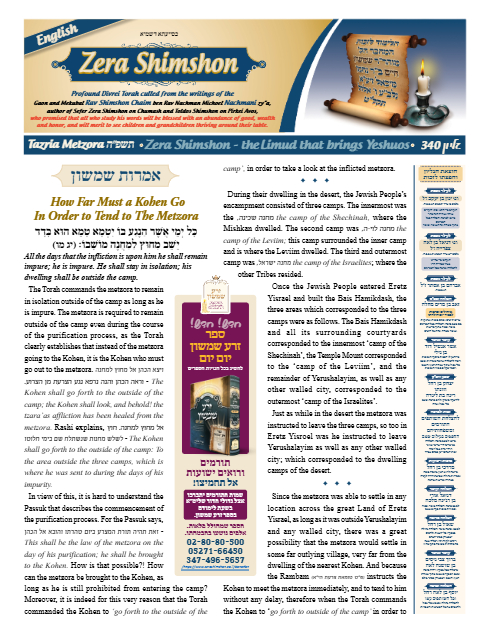
All the days that the infliction is upon him he shall remain impure; he is impure. He shall stay in isolation; his dwelling shall be outside the camp.

The Torah commands the metzora to remain in isolation outside of the camp as long as he is impure. The metzora is required to remain outside of the camp even during the course of the purification process, as the Torah clearly establishes that instead of the metzora going to the Kohen, it is the Kohen who must go out to the metzora.

ויצא הכהן אל מחוץ למחנה וראה הכהן והנה נרפא נגע הצרעת מן הצרוע. - The Kohen shall go forth to the outside of the camp; the Kohen shall look, and behold! the tzara’as affliction has been healed from the metzora. Rashi explains, אל מחוץ למחנה. חוץ לשלש מחנות שנשתלח שם בימי חלוטו - The Kohen shall go forth to the outside of the camp: To the area outside the three camps, which is where he was sent to during the days of his impurity.

In view of this, it is hard to understand the Passuk that describes the commencement of the purification process. For the Passuk says, זאת תהיה תורת המצרע ביום טהרתו והובא אל הכהן - This shall be the law of the metzora on the day of his purification; he shall be brought to the Kohen. How is that possible?! How can the metzora be brought to the Kohen, as long as he is still prohibited from entering the camp? Moreover, it is indeed for this very reason that the Torah commanded the Kohen to ‘go forth to the outside of the camp’, in order to take a look at the inflicted metzora.

During their dwelling in the desert, the Jewish People’s encampment consisted of three camps. The innermost was the מחנה שכינה, the camp of the Shechinah, where the Mishkan dwelled. The second camp was מחנה לוי-ה, the camp of the Leviim; this camp surrounded the inner camp and is where the Leviim dwelled. The third and outermost camp was מחנה ישראל, the camp of the Israelites; where the other Tribes resided.

Once the Jewish People entered Eretz Yisrael and built the Bais Hamikdash, the three areas which corresponded to the three camps were as follows. The Bais Hamikdash and all its surrounding courtyards corresponded to the innermost ‘camp of the Shechinah’, the Temple Mount corresponded to the ‘camp of the Leviim’, and the remainder of Yerushalayim, as well as any other walled city, corresponded to the outermost ‘camp of the Israelites’.

Just as while in the desert the metzora was instructed to leave the three camps, so too in Eretz Yisroel was he instructed to leave Yerushalayim as well as any other walled city; which corresponded to the dwelling camps of the desert.

Since the metzora was able to settle in any location across the great Land of Eretz Yisrael, as long as it was outside Yerushalayim and any walled city, there was a great possibility that the metzora would settle in some far outlying village, very far from the dwelling of the nearest Kohen. And because the Rambam (פ"ט טומאת צרעת הי"א) instructs the Kohen to meet the metzora immediately, and to tend to him without any delay, therefore when the Torah commands the Kohen to ‘go forth to outside of the camp’ in order to see the metzora, it may have seemed that no matter how far, the Kohen was obligated to immediately drop all his personal and business affairs, and to set travel in order to tend to the metzora.

In view of this we can explain that when the Torah stated that the metzora ‘shall be brought to the Kohen’, it wasn’t suggesting that the metzora should come all the way to the Kohen, but rather that the metzora should come as close as permitted to Yerushalayim or any walled city in which the Kohen resided. This was because although the kohen was indeed instructed to tend to the metzora immediately, nevertheless the Kohen was not obligated to travel far; rather the metzora must travel to the outskirts of the city, and once there the Kohen was only obligated to ‘go forth just to the outskirts of the camp’.

(זרע שמשון פרשת תזריע אות ח)

PDF Preview