Tazria Metzora and the Process of Redemption
Project Likkutei Sichos | April 26, 2025
Print This Article
View Original PDF

Tazria Metzora and the Process of Redemption

Project Likkutei Sichos | June 27, 2025

We have seen why the Messiah, of all possible manifestations, assumes the garb of a metzora. But in this context, it is possible to interpret the names of the two parashiot that discuss tzara’at as referring to the process of redemption: Tazria, meaning “sow,” refers to the work we do to cause redemption to “sprout”; Metzora refers to the Messiah himself. Thus, the phrase Tazria-Metzora allegorically means “Sow the seeds of the messianic redemption.”

In most years, the two parashiot of Tazria and Metzora are combined in the public reading of the Torah in the synagogue. In the allegorical context just mentioned, this teaches us that we must view our efforts to refine the world through studying the Torah and fulfilling its commandments not only as ends unto themselves—which they most certainly are, inasmuch as we are instructed to fulfill God’s commandments out of devoted obedience—but also as the means by which we hasten the advent of the Messiah. We must not dissociate our Tazria—our sowing—from Metzora—its messianic goal.

Moreover, we should ideally envision our efforts and their goal—living our lives according to the Torah’s dictates and the messianic Redemption—not as two separate entities, but as one continuum. Living the Torah life leads organically into the Redemption, and the Redemption is simply the fullest flowering of the Torah and its commandments that we knew during our exile. The Torah of the messianic future will be the same Torah we now possess, the only difference being that its innermost dimensions will finally be fully revealed to us.

Similarly, in the messianic future we will continue to observe the Torah’s commandments, only in their fullest scope—both quantitatively, as those commandments that can be performed only when the Temple stands and only when the entire Jewish people are settled in their homeland become once again practicable; and qualitatively, as reality sheds the gross materialism that presently conceals most of the Divine revelations that result from observing God’s commandments—including the innate materialistic orientation of our own consciousness, which will be replaced by heightened Divine consciousness.

In reading about the odyssey of the metzora and the process of his or her redemption from social ostracism—“exiled” from society—we are at the same time reading about both our own personal odysseys of spiritual crisis and redemption as well as our collective, national odyssey through our exile, as we work toward our final Redemption.
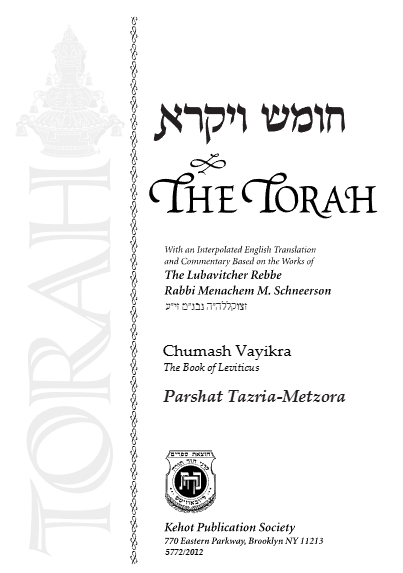
We have seen why the Messiah, of all possible manifestations, assumes the garb of a metzora. But in this context, it is possible to interpret the names of the two parashiot that discuss tzara’at as referring to the process of redemption: Tazria, meaning “sow,” refers to the work we do to cause redemption to “sprout”; Metzora refers to the Messiah himself. Thus, the phrase Tazria-Metzora allegorically means “Sow the seeds of the messianic redemption.”

In most years, the two parashiot of Tazria and Metzora are combined in the public reading of the Torah in the synagogue. In the allegorical context just mentioned, this teaches us that we must view our efforts to refine the world through studying the Torah and fulfilling its commandments not only as ends unto themselves—which they most certainly are, inasmuch as we are instructed to fulfill God’s commandments out of devoted obedience—but also as the means by which we hasten the advent of the Messiah. We must not dissociate our Tazria—our sowing—from Metzora—its messianic goal.

Moreover, we should ideally envision our efforts and their goal—living our lives according to the Torah’s dictates and the messianic Redemption—not as two separate entities, but as one continuum. Living the Torah life leads organically into the Redemption, and the Redemption is simply the fullest flowering of the Torah and its commandments that we knew during our exile. The Torah of the messianic future will be the same Torah we now possess, the only difference being that its innermost dimensions will finally be fully revealed to us.

Similarly, in the messianic future we will continue to observe the Torah’s commandments, only in their fullest scope—both quantitatively, as those commandments that can be performed only when the Temple stands and only when the entire Jewish people are settled in their homeland become once again practicable; and qualitatively, as reality sheds the gross materialism that presently conceals most of the Divine revelations that result from observing God’s commandments—including the innate materialistic orientation of our own consciousness, which will be replaced by heightened Divine consciousness.

In reading about the odyssey of the metzora and the process of his or her redemption from social ostracism—“exiled” from society—we are at the same time reading about both our own personal odysseys of spiritual crisis and redemption as well as our collective, national odyssey through our exile, as we work toward our final Redemption.

PDF Preview