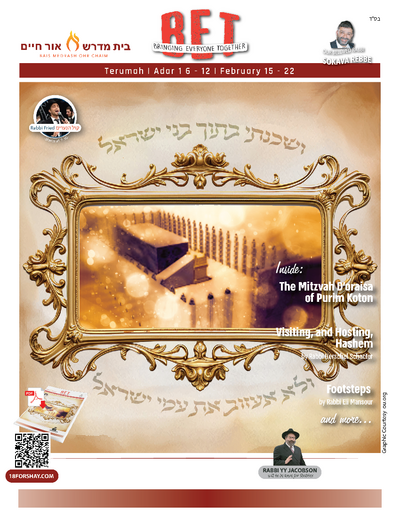
Dwell in Them
One of the most employed materials in the building of the Tabernacle – discussed in this week’s portion, Terumah – was cedar wood (atzei shitim.) Much of the structure and many of the vessels of the Tabernacle were fashioned from cedar.
Says Rashi, quoting the Midrash:
How did the children of Israel obtain [cedar wood for the construction of the Sanctuary] in the desert? Rabbi Tanchuma explained: Our father Jacob foresaw with his holy spirit that Israel was destined to build a Sanctuary in the desert; so he brought cedars to Egypt and planted them [there], and instructed his children to take them along when they left Egypt.
Jacob transported from the Land of Canaan young, tender saplings of cedar and lovingly planted them in the soil of Egypt, instructing his children that one day, when they depart from this country, they must take these trees with them.
Jacob dies. Joseph dies. All the siblings die. Then all the grandchildren die. The first generations of Jews who still knew Jacob and his children passed on. A new Pharaoh began to enslave the young nation. Brutal labor and the extermination of Jewish babies began to become the Jewish plight.
And throughout this entire horrific ordeal, the crushed Hebrew slaves watched these cedars grow. And with it, their hope grew. They harbored the knowledge that long before their enslavement by the Egyptians, these trees had grown in the soil of Holy Land—the land promised to them as their eternal heritage. Each generation of Jews pointed out these cedar trees to their children, transmitted to them Jacob’s instructions to take these trees along when they would leave Egypt, to be fashioned into a Sanctuary for G-d.
And so, throughout their long and bitter exile, these cedars had whispered to the Jewish slaves: This is not your home. You hail from a loftier, holier place. Soon you will leave this depraved land behind, to be reclaimed by G-d as His people. Soon you will uproot us from this foreign land and carry us triumphantly to Sinai, where you will construct for us an abode for the Divine presence, which shall once again manifest itself in your midst.
These cedar trees stood as a permanent, tangible, silent but powerful, and tall symbol of courage, dignity, and hope in a bright future. They gave a nation of tormented, wretched slaves something to “hold on to” in a very concrete way, as they struggled under the yoke of their Egyptian oppressors. These trees offered the Jews some measure of “Tanchuma,” of solace and fortitude, during their darkest moments.
Staves of Faith
“The Tzaddik shall bloom as a palm,” sings the Psalmist, “as a Cedar of Lebanon, he shall flourish.” Jacob planted cedars in Egypt, and G-d plants exactly such cedars in our midst throughout our long and turbulent history. These are the Tzaddikim, the Rebbes, the spiritual giants, defined in Psalms as “cedar trees,” providing us with a link to the past and hope for the future.
The Tzaddik is a soul that towers above the transience and turbulence of exile; a soul that is rooted in Israel’s sacred beginnings and pointed toward the ultimate Redemption—a soul whose two feet stand on earth, but whose head touches heaven. When our subjection to the temporal and the mundane threatens to overwhelm us, we need only look to the cedars implanted in our midst. In these timeless staves of faith, we find guidance and fortitude, comfort, and encouragement. We remember who we are and what we are capable of becoming.
Above Exile
That is the function of every spiritual “cedar tree” teacher in Judaism: To remind all of us that even as we are in exile, our souls can soar on the wings of eternity.
Rabbi YY Jacobson