From the Chasidic Masters Ahavat Shalom on the Tabernacles Panels
Wonders | February 20, 2026
Print This Article
View Original PDF

From the Chasidic Masters Ahavat Shalom on the Tabernacles Panels

Wonders | February 20, 2026

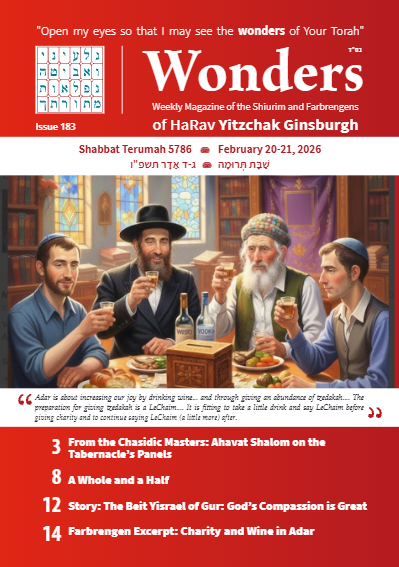
Can saying "thank you" actually create distance in a relationship? This counter-intuitive piece explores the hidden spiritual blueprints within the Biblical Tabernacle to answer that question. By examining how the sanctuary’s wooden panels were joined, we discover a radical definition of friendship: a bond so deep that we become like "twins," where formal gratitude is replaced by absolute oneness. This is the type of bond chasidim hope to achieve.

Beyond relationships, the text we look at from the Ahavat Shalom offers a practical guide to personal growth. It reveals a surprising spiritual anatomy: why "guarding" our physical actions—the "lower half" of our body—is actually the secret to protecting our peace of mind and spiritual clarity. Dive into this mystical journey to understand how ancient architecture holds the key to true love, unity, and mastering the self.

Based on a class given on Shabbat Mishpatim 5784. First published in Hebrew in Nifla’ot for parashat Terumah 5784.

Connecting the Panels

You shall make the panels for the Tabernacle... And they shall be matched (to’amim) at the bottom, and together they shall be perfectly matched (tamim) at its top by a single rectangular band; so, shall it be for both [panels] in the two corners, so it shall be.

The walls of the Tabernacle were made of 1.5-cubit wide panels (also called planks) that had two notches on top and two tabs on the bottom. They were then made to stand with every panel’s two bottom tabs fitted perfectly into a silver base with a socket (figure 1) and every two adjacent panels joined together on top by a gold rectangular band that fit into the notches (figure 2). The sockets fit the tabs so that they would not create a gap between the panels. In this way the panels made a perfect fit above and were perfectly flush with one another below.

Love of Twin Brothers

The word for matched, which is to’amim, is written exactly like the word for “twins,” which is te’omim. In fact, the numerical value of “band” is the same as the value of “twins.” The notion that the panels are meant to be like twins raises the possibility that the way in which the panels are united has something to teach us about relationships, particularly between people who are very close.

The Chasidic master, Rebbe Menachem Mendel Hager of Kossov (out of whom originated Vizhnitz), in his book Ahavat Shalom, explains that the panels that made up the walls of the Tabernacle (together with the crossbeams that ran inside the panels) represent both the relationship people have with a tzaddik and the relationship they have with their closest friends. He notes that the letters of “panels” permute to spell “connections” or “relationships.” These types of relationships require that the two people involved be bound and attached to one another along their entire length—matched below and whole above. The matched/whole panels represent the true love between friends: if one’s head hurts, the other’s will hurt also.

Do Not Say "Thank You"

To his analysis, we may add that the words for “matched” and “twins” are cognate with the word for “earnestness,” the inner psychological experience associated with the sefirah of hod, translated as either thanksgiving or acknowledgment. Each panel was fitted inside a base indicating that the ability to give thanks and to acknowledge the positive in our friends is the base foundation upon which all relationships stand. Furthermore, the Hebrew word for “base” has the same value as “to acknowledge” as in the short statement we say upon awaking every morning, “I give thanks before You.”

However, for all the basis that acknowledgment and showing gratitude provide for a relationship, one must be careful that the base does not separate the planks, meaning that it should not create a gap between the two people. This last insight might be surprising, but gratitude can open a gap between two people. If we are strangers or distant acquaintances, we certainly must thank one another. But truly good friends do not say “thank you” all the time; their connection is closer than that.

When two chasidim farbreng (pass the time) together, when one pours the other a LeChaim, the other does not say, “Thank you.” Instead, he immediately says “LeChaim” or “LeChaim U’Livrachah” (to life and to blessing). If we are two separate people, I thank you greatly, but if we are two hands of a single body, there is no need to thank. On the contrary, excessive thanks is a sign of distance and cold politeness. Likewise, chasidim are not accustomed to asking one another for forgiveness on the eve of Yom Kippur, because the connection of friendship goes far beyond that and they assume that each has already forgiven the other.

While saying “thank you” is a matter of Derech Eretz (proper, civilized conduct) and “Derech Eretz precedes Torah,” once there is Torah, which teaches that all Jews are literally like one body, then the Derech Eretz itself must be updated accordingly. Indeed, all that has been stated here regarding the connection between friends is even more relevant to the connection between a chasid and a rebbe.

Friends

The connection between friends who truly love one another is like the love of God, which is preceded by the instruction that we contemplate His oneness, “Hear O’ Israel, Havayah is our God, Havayah is one. You shall love Havayah your God....”

Much has been written over the ages about the meaning of God’s oneness, particularly by the Chasidic masters. When applied to the relationship between two loving friends, the word “one” can be seen as alluding to three levels of connection, in the following manner: The first letter, aleph, symbolizes absolute unity; one cannot even speak of there being two people involved. When we add the second letter, chet, to the first letter, they form the word “brother,” alluding to the love between twins—two who are like one. Finally, the third letter, dalet, whose value is 4 alludes to the concept of inter-inclusion that can be attained even between two separate entities according to the principle of “two that are four.”

Two people can find aspects of one another in themselves thereby coming to appreciate that they are more similar than they initially thought. Then they can both acknowledge one another and offer thanks to one another. However, one must include the dalet within the alef and chet (which spell “brother”) to complete the word “one” indicating that one should strive to reach a level of oneness that transcends the need to give thanks explicitly.

We do the same regarding our relationship with God. When we wake up in the morning, we begin our day by giving thanks, Modeh Ani (“I offer thank to You, O’ living and eternal King...”), but quickly move to reach a state of self-nullification (bitul) so that we can state that “all is one” when reciting the Shema. The state in which all of existence and all being within it becomes one is God’s purpose in Creation; it is the fulfillment of His desire to have a dwelling place below, in the lower worlds. Returning to parashat Terumah, this is the explicit purpose of making the Tabernacle: “And I [God] shall dwell among them.”

We have seen three levels of developing love between friends. They correspond to the three levels of love described in the verse, “You shall love Havayah your God [1] with all your heart, [2] with all your soul, and [3] with all your might.” The love of “with all your heart” is the love between two separate people, alluded to by the double letter beit in “your heart.” The sages interpret the two letters beit as referring to the two inclinations—the good inclination and the evil inclination (yetzer tov and yetzer hara)—a duality in the psyche that stems from the feeling that I and God are two separate entities. At this level, one should strive to, at the very least, give thanks—the dalet of “one.” The second level of love, between two friends that have become one corresponds to “With all your soul.” The sages explain that this means loving God even if He takes your soul, and this is the type of self-sacrifice two friends that have become one should have for one another to overcome the gap between them. This is the secret of the “brother” in “one.” The third level of love—when friends become a single, unified essence—corresponds to “With all your might.” At this level there is no longer any separation between the two friends. It is love that has no limits, just as “with all your might” means without limits.

Jacob the Twin Man

Let us continue with a quote from Ahavat Shalom:

It is written regarding Rebeccah, “And behold, there were twins (te’omim) in her womb,” but it is written tomim, without the letter aleph. The holy Zohar explains that tomim refers to Jacob alone. This is because te’omim refers to two things that unite and become one, and for this reason, Jacob alone is called tomim. Jacob represents the attribute of beauty (tiferet), the attribute of truth, the middle axis that is comprised of the two aspects of loving-kindness (chesed) and might (gevurah). He is the aspect of the middle crossbeam that spans from one end [of the Tabernacle] to the other, as is known. However, because the wicked Esau was with him in one womb, it is written tomim without the aleph, for the wicked Esau was a “backbiter who separates the Aluf,” meaning that he separates the Master (Alufo) of the world from His world.

According to the Ahavat Shalom, the word tomim, despite meaning “twins,” refers only to Jacob, as if he was a single child in Rebbecah’s womb! Because Esau “separates the Aluf”—he does not recognize the underlying unity of reality that is “God is one,” alluded to by the letter aleph, whose value is one, and which represents the Master of the Universe, the Alufo Shel Olam—he causes the word “twins” to be written without an aleph.

The Redemption depends on the unification of Jacob and Esau. In the past Esau was not ready, so when Jacob sent angels to Esau to him, they returned with the news that Esau not only was not ready, but he was also preparing to battle Jacob. In our times, the Lubavitcher Rebbe believed that Esau is ready to unify with Jacob for the sake of the Redemption. In any case, when they were in the womb, there was no connection between them, so the twinhood was not realized and “Jacob remained alone.”

Jacob is the archetypal soul of beauty (tiferet), referred to as “the beauty of Israel,” Jacob’s God-given name. Internally, tiferet is associated with “truth”—“Give truth to Jacob”—whose letters can be rearranged to spell “twin.” In reference to the panels in the Tabernacle, Jacob is symbolized by the middle crossbeam that went through all the panels. The panels have a socket below supporting them, a crossbeam in the middle, and a ring above. Corresponding this to the model of the Ten Sefirot, the crossbeam is thus the middle axis that joins the highest with the lowest all via the sefirah of knowledge (da’at), the attribute of Moses, whose relationship with Jacob is described as, “Moses from within, Jacob from without,” meaning that Moses, and specifically his knowledge of God, i.e., the Torah, is the soul of truth that needs to be given to Jacob. Jacob and the sefirah of beauty also connect the right axis with the left axis of the sefirot, specifically loving-kindness and might; the right side is “loving-kindness to Abraham” and the left side is “the Fear of Isaac,” whose numerical sum is incredibly exactly the value of “panels”!

Protecting the Lower Half of the Body

The Ahavat Shalom continues:

It is known that spiritual protection should focus on the limbs from the navel down. They are instruments of action, representing Esau. The division of the body at the navel is learnt in the Talmud from the description, “Your upper half aligns with Hormiz [light], your lower half with Hormin [darkness],” and from the verse “It shall be healing to your navel,” as explained in the holy books. When a person protects the body’s organs from the navel down, then the limbs from the navel up—meaning the mind and heart—are automatically protected.

There is a fundamental division in man—from the navel up and from the navel down known as the Golden Ratio division—similar to how Moses is described as “human from his midpoint and below; Godly, from his midpoint and above.” Similarly, in the secret of Adam Kadmon (Primordial Man), there is a primary division between above the navel and below the navel.

The main service of man is to guard the limbs from the navel down, specifically the organ of procreation (often just called “the limb”). From the navel up are the primary organs, the brain and heart; from the navel down are the organs of action, the aspect of Esau (who is called such because he was born looking “complete”, which in Hebrew is cognate with action). This is why he favored being “a man of the field,” the realm of action.

True that despite being above the navel, the hands are the primary instruments of action. However, the hands are used for action only when they descend downwards, therefore they are considered below the navel. Of course, we must guard the upper limbs as well, for example guarding our speech and our eyes; “Do not stray after your hearts and after your eyes.” But, when a person strays after their eyes, the eyes have become instruments of action; the eyes look at mundane reality, down below, from the navel down. However, the eyes in and of themselves do not need guarding. In Kabbalah, it is explained that the shattering of the World of Chaos occurred in the light of the eyes only once they had descended below the navel.

Regarding guarding our thought: While Chabad explains that thought (the intellectual sefirot) is primary, thought is not guarded, which might leave it empty, but rather is meant to be filled with good things; “Abstain from evil [by means of] doing good,” contemplate Godliness until there is no room for other thoughts.

When the panels are matched at the bottom—when we guard our faculties of action—then they are perfectly matched above—the mind and heart are automatically protected!
Can saying "thank you" actually create distance in a relationship? This counter-intuitive piece explores the hidden spiritual blueprints within the Biblical Tabernacle to answer that question. By examining how the sanctuary’s wooden panels were joined, we discover a radical definition of friendship: a bond so deep that we become like "twins," where formal gratitude is replaced by absolute oneness. This is the type of bond chasidim hope to achieve.

Beyond relationships, the text we look at from the Ahavat Shalom offers a practical guide to personal growth. It reveals a surprising spiritual anatomy: why "guarding" our physical actions—the "lower half" of our body—is actually the secret to protecting our peace of mind and spiritual clarity. Dive into this mystical journey to understand how ancient architecture holds the key to true love, unity, and mastering the self.

Based on a class given on Shabbat Mishpatim 5784. First published in Hebrew in Nifla’ot for parashat Terumah 5784.

Connecting the Panels

You shall make the panels for the Tabernacle... And they shall be matched (to’amim) at the bottom, and together they shall be perfectly matched (tamim) at its top by a single rectangular band; so, shall it be for both [panels] in the two corners, so it shall be.

The walls of the Tabernacle were made of 1.5-cubit wide panels (also called planks) that had two notches on top and two tabs on the bottom. They were then made to stand with every panel’s two bottom tabs fitted perfectly into a silver base with a socket (figure 1) and every two adjacent panels joined together on top by a gold rectangular band that fit into the notches (figure 2). The sockets fit the tabs so that they would not create a gap between the panels. In this way the panels made a perfect fit above and were perfectly flush with one another below.

Love of Twin Brothers

The word for matched, which is to’amim, is written exactly like the word for “twins,” which is te’omim. In fact, the numerical value of “band” is the same as the value of “twins.” The notion that the panels are meant to be like twins raises the possibility that the way in which the panels are united has something to teach us about relationships, particularly between people who are very close.

The Chasidic master, Rebbe Menachem Mendel Hager of Kossov (out of whom originated Vizhnitz), in his book Ahavat Shalom, explains that the panels that made up the walls of the Tabernacle (together with the crossbeams that ran inside the panels) represent both the relationship people have with a tzaddik and the relationship they have with their closest friends. He notes that the letters of “panels” permute to spell “connections” or “relationships.” These types of relationships require that the two people involved be bound and attached to one another along their entire length—matched below and whole above. The matched/whole panels represent the true love between friends: if one’s head hurts, the other’s will hurt also.

Do Not Say "Thank You"

To his analysis, we may add that the words for “matched” and “twins” are cognate with the word for “earnestness,” the inner psychological experience associated with the sefirah of hod, translated as either thanksgiving or acknowledgment. Each panel was fitted inside a base indicating that the ability to give thanks and to acknowledge the positive in our friends is the base foundation upon which all relationships stand. Furthermore, the Hebrew word for “base” has the same value as “to acknowledge” as in the short statement we say upon awaking every morning, “I give thanks before You.”

However, for all the basis that acknowledgment and showing gratitude provide for a relationship, one must be careful that the base does not separate the planks, meaning that it should not create a gap between the two people. This last insight might be surprising, but gratitude can open a gap between two people. If we are strangers or distant acquaintances, we certainly must thank one another. But truly good friends do not say “thank you” all the time; their connection is closer than that.

When two chasidim farbreng (pass the time) together, when one pours the other a LeChaim, the other does not say, “Thank you.” Instead, he immediately says “LeChaim” or “LeChaim U’Livrachah” (to life and to blessing). If we are two separate people, I thank you greatly, but if we are two hands of a single body, there is no need to thank. On the contrary, excessive thanks is a sign of distance and cold politeness. Likewise, chasidim are not accustomed to asking one another for forgiveness on the eve of Yom Kippur, because the connection of friendship goes far beyond that and they assume that each has already forgiven the other.

While saying “thank you” is a matter of Derech Eretz (proper, civilized conduct) and “Derech Eretz precedes Torah,” once there is Torah, which teaches that all Jews are literally like one body, then the Derech Eretz itself must be updated accordingly. Indeed, all that has been stated here regarding the connection between friends is even more relevant to the connection between a chasid and a rebbe.

Friends

The connection between friends who truly love one another is like the love of God, which is preceded by the instruction that we contemplate His oneness, “Hear O’ Israel, Havayah is our God, Havayah is one. You shall love Havayah your God....”

Much has been written over the ages about the meaning of God’s oneness, particularly by the Chasidic masters. When applied to the relationship between two loving friends, the word “one” can be seen as alluding to three levels of connection, in the following manner: The first letter, aleph, symbolizes absolute unity; one cannot even speak of there being two people involved. When we add the second letter, chet, to the first letter, they form the word “brother,” alluding to the love between twins—two who are like one. Finally, the third letter, dalet, whose value is 4 alludes to the concept of inter-inclusion that can be attained even between two separate entities according to the principle of “two that are four.”

Two people can find aspects of one another in themselves thereby coming to appreciate that they are more similar than they initially thought. Then they can both acknowledge one another and offer thanks to one another. However, one must include the dalet within the alef and chet (which spell “brother”) to complete the word “one” indicating that one should strive to reach a level of oneness that transcends the need to give thanks explicitly.

We do the same regarding our relationship with God. When we wake up in the morning, we begin our day by giving thanks, Modeh Ani (“I offer thank to You, O’ living and eternal King...”), but quickly move to reach a state of self-nullification (bitul) so that we can state that “all is one” when reciting the Shema. The state in which all of existence and all being within it becomes one is God’s purpose in Creation; it is the fulfillment of His desire to have a dwelling place below, in the lower worlds. Returning to parashat Terumah, this is the explicit purpose of making the Tabernacle: “And I [God] shall dwell among them.”

We have seen three levels of developing love between friends. They correspond to the three levels of love described in the verse, “You shall love Havayah your God [1] with all your heart, [2] with all your soul, and [3] with all your might.” The love of “with all your heart” is the love between two separate people, alluded to by the double letter beit in “your heart.” The sages interpret the two letters beit as referring to the two inclinations—the good inclination and the evil inclination (yetzer tov and yetzer hara)—a duality in the psyche that stems from the feeling that I and God are two separate entities. At this level, one should strive to, at the very least, give thanks—the dalet of “one.” The second level of love, between two friends that have become one corresponds to “With all your soul.” The sages explain that this means loving God even if He takes your soul, and this is the type of self-sacrifice two friends that have become one should have for one another to overcome the gap between them. This is the secret of the “brother” in “one.” The third level of love—when friends become a single, unified essence—corresponds to “With all your might.” At this level there is no longer any separation between the two friends. It is love that has no limits, just as “with all your might” means without limits.

Jacob the Twin Man

Let us continue with a quote from Ahavat Shalom:

It is written regarding Rebeccah, “And behold, there were twins (te’omim) in her womb,” but it is written tomim, without the letter aleph. The holy Zohar explains that tomim refers to Jacob alone. This is because te’omim refers to two things that unite and become one, and for this reason, Jacob alone is called tomim. Jacob represents the attribute of beauty (tiferet), the attribute of truth, the middle axis that is comprised of the two aspects of loving-kindness (chesed) and might (gevurah). He is the aspect of the middle crossbeam that spans from one end [of the Tabernacle] to the other, as is known. However, because the wicked Esau was with him in one womb, it is written tomim without the aleph, for the wicked Esau was a “backbiter who separates the Aluf,” meaning that he separates the Master (Alufo) of the world from His world.

According to the Ahavat Shalom, the word tomim, despite meaning “twins,” refers only to Jacob, as if he was a single child in Rebbecah’s womb! Because Esau “separates the Aluf”—he does not recognize the underlying unity of reality that is “God is one,” alluded to by the letter aleph, whose value is one, and which represents the Master of the Universe, the Alufo Shel Olam—he causes the word “twins” to be written without an aleph.

The Redemption depends on the unification of Jacob and Esau. In the past Esau was not ready, so when Jacob sent angels to Esau to him, they returned with the news that Esau not only was not ready, but he was also preparing to battle Jacob. In our times, the Lubavitcher Rebbe believed that Esau is ready to unify with Jacob for the sake of the Redemption. In any case, when they were in the womb, there was no connection between them, so the twinhood was not realized and “Jacob remained alone.”

Jacob is the archetypal soul of beauty (tiferet), referred to as “the beauty of Israel,” Jacob’s God-given name. Internally, tiferet is associated with “truth”—“Give truth to Jacob”—whose letters can be rearranged to spell “twin.” In reference to the panels in the Tabernacle, Jacob is symbolized by the middle crossbeam that went through all the panels. The panels have a socket below supporting them, a crossbeam in the middle, and a ring above. Corresponding this to the model of the Ten Sefirot, the crossbeam is thus the middle axis that joins the highest with the lowest all via the sefirah of knowledge (da’at), the attribute of Moses, whose relationship with Jacob is described as, “Moses from within, Jacob from without,” meaning that Moses, and specifically his knowledge of God, i.e., the Torah, is the soul of truth that needs to be given to Jacob. Jacob and the sefirah of beauty also connect the right axis with the left axis of the sefirot, specifically loving-kindness and might; the right side is “loving-kindness to Abraham” and the left side is “the Fear of Isaac,” whose numerical sum is incredibly exactly the value of “panels”!

Protecting the Lower Half of the Body

The Ahavat Shalom continues:

It is known that spiritual protection should focus on the limbs from the navel down. They are instruments of action, representing Esau. The division of the body at the navel is learnt in the Talmud from the description, “Your upper half aligns with Hormiz [light], your lower half with Hormin [darkness],” and from the verse “It shall be healing to your navel,” as explained in the holy books. When a person protects the body’s organs from the navel down, then the limbs from the navel up—meaning the mind and heart—are automatically protected.

There is a fundamental division in man—from the navel up and from the navel down known as the Golden Ratio division—similar to how Moses is described as “human from his midpoint and below; Godly, from his midpoint and above.” Similarly, in the secret of Adam Kadmon (Primordial Man), there is a primary division between above the navel and below the navel.

The main service of man is to guard the limbs from the navel down, specifically the organ of procreation (often just called “the limb”). From the navel up are the primary organs, the brain and heart; from the navel down are the organs of action, the aspect of Esau (who is called such because he was born looking “complete”, which in Hebrew is cognate with action). This is why he favored being “a man of the field,” the realm of action.

True that despite being above the navel, the hands are the primary instruments of action. However, the hands are used for action only when they descend downwards, therefore they are considered below the navel. Of course, we must guard the upper limbs as well, for example guarding our speech and our eyes; “Do not stray after your hearts and after your eyes.” But, when a person strays after their eyes, the eyes have become instruments of action; the eyes look at mundane reality, down below, from the navel down. However, the eyes in and of themselves do not need guarding. In Kabbalah, it is explained that the shattering of the World of Chaos occurred in the light of the eyes only once they had descended below the navel.

Regarding guarding our thought: While Chabad explains that thought (the intellectual sefirot) is primary, thought is not guarded, which might leave it empty, but rather is meant to be filled with good things; “Abstain from evil [by means of] doing good,” contemplate Godliness until there is no room for other thoughts.

When the panels are matched at the bottom—when we guard our faculties of action—then they are perfectly matched above—the mind and heart are automatically protected!

PDF Preview