Getting Our Priorities Straight Kemach vs Torah
למודי משה | February 20, 2026
Print This Article
View Original PDF

Getting Our Priorities Straight Kemach vs Torah

למודי משה | February 20, 2026

Getting Our Priorities Straight: Kemach vs Torah

When the Torah explains how the kaylim [vessels] of the Mishkan were set out, the pasuk says:ונתת את הכפרת על ארון העדת בקדש הקדשים. ושמת את השלחן מחוץ לפרכת ואת המנרה נכח השלחן על צלע המשכן תימנה והשלחן תתן על צלע צפון - “You will then place the cover on the Ark of Testimony in the Holy of Holies. And place the Table outside the curtain and the Menorah should be placed opposite the Table, toward the southern wall; and the Table should be toward the northern wall.” (26:34-35)

Anyone who examines the pasuk carefully sees a redundancy. The Torah first says to put the Shulchan [Table] in front of the curtain and then immediately says to put the Menorah opposite it on the southern side. Any person with the power of deduction knows that as a result, the Shulchan is on the northern side. Why does the Torah need to repeat and reiterate the fact that the Shulchan is on the northern side?

R' Frand related a beautiful interpretation in this from Rav Kulefsky (previous Rosh Yeshiva of Ner Yisroel). The sefer “Sifsei Kohen” asks the following question: We know that the Shulchan symbolically represents parnasa [livelihood], the ability for the Jewish people to sustain themselves physically and materially. The Menorah symbolically represents Torah. The light of the Menorah symbolizes the light of Torah. Why then, asks the Sifsei Kohen, was the Shulchan placed first, before the Menorah? After all, the Menorah is more significant than the Shulchan.

Rav Kulefsky answers, “If there is no kemach [flour], there is no Torah” (Avos 3:17). If there is no livelihood, there can be no Torah. Therefore, first we put out the Shulchan, representing parnasa and then we put out the Menorah, representing Torah.

Rav Kulefsky asks further that the same Mishnah says, “If there is no Torah, there is no kemach!” So what did the Sifsei Kohen accomplish by quoting the Mishnah? The question remains, why give the Shulchan priority over the Menorah?

Rav Kulefsky quotes a very important comment from the Vilna Gaon on Mishlei. The Mishnah also says “If there is no chochma [wisdom], there is no yirah [fear] of G-d.” Then the Mishnah says, “If there is no fear of G-d, there is no wisdom.” The Gaon asks, what does this mean? Which way is it?

The Gaon answers that when we speak in terms of chronological priorities, wisdom needs to precede fear of Hashem, because “the ignoramus cannot be pious” (Avos 2:5). Simply, someone who does not know anything, cannot be observant. However, in terms of ‘tachlis’ – in terms of our goals and purpose in life, priority is given to fear of Hashem. In other words, if wisdom is not going to lead to observance, (for example, writing ‘chiddushei Torah’ on Shabbos while smoking a cigarette), the wisdom is worthless. The person can learn a blatt Gemara, but if he is not an honest person, his learning is not worth much.

The same is true here as well. In terms of chronological priorities, unless a person establishes a viable means of supporting himself — one way or another — if there is no kemach, there is no Torah. If a person must go around begging, he is not going to be able to sit and learn.

But in terms of ultimate goals and purposes, in terms of tachlis, if it doesn’t lead to Torah, if someone is just accumulating money for the sake of making money, then the money is worthless. If a person does not use his kemach for the right reasons, it is of no value.

This is what the Torah is teaching: First we place the Shulchan, because “If there is no flour, there is no Torah.” Then we put the Menorah opposite the Shulchan because we need the Shulchan to be there for the Torah, represented by the Menorah, to exist.

Then the pasuk reiterates that the Shulchan should be on the northern side. Now that we have reached the point where we have established the Menorah / Torah, we must realize that the Shulchan’s only purpose is to be opposite the Menorah. At this point, we need to realize that the Shulchan’s reason for existing is only to support the Menorah. Merely having a Shulchan, in and of itself, serves no purpose. We need to have our priorities straight: Without Torah, the kemach serves no purpose!
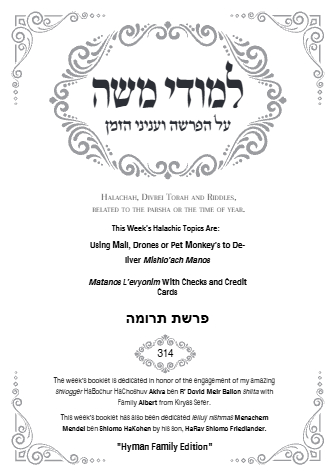

Getting Our Priorities Straight: Kemach vs Torah

When the Torah explains how the kaylim [vessels] of the Mishkan were set out, the pasuk says:ונתת את הכפרת על ארון העדת בקדש הקדשים. ושמת את השלחן מחוץ לפרכת ואת המנרה נכח השלחן על צלע המשכן תימנה והשלחן תתן על צלע צפון - “You will then place the cover on the Ark of Testimony in the Holy of Holies. And place the Table outside the curtain and the Menorah should be placed opposite the Table, toward the southern wall; and the Table should be toward the northern wall.” (26:34-35)

Anyone who examines the pasuk carefully sees a redundancy. The Torah first says to put the Shulchan [Table] in front of the curtain and then immediately says to put the Menorah opposite it on the southern side. Any person with the power of deduction knows that as a result, the Shulchan is on the northern side. Why does the Torah need to repeat and reiterate the fact that the Shulchan is on the northern side?

R' Frand related a beautiful interpretation in this from Rav Kulefsky (previous Rosh Yeshiva of Ner Yisroel). The sefer “Sifsei Kohen” asks the following question: We know that the Shulchan symbolically represents parnasa [livelihood], the ability for the Jewish people to sustain themselves physically and materially. The Menorah symbolically represents Torah. The light of the Menorah symbolizes the light of Torah. Why then, asks the Sifsei Kohen, was the Shulchan placed first, before the Menorah? After all, the Menorah is more significant than the Shulchan.

Rav Kulefsky answers, “If there is no kemach [flour], there is no Torah” (Avos 3:17). If there is no livelihood, there can be no Torah. Therefore, first we put out the Shulchan, representing parnasa and then we put out the Menorah, representing Torah.

Rav Kulefsky asks further that the same Mishnah says, “If there is no Torah, there is no kemach!” So what did the Sifsei Kohen accomplish by quoting the Mishnah? The question remains, why give the Shulchan priority over the Menorah?

Rav Kulefsky quotes a very important comment from the Vilna Gaon on Mishlei. The Mishnah also says “If there is no chochma [wisdom], there is no yirah [fear] of G-d.” Then the Mishnah says, “If there is no fear of G-d, there is no wisdom.” The Gaon asks, what does this mean? Which way is it?

The Gaon answers that when we speak in terms of chronological priorities, wisdom needs to precede fear of Hashem, because “the ignoramus cannot be pious” (Avos 2:5). Simply, someone who does not know anything, cannot be observant. However, in terms of ‘tachlis’ – in terms of our goals and purpose in life, priority is given to fear of Hashem. In other words, if wisdom is not going to lead to observance, (for example, writing ‘chiddushei Torah’ on Shabbos while smoking a cigarette), the wisdom is worthless. The person can learn a blatt Gemara, but if he is not an honest person, his learning is not worth much.

The same is true here as well. In terms of chronological priorities, unless a person establishes a viable means of supporting himself — one way or another — if there is no kemach, there is no Torah. If a person must go around begging, he is not going to be able to sit and learn.

But in terms of ultimate goals and purposes, in terms of tachlis, if it doesn’t lead to Torah, if someone is just accumulating money for the sake of making money, then the money is worthless. If a person does not use his kemach for the right reasons, it is of no value.

This is what the Torah is teaching: First we place the Shulchan, because “If there is no flour, there is no Torah.” Then we put the Menorah opposite the Shulchan because we need the Shulchan to be there for the Torah, represented by the Menorah, to exist.

Then the pasuk reiterates that the Shulchan should be on the northern side. Now that we have reached the point where we have established the Menorah / Torah, we must realize that the Shulchan’s only purpose is to be opposite the Menorah. At this point, we need to realize that the Shulchan’s reason for existing is only to support the Menorah. Merely having a Shulchan, in and of itself, serves no purpose. We need to have our priorities straight: Without Torah, the kemach serves no purpose!

PDF Preview