Haftorah of Sidra Terumah
This week’s Haftorah is taken from the first Sefer Melochim, Chapter 5 verse 26 — Chapter 6 verse 13
1. The Sidra is about the making of the Mishkan, the Haftorah is about the building of the Beis HaMikdash.
2. Really, the making of the Mishkan in the Wilderness on our way out from Egypt to Eretz Yisroel, was, so to speak, not part of the original “plan.” HaShem had told Mosheh at the Burning Bush, long before Mosheh returned to Egypt from Midyan to lead us out from Egypt, that when we left Egypt we would receive the Torah at Mount Sinai and so we did. Then, after HaShem had given us His Torah, Mosheh ascended the mountain to learn from HaShem all the Oral Torah, to return to us after forty days. We would then have gone directly to Eretz Yisroel, taken possession of the Land and Mosheh would have set about building the Beis HaMikdash (one of the three Mitzvos that we are commanded on our coming into Eretz Yisroel). But when Mosheh descended, he saw how the people had erred and sinned with the Golden Calf. He begged HaShem to forgive His People and take them back again and on the tenth day of Tishrei, HaShem granted us His pardon. (Later, when HaShem commanded the Yommim Tovim, He fixed this date to be the annual Day of Atonement.)
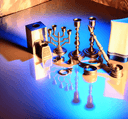
3. Mosheh then beseeched HaShem to indeed show that He had taken us back again and it was in response to this that HaShem commanded, “Let them make for Me a Sanctuary and I will dwell amongst them” — openly. This “make for Me a Sanctuary” took the best part of a year. This Sanctuary was in fact a kind of interim “ahead-of-time” version of the great Beis HaMikdash that was going to be built in Eretz Yisroel which for practical reasons had to be transportable and smaller.
4. The Haftorah tells us how the young King Shlomo put in hand the building of the Beis HaMikdash that his father Dovid had so much wanted to build. The design of the Beis HaMikdash is based on the Mishkan, both of these holy structures commanded by HaShem Himself in all their particulars. Besides the obvious deep symbolism in each and every detail of the Beis HaMikdash, it was at the same time intended to be a focal point for the Jewish People and for all humanity who came from far and wide to see this great, impressive edifice dedicated to the Glory of HaShem. But not only was the building itself symbolic, even the way it was erected was an expression of peace, rising as it did silently without the sound of any implement of iron (the material of the sword) allowed at the sacred building site.
5. The Haftorah ends with the promise of HaShem to Shlomo that as long as he and his descendants will be loyal to HaShem and His Torah, so long will the Divine Presence make Its abode here within these walls, within the Jewish People. Yet sacred buildings are not the main thing. Indeed, we have existed as a People without a Beis HaMikdash for far longer than we have had one. For HaShem wishes to dwell among us, His People, in our homes and hearts and His Presence will come wherever we ourselves give access to Him to come.