Keruvim in the Torah and Their Symbolism
In Genesis 3, we read that G-d drove man out of the Garden of Eden and placed at the east of the Garden of Eden, the Keruvim, and a flaming sword (to keep man from returning to the Garden).
In Exodus 25, the Israelites are commanded to build an Ark (of the Covenant) to house the Luchos (tablets) of the 10 Commandments. Upon the Ark, two Keruvim, made of gold, are to be placed, facing each other with outstretched wings.
In Kings 1, we read that King Shlomo had made two Keruvim of olive wood, plated with gold, each 10 cubits tall, (approximately 17 feet), again with outstretched wings, as an adornment to the Kodesh HaKedoshim. Keruvim were carved into the doors of the temple and overlaid with gold. Their images were sewn on a veil of linen used in the temple.
The Torah portion of Terumah discusses the details of the Sanctuary in which G-d dwells. The first vessel related in detail is the Ark of the Covenant, above which are the two Keruvim. While the Holy Ark contains the Torah, G-d's eternal wisdom, His voice and ongoing directives emanate from between the joined wingtips of the two Keruvim, who symbolize the love between G-d and the people of Israel.
KERUVIM FROM THE TORAH
The body was 10 tefachim high. The Keruvim were also very heavy: the volume of the Keruvim was fifteen hundredths of a cubic meter. The volume was not hollow since both Keruvim were solid gold. Their height was ten handbreadths and they also had long wings. This translates into thousands of pounds of gold!
The wings were stretched upwards as stated (Shmos 25, 20) סוככים בכנפיהם על הכפורת. From the top of the wings down to the top of the Kapores was a space of 10 tefachim. From here it is learned that the minimum size of the area of a Sukkah that is covered by Schach (connected to סוככים) is a space of 10 tefachim.
The face was one tefach. The face had the appearance of a young child. The one in the north was a male, and the one in the south was of a female. Their faces were directed towards the cover (which was on top of the Aron which contained the Luchos), while their backs were away from it. Thus, the Keruvim stood like students facing their master.
The Keruvim were beaten out of the same piece of gold as the ark cover (Kapores). They could not be made separately and later attached to the cover.
THE KERUVIM IN CONTEXT OF THE ARK
Ramban held that the purpose of the Ark, its contents, and the lid, were all of a singular purpose, namely to cause the Divine Presence to dwell, therefore, the faces would also reflect this idea. They resembled the Divine Presence as it appeared to Ezekiel in his vision.
Rashi understood that the Aron, lid, and the Keruvim each had a separate function. The Keruvim represent G-d’s love to the Jewish people. Therefore, the appearance of the Keruvim were the features of children. (Lekutei Sichos vol. 26, pp. 175ff)
SIGNIFICANCE OF THE KERUVIM
Everything in the Mishkan (and the Bais HaMikdash) had a purpose to teach a person how to keep his mind attached constantly to HaShem. The Keruvim also teach us many valuable things:
- Per Rambam, just as we believe in HaShem, so we must believe in the existence of angels, and that they are a conduit for prophecy in this world.
- They demonstrate how much G-d loves us when we do His Will. When the Jews do the Will of HaShem then, the two Keruvim embrace, like a man and wife, showing how cherished we are to HaShem.
- The Luchos were in the Ark. The Keruvim were on top with their wings spread upwards. The Torah must be studied for its own sake (upwards), to honor G-d and sustain His creation.
- The Keruvim also teach us the importance of training one’s children to study Torah and keep the Mitzvos. This is the reason the Keruvim have the appearance of young children.
- Their appearance as young children also teaches us that the children are our guarantors for the Torah.
- Further, the world is sustained primarily through the breath of young children who are beginning their Torah studies.
DEEPER UNDERSTANDING OF THE KERUVIM (Inner.org)
Powers of Two
The Keruvim are initially referred to as Two. Each cherub had 4 elements (2 squared):
A Body Right Wing
A Face Left Wing
When joined together at their wingtips, the Keruvim have a total of 8 elements, (2 cubed).
The root of the Hebrew word for the Keruvim, chof-reish-beit also represents 2. The numerical value of the chof is 20, of the reish 200 and of the beit 2. All of these numbers can be reduced to 2.
The 2’s represent the perfect state of love, harmony and delight symbolized by the Keruvim. This love serves as the magnet that draws down G-d's voice to speak to Israel.
Male Symmetry and Female Symmetry
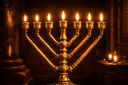
The two vessels in the Temple that reflect perfect symmetry are the Menorah and the Keruvim. The menorah's symmetry is relatively male, while the symmetry of the Keruvim is relatively female.
Male symmetry is a well-defined axis of 1 in the middle, with an identical number of elements that are present on each side of the axis. In this type of symmetry, there will always be an odd number of elements, another sign of the male state. The Menorah perfectly illustrates this type of symmetry.
Female symmetry has no defined axis, but is rather an even number of elements arranged in a perfectly symmetrical manner.
In the Temple, the male-symmetrical menorah is positioned in the holy sanctuary. The female-symmetrical Keruvim are in the Holy of Holies. The epitome of beauty and the symmetry of coupling are female, as also represented by the powers of 2 associated with the Keruvim.
Keruvim at the Garden of Eden
The first place that the Keruvim appear in the Torah is after Adam and Eve are evicted (in Hebrew, the word for "eviction," gerush, is the same as the word for divorce) from the Garden of Eden. The Keruvim assumed a fearful role at the entrance to the Garden, along with the fiery, turning sword. Their role was to ensure that Adam would not re-enter the Garden, eat from the Tree of Life and eternalize the primordial sin.
In this context, the Keruvim are a type of angel. Maimonides classifies ten types of angels. According to Kabbalah, these ten types of angels correspond to the ten sefirot. The lowest level of angels, ishim, ("men") are those that converse with prophets or people imbued with the holy spirit. Ishim correspond to the sefirah of malchut.
The next level of angels, Keruvim, corresponds to the sefirah of yesod. They represent the spiritual power of union between man and wife, and symbolize the union between G-d and Israel.
Baby Face
Our Sages explain that the Hebrew word for cherub, kruv, is from Aramaic and means "as a baby." The Keruvim had baby faces. A baby face represents innocence. The loving touch of the Keruvim in the Holy of Holies reflects the epitome of pure, innocent love. This innocence exists in the Holy of Holies, in a realm that predates the primordial sin. After the primordial sin, the Keruvim also assumed the role of fearful angels.
The Inner Essence of Innocence
The commentator, Abraham Ibn Ezra, defines the word kruv as formless matter that can assume any form whatsoever based on the Vision of the Chariot in the first chapter of Ezekiel. The prophet initially describes four figures: a lion, an ox, an eagle and a man. Later, Ezekiel replaces the ox with a description of a kruv. Subsequently, Ezekiel describes all the forms as keruvim. The Ibn Ezra concludes from this that the kruv is an amorphous state that can assume any form.
This is the exact property of the Keruvim, who can assume the form of fearful angels and also of consummate love. Innocence lends itself to this amorphous state, which can assume opposite forms. Amorphousness is also reflected in a baby's face, which assumes a more certain form after the baby matures and manifests his power of free choice. Thus, this ability to strip away one form and to wear another is the inner essence of innocence.