Purim of Hebron
Living Jewish | February 21, 2026
Print This Article
View Original PDF

Purim of Hebron

Living Jewish | February 21, 2026

Envoys of the Jewish community in Jerusalem came to their brethren, the members of the Sephardic community in Hebron, with an urgent request. The community was in need of assistance for the mitzvah of redeeming captives. At first, the Jews of Hebron responded positively and asked to hear what the matter was. However, when they heard the sum named, they looked at one another in astonishment.

“Five thousand liras,” said the emissaries. “That is the amount the Sages of Jerusalem have imposed upon us to collect from you—not a single lira less.”

The community of Hebron was not wealthy and had its own charitable needs. “The poor of our own city come first,” the residents argued. “We are unable to give such a large sum.” As a result, the emissaries left Hebron empty-handed.

A short time later, a new pasha (ruler) was appointed to Hebron by the Turkish government that then ruled the Land of Israel. Upon assuming office, the pasha imposed various harsh decrees upon the Jews of his city.

An Enormous Sum

He went even further when one day he summoned the heads of the community and informed them that he demanded that the Jews of Hebron pay him a one-time tax of fifty thousand liras. It was an enormous sum that the members of the Hebron community, even if they greatly wished to, could not possibly pay.

The villain left no room for doubt regarding the seriousness of his intentions. On the spot, he ordered his servants to arrest the heads of the community and throw them into prison until the full amount he demanded would be produced.

News of the decree and the arrests spread quickly—and the city of Hebron was thrown into confusion.

The Sages of the community hurried to convene all the members of their congregation to take counsel. During the gathering, one of the Sages rose and began to confess guilt: “We are at fault, for we did not heed the request of the Sages of Jerusalem and did not assist them in the mitzvah of redeeming captives. Therefore this calamity has come upon us. It can only be that Heaven is dealing with us measure for measure...”

Fasting and Prayers

At the end of the assembly, it was decided to raise every possible sum from within the community and from outside it. At the same time, all men, women, and children were called upon to increase prayer and supplication before Him in whose hands lie the hearts of kings and ministers.

In the days that followed, a sense of tension and an atmosphere of spiritual awakening enveloped all the Jews of Hebron. Many of them fasted and afflicted themselves; the Sages of the community and its leaders tried, in their own ways, to avert the harsh decree.

After a full day of fasting and prayers accompanied by the intentions and mystical unifications known to them, the Sages composed a special text of supplication for mercy. They wrote the text in Assyrian script on a parchment scroll, which they asked to be lowered into the Cave of Machpelah.

In those days, Jews were forbidden to enter the Cave of Machpelah. The only way to get the scroll inside, to the resting place of the Patriarchs, was by bribing the cave’s guard. Indeed, after he received a respectable sum, the scroll with the plea for mercy reached its destination.

The final date the pasha set for payment of the money was the 14th of Tevet. He announced that if by then his demand was not met, he would sell all the members of the community into slavery and thus obtain the money he required.

The Dream

On the night of the 14th of Tevet, all the members of the community gathered in the synagogue. At the Sages’ instruction, the doors and windows were closed. The Sages aroused their flock to wholehearted repentance. Afterward, the congregation said selichot.

That night, sleep fled from the pasha. His thoughts were preoccupied with what was to occur the next day. He could not fall asleep, thinking about the legendary sum he was destined to receive from the Jews.

Suddenly he rose from his bed and began to wander through the rooms of his residence. He entered the treasury chamber and felt with his hands a sack full of gold dinars. “Soon,” he said to himself, “my wealth will double and redouble from the money of the Jews...”

Eventually, fatigue overcame him and he fell asleep. In his dream, he saw three majestic figures. The figures entered his house, walked with measured steps toward the sack of dinars, took it with them, and vanished as suddenly as they had appeared. The terrified pasha let out cries of anguish—and awoke.

All that night, the Jews of Hebron did not cease praying and pleading. Toward morning, before dawn broke, a knock was suddenly heard at the door of the synagogue. The door was opened, and to the astonishment of the Jews who opened it, they saw before them a sack full of gold dinars. In amazement, the Jews of Hebron gazed at the sack of coins that had been placed at their entrance by an unseen hand.

A short while later, the pasha himself appeared at the gates of the synagogue and demanded the fifty thousand liras. The excited Jews extended toward him the sack of dinars—the very sack that he himself had felt with his own hands only a few hours earlier, the sack that had been taken by the three figures in his dream.

At that moment, the pasha too understood that the G-d of the Jews had once again heeded their prayers and performed a miracle for them. “Yes, yes,” the pasha stammered, “I know how this sack came to you. Your forefathers—Abraham, Isaac, and Jacob—visited my house tonight...”

The 14th of Tevet, the day on which the Jews of Hebron were destined to be sold into slavery, was transformed for them into a day of joy and gladness, a festive day, and it was established for generations as “Purim of Hebron.”
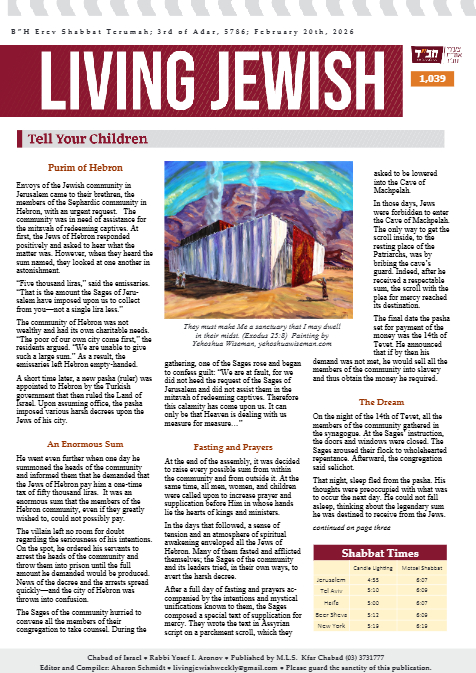

Envoys of the Jewish community in Jerusalem came to their brethren, the members of the Sephardic community in Hebron, with an urgent request. The community was in need of assistance for the mitzvah of redeeming captives. At first, the Jews of Hebron responded positively and asked to hear what the matter was. However, when they heard the sum named, they looked at one another in astonishment.

“Five thousand liras,” said the emissaries. “That is the amount the Sages of Jerusalem have imposed upon us to collect from you—not a single lira less.”

The community of Hebron was not wealthy and had its own charitable needs. “The poor of our own city come first,” the residents argued. “We are unable to give such a large sum.” As a result, the emissaries left Hebron empty-handed.

A short time later, a new pasha (ruler) was appointed to Hebron by the Turkish government that then ruled the Land of Israel. Upon assuming office, the pasha imposed various harsh decrees upon the Jews of his city.

An Enormous Sum

He went even further when one day he summoned the heads of the community and informed them that he demanded that the Jews of Hebron pay him a one-time tax of fifty thousand liras. It was an enormous sum that the members of the Hebron community, even if they greatly wished to, could not possibly pay.

The villain left no room for doubt regarding the seriousness of his intentions. On the spot, he ordered his servants to arrest the heads of the community and throw them into prison until the full amount he demanded would be produced.

News of the decree and the arrests spread quickly—and the city of Hebron was thrown into confusion.

The Sages of the community hurried to convene all the members of their congregation to take counsel. During the gathering, one of the Sages rose and began to confess guilt: “We are at fault, for we did not heed the request of the Sages of Jerusalem and did not assist them in the mitzvah of redeeming captives. Therefore this calamity has come upon us. It can only be that Heaven is dealing with us measure for measure...”

Fasting and Prayers

At the end of the assembly, it was decided to raise every possible sum from within the community and from outside it. At the same time, all men, women, and children were called upon to increase prayer and supplication before Him in whose hands lie the hearts of kings and ministers.

In the days that followed, a sense of tension and an atmosphere of spiritual awakening enveloped all the Jews of Hebron. Many of them fasted and afflicted themselves; the Sages of the community and its leaders tried, in their own ways, to avert the harsh decree.

After a full day of fasting and prayers accompanied by the intentions and mystical unifications known to them, the Sages composed a special text of supplication for mercy. They wrote the text in Assyrian script on a parchment scroll, which they asked to be lowered into the Cave of Machpelah.

In those days, Jews were forbidden to enter the Cave of Machpelah. The only way to get the scroll inside, to the resting place of the Patriarchs, was by bribing the cave’s guard. Indeed, after he received a respectable sum, the scroll with the plea for mercy reached its destination.

The final date the pasha set for payment of the money was the 14th of Tevet. He announced that if by then his demand was not met, he would sell all the members of the community into slavery and thus obtain the money he required.

The Dream

On the night of the 14th of Tevet, all the members of the community gathered in the synagogue. At the Sages’ instruction, the doors and windows were closed. The Sages aroused their flock to wholehearted repentance. Afterward, the congregation said selichot.

That night, sleep fled from the pasha. His thoughts were preoccupied with what was to occur the next day. He could not fall asleep, thinking about the legendary sum he was destined to receive from the Jews.

Suddenly he rose from his bed and began to wander through the rooms of his residence. He entered the treasury chamber and felt with his hands a sack full of gold dinars. “Soon,” he said to himself, “my wealth will double and redouble from the money of the Jews...”

Eventually, fatigue overcame him and he fell asleep. In his dream, he saw three majestic figures. The figures entered his house, walked with measured steps toward the sack of dinars, took it with them, and vanished as suddenly as they had appeared. The terrified pasha let out cries of anguish—and awoke.

All that night, the Jews of Hebron did not cease praying and pleading. Toward morning, before dawn broke, a knock was suddenly heard at the door of the synagogue. The door was opened, and to the astonishment of the Jews who opened it, they saw before them a sack full of gold dinars. In amazement, the Jews of Hebron gazed at the sack of coins that had been placed at their entrance by an unseen hand.

A short while later, the pasha himself appeared at the gates of the synagogue and demanded the fifty thousand liras. The excited Jews extended toward him the sack of dinars—the very sack that he himself had felt with his own hands only a few hours earlier, the sack that had been taken by the three figures in his dream.

At that moment, the pasha too understood that the G-d of the Jews had once again heeded their prayers and performed a miracle for them. “Yes, yes,” the pasha stammered, “I know how this sack came to you. Your forefathers—Abraham, Isaac, and Jacob—visited my house tonight...”

The 14th of Tevet, the day on which the Jews of Hebron were destined to be sold into slavery, was transformed for them into a day of joy and gladness, a festive day, and it was established for generations as “Purim of Hebron.”

PDF Preview