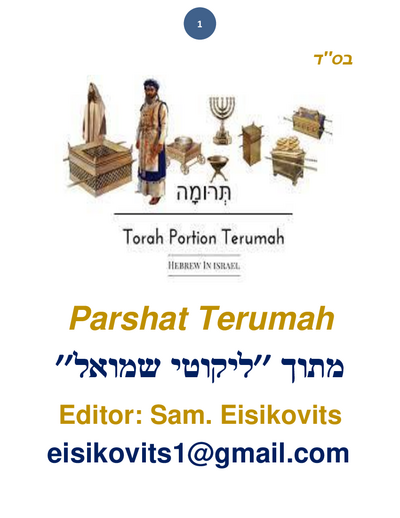
Tabernacle
The verses of the establishment of the Tabernacle reflect the description of the creation of the world. After God creates the world with wondrous wisdom, it is man's turn to bring holiness into it.
Rabbi Eliezer Eisikowits
It is said that when the famous scientist Isaac Newton died, he left in his estate a mysterious wooden crate full of writings that had been gathering dust for years. When they finally opened it, the researchers were in for a surprise. They discovered that Newton – the one who discovered the law of gravity, invented a new kind of mathematics, and is considered the greatest scientist ever – was most interested in spiritual subjects and the book-of-books. In particular, he was interested in the study of the dimensions and features of the Tabernacle. It occurred to him that the Tabernacle and its parts were a miniature model of the great world, and that all the secrets of creation were hidden within it. Therefore, in order to fully understand the parts of the Tabernacle, he must know exactly how the world works. Newton therefore laid the foundations of modern science while trying to understand the Torah affair...
We do not know exactly what the Gentile scholar concluded in his research, nor is it very important for us to know. As Jews, we have more reliable sources with which to explore the secrets of the Tabernacle, the depth of whose sacred secrets we will not reach. But an interesting fact is that this famous scholar was imbued with spiritual consciousness and realized that his studies do not reveal a single drop in the sea of infinite wisdom in which the world was created.
At the end of the introduction to his book, he writes : "I, as a child, spent all his life playing by the sea, enjoying the occasional smoother pebble or beautiful shell than the others, while the great ocean of truth stretched out before him without anyone revealing his secrets."
**
A perusal of the verses dealing with the establishment of the Tabernacle will notice the many similarities between them and the portion of the creation of the world.
Seven times the verb "doing" appears at the time of the creation of the world, and about two hundred times the verb "doing" is mentioned during the construction of the Tabernacle.
At the end of the creation of the world, it is said, "And the heavens and the earth and all their army were contained, and on the seventh day God did the work that He did". At the same time, at the end of the establishment of the Tabernacle, it is said, "All the work of the Tabernacle of the Tabernacle shall be completed... And Moses could do the work."
The creation of the world ends with a blessing," and God blessed the seventh day, "and even the establishment of the Tabernacle ends with a blessing," and Moses blessed them."
After the process of creation, it is said, "God saw all that He did, and behold, it is very good," and against this, after the end of the act of the Tabernacle, it is said, "And Moses feared all the work, and behold, they did it when the Lord commanded them to do so.
G-d created the entire world in six days and rested on the seventh day. The pattern of the Tabernacle is also shown by the name of Moses at Mount Sinai after six days, as it is written at the end of the portion of Mishpatim ["And the glory of God dwelled on Mount Sinai, and the cloud covered him for six days, and he called out to Moses on the seventh day out of the cloud" [Exodus 24:16].
The connection between the Tabernacle and creation appears openly in the context of the Sabbath. On Shabbat, it was forbidden to do crafts "in memory of Genesis", and here is the list of the 39 forbidden crafts on Shabbat based on the same crafts that were used in the construction of the Tabernacle.
There is therefore a deep connection between the Tabernacle and the Sabbath: the former is an island of holiness within space; the second is an island of holiness within time.
The meaning is clear: the establishment of the Tabernacle is the continuation and completion of the creation of the world. G-d creates the world and places man in it as the crown of creation, and the people of Israel establish within the world a Tabernacle so that the Divine presence will sing in it and bring holiness into the physical reality of the world.
**
Details that stand out in the Tabernacle is the meticulous adherence to measurements. Each part and vessel in the Tabernacle has a meticulous length and width that should not be exceeded. In this respect, too, the Tabernacle reflects a fundamental feature of the world.
One of the most significant scientific discoveries of modern times is the unimaginable level of precision that the forces of nature must act with in order for the world to exist.
Today, science knows dozens of parameters that, even a minor change in them, would disable the universe and prevent it from being a suitable environment for life. For example, a slight change in gravity, upward or downward, would irreparably disrupt the universe. Minimal change in nuclear power. It would prevent the action of the stars—and again, the universe would become a place devoid of life. The same is true of microscopic displacement in the intensity of the electromagnetic force, the weight of the elementary particles, or the precise value of nature's constants.
We are not talking here about the Divine wisdom revealed in the planning and order of the living world, but about that part of the world that is somehow called the "still," even though in practice it cries out loud the wisdom of the Creator.
The human brain finds it difficult to grasp the level of accuracy required in every possible parameter. The universe turns out to be a machine made up of so many incredibly delicate parts that every change of them – even featherweight – will cause it to collapse. Who engineered the machine? Who adjusted the exact value of its parts?
In the book of Proverbs, the course of creation is described as follows, "God wisely established a earth, established heaven wisely. In his mind, chasms were split [Proverbs 39-20].And here are exactly the qualities required by the builder of the Tabernacle, Bezalel ben Uri, and he will fill him the Spirit of God, with wisdom and wisdom and knowledge and in every work.
The Tabernacle and creation reflect each other and both have one purpose: to sanctify the world.