The Ohr Hachaim HaKodesh on Terumah
Parsha Pages | February 12, 2024
Print This Article
View Original PDF

The Ohr Hachaim HaKodesh on Terumah

Parsha Pages | December 10, 2025

Experts and Rulers

Daber el Bnei Yisrael – “Speak to Bnei Yisrael, and let them take for Me a teruma, from every man whose heart is charitable shall you take My portion – terumosi” (25:2).

The Ohr HaChaim HaKodosh has a unique interpretation of our pasuk: he begins by way of introduction (see Bava Basra 8b) that normally tzedaka collectors must collect in groups of two, because we do not allow individuals to collect money and impose their will on the community as rulers in such matters alone. In fact, he cites the opinion of Tosafos and the Ran (Rabbeinu Nissim) that even two are insufficient except in matters where the amounts collected are fixed, but when estimates need to be made and an appraisal calculated of each person’s net worth to fix the amount of the donation, then three collectors must work together to arrive at the correct figure.

Now the Ohr HaChaim says that the Halacha is (Sanhedrin 5) that an individual who is an expert can in fact judge these monetary matters alone, and his rule is law. Tosafos there say that he can force anyone to pay a donation and act alone without a need for two. They derive this logically: since an expert can judge matters alone when normally three judges are required, surely here, in matters of rule of law where normally we require just two, he can rule [and calculate and collect tzedoka donations and the teruma].

Based on this concept that an expert can rule, calculate and collect by force, the Ohr HaChaim reinterprets the word daber to mean “rule” and “control” instead of “speak”. The Ohr HaChaim understands from the pasuk that HaShem commanded Moshe to rule over Bnei Yisrael as an expert individual, who can rule alone on matters of donation, calculate the net worth and ability of individuals and how much they should give and collect from them even by force if need be. Daber el Bnei Yisrael – “rule over Bnei Yisrael” – and calculate and collect from them on your own, even though appraisal normally requires three and collection two, because you, Moshe, are an expert individual and you can take the place of three and, of course, two, in matters of collection that require rule of law.

This idea, says the Ohr HaChaim, is demonstrated in pasuk 36:3, where we see Moshe collecting the donations on his own. My Teruma “From every man whose heart is charitable shall you take My portion – terumosi” (25:2). The Ohr HaChaim continues his novel interpretation and suggests that this pasuk implies that regarding people who have nedivus lev (a charitable heart) that encourages him to give, perhaps no appraisal calculations were made. Since we expect that people know how much they can afford to give perhaps since they were self-motivated to be charitable, we just accept whatever they bring. Others have an appraisal. Such a donation, points out the Ohr HaChaim, is called by HaShem “My teruma – terumosi”, whereas the first half of the pasuk calls the donations collected [sometimes by force] simply teruma.

Terumas HaMishkan

“From every man” (25:2). The Ohr HaChaim points out that this part of our pasuk teaches that we include three categories of people whose donations are normally rejected but are accepted for terumas haMishkan. These three categories include: orphans, women and overly charitable spendthrifts. Normally, we do not take charitable donations from these three types of people because of special rules that apply to each category type:

In Bava Basra (8a) we learn that orphans cannot be forced to give charity except when it gives their family name honor and prestige or atones for them. In Bava Kama (119) we learn that women’s donations must be minimal except when they are wealthy. Baava Basra (ibid) rules that tzedoka collectors should not visit overly charitable spendthrifts, because Taanis 24a tells us that under pressure they will give too much and under duress they will force themselves to donate beyond their means.

When collecting for terumas haMishkan, however, donations were accepted me’es kol ish asher yidvenu libo – “from every man whose heart is charitable” – even from these three categories, [me]’es – to include women, kol – to include orphans, ish asher yidvenu libo – this includes overly charitable spendthrifts. From these three types of people we accept even large sums and gifts.

An Exception to the Rule: Terumas haMishkan.

Now the Ohr HaChaim explains why Terumas haMishkan is such an outstanding exception to all the normal rules of tzedaka, based on the Medroshim of Chazal:

Yerushalmi Shekalim 1:1 and Medrash Tanchuma teach that the Mishkan atones for the chet ho’egel – the sin of the Golden Calf. Furthermore, Chazal explain how it was that Bnei Yisrael had all this wealth to build the Mishkan and donate toward its construction, even though they had recently been released from slavery and were wandering in the desert. In Shemos Rabba ch. 33, Chazal tell us that together with the mon, gems and precious stones rained down. In Medrash Tanchuma on Beshallach we are told that the spoils of the Exodus from Egypt were so great that even the smallest had something like forty laden donkeys of gold, silver and precious stones, and in Medrash Shir HaShirim Rabba, on the words torei zohov, we are told that the spoils of the Egyptians at Kerias Yam Suf were even greater than the spoils of Egypt itself! If so, we see clearly, says the Ohr HaChaim, that Bnei Yisrael were actually very wealthy people. Now we can understand why regarding terumas haMishkan the normal rules of tzedoka did not apply and they accepted donations from orphans, women and the overly charitable spendthrifts. Orphans’ donations are only accepted when this lends them a good name; here, the Mishkan atoned for them and for the chet ho’egel. Normally, we accept only small donations from women, but here they were all so wealthy that that rule also did not apply. We do not accept the gifts of overly charitable spendthrifts and we don’t send gabbo’im to collect from them because normally we worry about pressuring them; again, they were so wealthy that this rule no longer applied.

Finally, the Ohr HaChaim applies what we learned to teach us a lesson that when donating for Terumas haMishkan, Bnei Yisrael attached their souls in dveikus to HaShem. This is because the soul is also known as teruma (see Yirmiyohu 2:3, where Bnei Yisrael are called Reishis, and Reishis also means teruma). By giving the donation of teruma they were actually donating their very souls to HaShem, and so His Divine Presence – the Shechina – alighted upon them and dwelled among them.
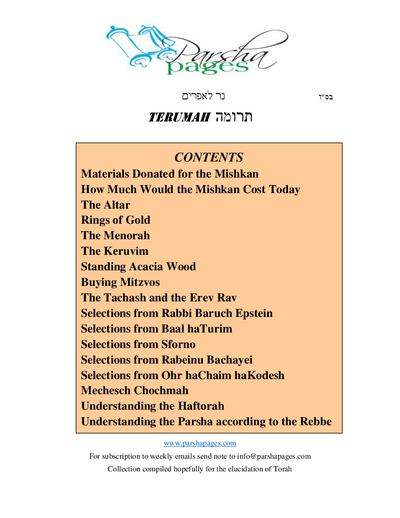

Experts and Rulers

Daber el Bnei Yisrael – “Speak to Bnei Yisrael, and let them take for Me a teruma, from every man whose heart is charitable shall you take My portion – terumosi” (25:2).

The Ohr HaChaim HaKodosh has a unique interpretation of our pasuk: he begins by way of introduction (see Bava Basra 8b) that normally tzedaka collectors must collect in groups of two, because we do not allow individuals to collect money and impose their will on the community as rulers in such matters alone. In fact, he cites the opinion of Tosafos and the Ran (Rabbeinu Nissim) that even two are insufficient except in matters where the amounts collected are fixed, but when estimates need to be made and an appraisal calculated of each person’s net worth to fix the amount of the donation, then three collectors must work together to arrive at the correct figure.

Now the Ohr HaChaim says that the Halacha is (Sanhedrin 5) that an individual who is an expert can in fact judge these monetary matters alone, and his rule is law. Tosafos there say that he can force anyone to pay a donation and act alone without a need for two. They derive this logically: since an expert can judge matters alone when normally three judges are required, surely here, in matters of rule of law where normally we require just two, he can rule [and calculate and collect tzedoka donations and the teruma].

Based on this concept that an expert can rule, calculate and collect by force, the Ohr HaChaim reinterprets the word daber to mean “rule” and “control” instead of “speak”. The Ohr HaChaim understands from the pasuk that HaShem commanded Moshe to rule over Bnei Yisrael as an expert individual, who can rule alone on matters of donation, calculate the net worth and ability of individuals and how much they should give and collect from them even by force if need be. Daber el Bnei Yisrael – “rule over Bnei Yisrael” – and calculate and collect from them on your own, even though appraisal normally requires three and collection two, because you, Moshe, are an expert individual and you can take the place of three and, of course, two, in matters of collection that require rule of law.

This idea, says the Ohr HaChaim, is demonstrated in pasuk 36:3, where we see Moshe collecting the donations on his own. My Teruma “From every man whose heart is charitable shall you take My portion – terumosi” (25:2). The Ohr HaChaim continues his novel interpretation and suggests that this pasuk implies that regarding people who have nedivus lev (a charitable heart) that encourages him to give, perhaps no appraisal calculations were made. Since we expect that people know how much they can afford to give perhaps since they were self-motivated to be charitable, we just accept whatever they bring. Others have an appraisal. Such a donation, points out the Ohr HaChaim, is called by HaShem “My teruma – terumosi”, whereas the first half of the pasuk calls the donations collected [sometimes by force] simply teruma.

Terumas HaMishkan

“From every man” (25:2). The Ohr HaChaim points out that this part of our pasuk teaches that we include three categories of people whose donations are normally rejected but are accepted for terumas haMishkan. These three categories include: orphans, women and overly charitable spendthrifts. Normally, we do not take charitable donations from these three types of people because of special rules that apply to each category type:

In Bava Basra (8a) we learn that orphans cannot be forced to give charity except when it gives their family name honor and prestige or atones for them. In Bava Kama (119) we learn that women’s donations must be minimal except when they are wealthy. Baava Basra (ibid) rules that tzedoka collectors should not visit overly charitable spendthrifts, because Taanis 24a tells us that under pressure they will give too much and under duress they will force themselves to donate beyond their means.

When collecting for terumas haMishkan, however, donations were accepted me’es kol ish asher yidvenu libo – “from every man whose heart is charitable” – even from these three categories, [me]’es – to include women, kol – to include orphans, ish asher yidvenu libo – this includes overly charitable spendthrifts. From these three types of people we accept even large sums and gifts.

An Exception to the Rule: Terumas haMishkan.

Now the Ohr HaChaim explains why Terumas haMishkan is such an outstanding exception to all the normal rules of tzedaka, based on the Medroshim of Chazal:

Yerushalmi Shekalim 1:1 and Medrash Tanchuma teach that the Mishkan atones for the chet ho’egel – the sin of the Golden Calf. Furthermore, Chazal explain how it was that Bnei Yisrael had all this wealth to build the Mishkan and donate toward its construction, even though they had recently been released from slavery and were wandering in the desert. In Shemos Rabba ch. 33, Chazal tell us that together with the mon, gems and precious stones rained down. In Medrash Tanchuma on Beshallach we are told that the spoils of the Exodus from Egypt were so great that even the smallest had something like forty laden donkeys of gold, silver and precious stones, and in Medrash Shir HaShirim Rabba, on the words torei zohov, we are told that the spoils of the Egyptians at Kerias Yam Suf were even greater than the spoils of Egypt itself! If so, we see clearly, says the Ohr HaChaim, that Bnei Yisrael were actually very wealthy people. Now we can understand why regarding terumas haMishkan the normal rules of tzedoka did not apply and they accepted donations from orphans, women and the overly charitable spendthrifts. Orphans’ donations are only accepted when this lends them a good name; here, the Mishkan atoned for them and for the chet ho’egel. Normally, we accept only small donations from women, but here they were all so wealthy that that rule also did not apply. We do not accept the gifts of overly charitable spendthrifts and we don’t send gabbo’im to collect from them because normally we worry about pressuring them; again, they were so wealthy that this rule no longer applied.

Finally, the Ohr HaChaim applies what we learned to teach us a lesson that when donating for Terumas haMishkan, Bnei Yisrael attached their souls in dveikus to HaShem. This is because the soul is also known as teruma (see Yirmiyohu 2:3, where Bnei Yisrael are called Reishis, and Reishis also means teruma). By giving the donation of teruma they were actually donating their very souls to HaShem, and so His Divine Presence – the Shechina – alighted upon them and dwelled among them.

PDF Preview


