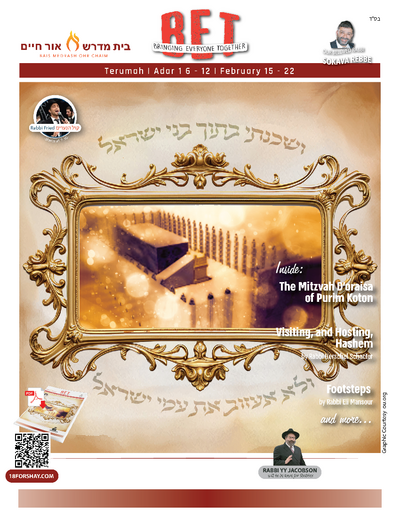
The Significance of the Bait Hamikdash and the Sin of the Golden Calf
So much of our daily life as Torah Jews revolves around the lacking of the Bait Hamikdash and the hope of BE"H the rebuilding of the Bait Hamikdash. So much so that at the highlight of a person's life, under his chuppah, we break a glass to illustrate that no joy is complete without the Bais Hamikdash. As we look deeper we understand that the Bait Hamikdash is a result of sin. It is because of the sin of the eigel hazahav that we received the Bait Hamikdash in order to make rectification. Imagine what the world would of been like without the Mishkan or the Bait Hamikdash. How would we end our chuppas? What kind of world would we live in without the need of a Bait Hamikdash? One second – we don't have a Bait Hamikdash now. Are we in the same situation?
What is also challenging is that the eigal hazahav was an action done with one item. Additionally, it was only a part of the nation that worshiped it. Yet in the rectification of the eigal, the Beit Hamikdash, we have many parts and all kinds of utensils and forms of worship. How does this make sense? We should have one action or similar activity to reverse the sin of the eigel. Why so many different kinds of avoda?
Once upon a time there was a king who had a very stressful day. He requested from his guards to send over his adviser. It took time for the guards to locate the whereabouts of the king's adviser, and by then it was late at night. The messengers of the king banged hard on the door, but there was no answer. The adviser was not responding because he was tired and did not want to go to the king. The guards broke the door down and grabbed the adviser out of bed. Attempting to escape, the adviser knocked the guards torches out of their hands, and began to run in the cover of darkness. The guards managed to grab him and put him in jail.
At the trial the king declared that his violation was only for knocking over the torch in the hands of the messengers, and he received a minimum fine. The next time the adviser met the king he asked, "why were you so easy on me and not have me killed for what I did?" The king explained that knocking the torches was the only real violation because at that moment you were not feeling close to me due to your extreme tiredness. Now that you feel better, you will be ready to continue our special relationship.
The sin of the golden calf was one action and one way of worship, but it was done with 3000 different reasons and intentions. The root of all the actions however, were a feeling of distance from Hashem. The "why" we were feeling that way has 3000 different answers. To truly rectify the actions and the reasons we needed a Bais Hamikdash that will have so many types of avodah (worship) so that it will encompass all the different types of reasons and feelings of distance from Hashem.
A world without the Bais Hamikdash is a world where we must feel within ourselves that outstanding bond and closeness to Hashem. However, being that we are who we are, we need that external infusion and tools to assist us in reaching that level of closeness. We hope and daven for the return of the Bais Hamikdash, so that we can live in a world of unity with our Father in Heaven, Amen.