The Three Arks
The Three Arks
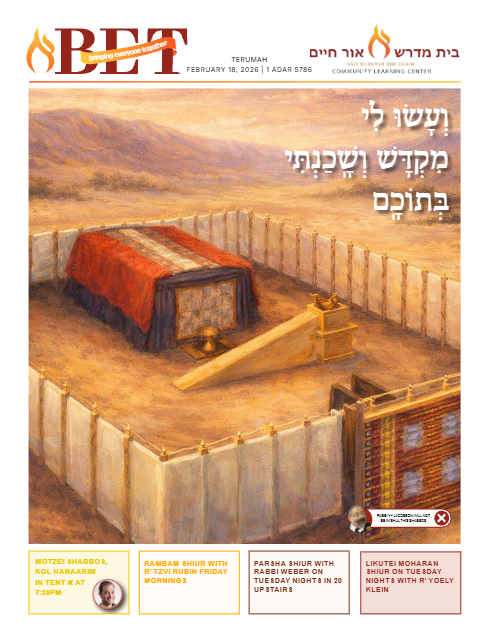
The holiest article in the Tabernacle that the Jewish people constructed in the desert was the Ark, which housed the Tablets of the Ten Com- mandments. In this week’s portion (Terumah), the Torah commands the Ark to be made of acacia wood and to be covered within and without with gold.
To fulfill this stipulation, the Jews made three boxes tucked into each other. The larger visible box was made of pure gold. Inside it, they placed a box of acacia wood. Then a second golden box was made, and it was put inside the wooden one. Thus, the middle wooden box was covered with gold inside and out.
The Three Layers of the Soul
Gold is an inanimate metal, while wood be- longs to the botanical world of growth and de- velopment. Yet wood has nothing of the brilliant glitter and splendor of gold. And while wood may be developed into a magnificent structure, it can, unlike gold, also deteriorate and rot.
The spiritual masters teach that the psycho- logical structure of every human being consists of three strata, one “beneath” the other. The deep- est, often invisible, stratum is the quintessential soul that may be unknown even to a person themself (even if its impact is present in some form). Then there is the conscious personality, including all of our instinctive thoughts, feelings, moods, instincts, and desires. Finally, there is the layer of behavior, the active thoughts, words, and deeds we express and carry out during our daily lives and interactions.
The three arks that the Jewish people con- structed three millennia ago in the Sinai Desert represented these three dimensions of the hu- man structure. The most inner ark, made of pure gold and tucked inside the other two arks, reflect- ed the most inner dimension of the soul, which can be defined as “pure gold.” This is the Divine, spiritual essence of our identity, displaying a bril- liant luster of sacredness, integrity, and love. At the core, you are a “derivative” of infinite oneness, a manifestation of G-d’s light in this world.
Just as gold coming from the inorganic world is not subject to real change, so too, the golden essence of the human soul cannot be altered, tar- nished, tainted, or compromised. No matter how much we were abused or we abused ourselves, the core of our consciousness remains a piece of gold. Just as G-d is indestructible, so are you. In that Divine space, you remain fully intact, full of confidence, fortitude, joy, possibility, love, com- passion, and courage.
The middle ark made of wood reflected the more visible conscious personality of the human soul. Just like wood, our feelings and attitudes go through many changes during our lives. We may develop and refine our “wood- en” character so that it becomes exquisite and beautiful, or our personality may experience decomposition.
Our “wooden” self may vacillate between ex- tremes. At times, we may feel idealistic, virtuous, and spiritual, but at other times, we find ourselves consumed by bleak emotions, negative cravings, and dark ambitions. We feel rotten and decayed inside.
Finally, the third and outer ark, conspicuous for all to see, was made of pure gold. This reflect- ed the Torah’s blueprint for the most external stra- tum of the human structure, a person’s behavior. Though we may feel our personalities to be torn inside, and at times even saturated with gloom and pain, we need not grant them per- mission to dictate our behavior. We must always remember that even while our conscious moods may gravitate toward decadence, our essence remains pure gold.
This is Judaism’s fundamental code of hu- man behavior. Even while you feel selfish, unho- ly, and obnoxious inside, your behavior, what you do, how you talk, and how you consciously think can reflect the beauty and splendor of your innate G-dliness and infinite holiness. You can feel your “wood” in all of its nuanced manifestations and then choose the golden path.
RABBI YY JACOBSON