The Way Torah Is Stored
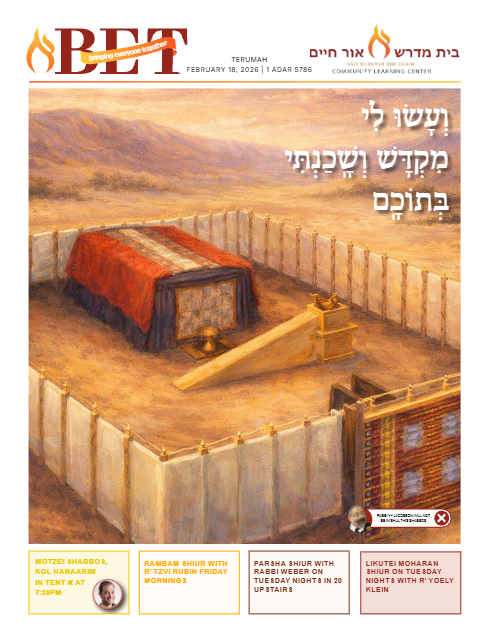
In Parashat Terumah, we read about the specifications of the Mishkan and its furnishings. The Torah is very precise in its description of the different aspects of the Mishkan and presents the precise measurements of the structure itself as well as the individual furnishings.
In discussing the Aron, the ark, which contained the tablets brought from Sinai and a Torah scroll, the Torah informs us that the ark measured 2.5 amot long, 1.5 amot wide, and 1.5 amot high. Interestingly, the Aron is the only part of the Mishkan that is assigned a half-measurement in every dimension. Its length, width, and height are all half-amot, and there are no complete amot measurements associated with it.
The Rabbis detected within these measurements an allusion to the importance of humility in the process of Torah scholarship, which is symbolized by the Aron, the ark in which the Torah was stored. A person can become knowledgeable in Torah only if he always sees himself as a “half,” as incomplete, recognizing that he has more to learn and still needs to grow. The arrogant student who sees himself as “whole,” as a complete product, cannot grow in Torah. Arrogance repels Torah knowledge, whereas genuine humility attracts Torah. This is why the Gemara refers to Torah scholars as “talmidei chachamim,” which literally means “wise students.” Even if a person is a “chacham,” he must see himself as a “talmid,” as a student, as somebody who must still learn, study, and grow.
Torah is often compared to water. One reason for this is that it is indispensable for life, just as life cannot be sustained without water. But additionally, water always flows to the low-lying areas. It constantly searches for a lower place. Torah, too, is naturally concentrated among the “lowly,” among the humble people. It cannot remain in the mind and heart of an arrogant, overly confident person. Torah can survive only in a person who recognizes the fact that he is only a “half,” that he is not perfect.
The Talmud tells that the great sage Rabbi Yehoshua had an unattractive appearance. A Roman princess once asked him how G-d could allow such a precious warehouse of Torah knowledge to be contained in such an unbecoming utensil. Rabbi Yehoshua replied by asking the princess where her father stored his quality wines, and she said that they were stored in cheap, earthenware vats.
“Surely,” Rabbi Yehoshua said, “wine of such high quality deserves more elegant containers!” He advised the young woman to move the wine into exquisite gold barrels, and she complied. Soon thereafter, she came back to the Rabbi and reported that all the wine had spoiled.
Rabbi Yehoshua explained that the same is true of Torah. Like wine, it will spoil if it is placed in a fancy, ornate “utensil.” Torah must be stored in simple “earthenware,” in someone who does not condescend, who recognizes his flaws and sees himself as a “half.” If we want to become “receptacles” of Torah, to truly understand the Torah and what it demands of us, we need to humbly acknowledge our modest stature and engender within ourselves the kind of honest, self-effacing humility that Torah knowledge requires.