Aharon Shall Carry Their Names Before Hashem
Shvilei Pinchas | February 21, 2024
Print This Article
View Original PDF

Aharon Shall Carry Their Names Before Hashem

Shvilei Pinchas | December 10, 2025

This week’s parsha is parshas Tetzaveh. With immense pleasure, we will explore why Aharon, the Kohen Gadol, was commanded to carry the names of the twelve shevatim of Yisrael on two of his four golden garments. Those garments were only worn by the Kohen Gadol when he performed his service in the Beis HaMikdash. The names of Bnei Yisrael were on the two shoulder straps of the Eiphod and also on the stones of the Choshen that rested over his pure heart.

We will begin by reviewing the pesukim detailing the making of the Eiphod (Shemos 28, 6):

"ועשו את האפוד זהב תכלת וארגמן... שתי כתפות חוברות יהיה לו אל שני קצותיו וחיבר... ולקחת את שתי אבני שוהם ופיתחת עליהם שמות בני ישראל, ששה משמותם על האבן האחת ואת שמות הששה הנותרים על האבן השנית כתולדותם... ושמת את שתי האבנים על כתפות האפוד אבני זכרון לבני ישראל, ונשא אהרן את שמותם לפני ה' על שתי כתפיו לזכרון".

They shall make the Eiphod of gold, of blue, purple, and crimson yarns . . . It shall have two shoulder straps attached; they shall be attached at its two ends . . . Then take two shoham (lazuli) stones and engrave on them the names of Bnei Yisrael; six of their names on the one stone, and the names of the remaining six on the other stone, in the order of their birth . . . You shall place the two stones on the shoulder straps of the Eiphod, as stones for remembrance of Bnei Yisrael. Aharon shall carry their names before Hashem on both his shoulders as a remembrance.

Then, the text goes on to supply additional details (ibid. 15):

"ועשית חושן משפט מעשה חושב כמעשה אפוד תעשנו זהב תכלת וארגמן... ומילאת בו מלואת אבן ארבעה טורים... והאבנים תהיין על שמות בני ישראל שתים עשרה על שמותם פתוחי חותם איש על שמו תהיין לשני עשר שבט... ונשא אהרן את שמות בני ישראל בחושן המשפט על לבו בבואו אל הקודש לזכרון לפני ה' תמיד".

You shall make a Choshen HaMishpat (Breastplate of Judgment) of woven design, like the craftsmanship of the Eiphod shall you make it . . . You shall fill it with stone mountings, four rows of stone . . . The stones shall be according to the names of Bnei Yisrael, twelve according to their names, engraved like a signet ring, each according to its name shall it be, for the twelve tribes . . . Aharon shall bear the names of Bnei Yisrael on the Choshen HaMishpat over his heart when he enters the Sanctuary, as a constant remembrance before Hashem.

As such, we can only wonder why it was necessary for Aharon HaKohen to bear the names of Bnei Yisrael twice—on two separate garments—both on his shoulders and over his heart—as a remembrance before Hashem. Why did it not suffice to carry their names only over his heart? Additionally, why were the names arranged differently on the two garments? On the Eiphod, the names were split into two groups—six on the right shoulder and six on the left shoulder. Whereas on the Choshen worn over Aharon’s heart, all twelve names of Bnei Yisrael were engraved on the stones as a single group.
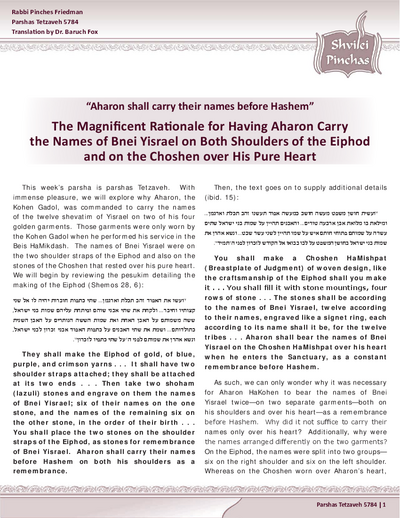
This week’s parsha is parshas Tetzaveh. With immense pleasure, we will explore why Aharon, the Kohen Gadol, was commanded to carry the names of the twelve shevatim of Yisrael on two of his four golden garments. Those garments were only worn by the Kohen Gadol when he performed his service in the Beis HaMikdash. The names of Bnei Yisrael were on the two shoulder straps of the Eiphod and also on the stones of the Choshen that rested over his pure heart.

We will begin by reviewing the pesukim detailing the making of the Eiphod (Shemos 28, 6):

"ועשו את האפוד זהב תכלת וארגמן... שתי כתפות חוברות יהיה לו אל שני קצותיו וחיבר... ולקחת את שתי אבני שוהם ופיתחת עליהם שמות בני ישראל, ששה משמותם על האבן האחת ואת שמות הששה הנותרים על האבן השנית כתולדותם... ושמת את שתי האבנים על כתפות האפוד אבני זכרון לבני ישראל, ונשא אהרן את שמותם לפני ה' על שתי כתפיו לזכרון".

They shall make the Eiphod of gold, of blue, purple, and crimson yarns . . . It shall have two shoulder straps attached; they shall be attached at its two ends . . . Then take two shoham (lazuli) stones and engrave on them the names of Bnei Yisrael; six of their names on the one stone, and the names of the remaining six on the other stone, in the order of their birth . . . You shall place the two stones on the shoulder straps of the Eiphod, as stones for remembrance of Bnei Yisrael. Aharon shall carry their names before Hashem on both his shoulders as a remembrance.

Then, the text goes on to supply additional details (ibid. 15):

"ועשית חושן משפט מעשה חושב כמעשה אפוד תעשנו זהב תכלת וארגמן... ומילאת בו מלואת אבן ארבעה טורים... והאבנים תהיין על שמות בני ישראל שתים עשרה על שמותם פתוחי חותם איש על שמו תהיין לשני עשר שבט... ונשא אהרן את שמות בני ישראל בחושן המשפט על לבו בבואו אל הקודש לזכרון לפני ה' תמיד".

You shall make a Choshen HaMishpat (Breastplate of Judgment) of woven design, like the craftsmanship of the Eiphod shall you make it . . . You shall fill it with stone mountings, four rows of stone . . . The stones shall be according to the names of Bnei Yisrael, twelve according to their names, engraved like a signet ring, each according to its name shall it be, for the twelve tribes . . . Aharon shall bear the names of Bnei Yisrael on the Choshen HaMishpat over his heart when he enters the Sanctuary, as a constant remembrance before Hashem.

As such, we can only wonder why it was necessary for Aharon HaKohen to bear the names of Bnei Yisrael twice—on two separate garments—both on his shoulders and over his heart—as a remembrance before Hashem. Why did it not suffice to carry their names only over his heart? Additionally, why were the names arranged differently on the two garments? On the Eiphod, the names were split into two groups—six on the right shoulder and six on the left shoulder. Whereas on the Choshen worn over Aharon’s heart, all twelve names of Bnei Yisrael were engraved on the stones as a single group.

PDF Preview


