Amalek Strove to Extract the Two Vavs from the Phrase Medor Dor
Shvilei Pinchas | March 05, 2025
Print This Article
View Original PDF

Amalek Strove to Extract the Two Vavs from the Phrase Medor Dor

Shvilei Pinchas | June 27, 2025

Amalek Strove to Extract the Two Vavs from the Phrase "מדור דור"

I had a marvelous idea concerning the connection between the kedushah of Shabbas and the military victory over Amalek. Let us refer to a passuk related to that battle (ibid. 17, 16): "ויאמר כי יד על כס יה מלחמה לה' בעמלק מדור דור"—and he (Moshe) said, “For there is a hand on the throne of G-d; Hashem maintains a war against Amalek from generation to generation.” Now, in a sefer Torah, these last two words are written as "מדר דר", without the two “vavs,” even though they are read as "מדור דור", with the two “vavs.” It behooves us to explore the significance of this curious modification of the text.

We will begin to shed some light on the matter by referring to a teaching in the Gemara (Kiddushin 30a): "אמר רבי יהושע בן לוי, כל המלמד את בן בנו תורה, מעלה עליו הכתוב כאילו קבלה מהר סיני, שנאמר והודעתם לבניך ולבני בניך, וסמיך ליה יום אשר עמדת לפני ה' אלקיך בחורב". Rabbi Yehoshua ben Levi said: Anyone who teaches his grandson Torah, Scripture deems it as if he had personally received it (the Torah) from Har Sinai, as it states (Devarim 4, 9): “You shall make them known to your sons and your grandsons”; juxtaposed to it, it says (ibid. 10): “The day that you stood before Hashem, your G-d, at Choreiv.” Why does it specify teaching your grandchildren Torah?

It appears that we can explain the matter based on a teaching elsewhere in the Gemara (B.M. 85a): "אמר רבי פרנך אמר רבי יוחנן, כל שהוא תלמיד חכם ובנו תלמיד חכם ובן בנו תלמיד חכם, שוב אין תורה פוסקת מזרעו לעולם, שנאמר ואני זאת בריתי וגו', לא ימושו מפיך ומפי זרעך ומפי זרע זרעך אמר ה' מעתה ועד עולם. מאי אמר ה', אמר הקב"ה אני ערב לך בדבר זה, מאי מעתה ועד עולם, אמר רבי ירמיה, מכאן ואילך תורה מחזרת על אכסניא שלה". Rabbi Parnach said that Rabbi Yocḥanan said: Anyone who is a Torah scholar, and whose son is a Torah scholar, and whose grandson is a Torah scholar, the Torah will never again cease from his descendants, as it is stated (Yeshayah 59, 21): “And as for Me, this is My covenant . . . they shall not depart from your mouth, nor from the mouth of your offspring, nor from the mouth of the children of your offspring, says Hashem, from now and forever.” What is the implication of the phrase “says Hashem”? The Gemara answers: HKB”H said, “I am your guarantor in this matter.” What is the meaning of the phrase “from now and forever”? Rabbi Yirmiyah said: From this point forward, the Torah returns to its lodging, i.e., the Torah is now lodged in the family forever.

Regarding this phenomenon, the Gemara (B.B. 59a) cites the passuk (Koheles 4, 12): "והחוט המשולש לא במהרה ינתק"—and the three-ply cord will not be severed easily (unraveled quickly). There Tosafos note that there have been many cases where this did not hold true. So, they explain that it is speaking of cases where three generations coexisted, i.e., their lives overlapped, and they learned Torah together; only then is it guaranteed that the Torah will never cease from their family.

This can be explained simply based on the concept of “chazakah.” When something is repeated three times, it is considered a “chazakah”—an established fact or status. For instance, when someone occupies a field for three consecutive years (B.B. 28a): אמר ר' יוחנן שמעתי מהולכי אושא שהיו אומרים, מנין לחזקה ג' שנים, משור המועד, מה שור המועד כיון שנגח ג' נגיחות נפק ליה מחזקת תם וקם ליה בחזקת מועד, הכי נמי כיון דאכלה תלת שנין, נפק לה מרשות מוכר וקיימא לה ברשות לוקח". Rabbi Yochanan said: I heard from those who traveled to Usha that they would say: From where do we derive the concept of a three-year “chazakah”? From the law of “shor ha’muad.” Just as a “shor ha’muad,” once it has gored three times, it leaves the status of a “tam” and assumes the status of a “muad”; here, too, once the occupant has used the property for three years, it leaves the possession of the seller and is established in the possession of the buyer.

Similarly, if someone teaches his son and his grandson Torah, there are three consecutive generations studying Torah; thus, it establishes a “chazakah” that the light of the Torah will be perpetuated in their family for all future generations. This then is the message conveyed by the passuk (Devarim 4, 9): "רק השמר לך ושמור נפשך מאד פן תשכח את הדברים אשר ראו עיניך, ופן יסורו מלבבך כל ימי חייך, והודעתם לבניך ולבני בניך, יום אשר עמדת לפני ה' אלקיך בחורב". Only beware and guard your soul exceedingly, lest you forget the things your eyes have beheld, and lest you remove them from your heart all the days of your life; and make them known to your children and your children’s children—the day that you stood before Hashem, your G-d, at Choreiv. Note that the passuk emphasizes making them known “to your children and your children’s children,” so that the Torah will be ingrained and inculcated in three generations. If this condition is met, HKB”H guarantees that the Torah will continue to illuminate one’s future generations.
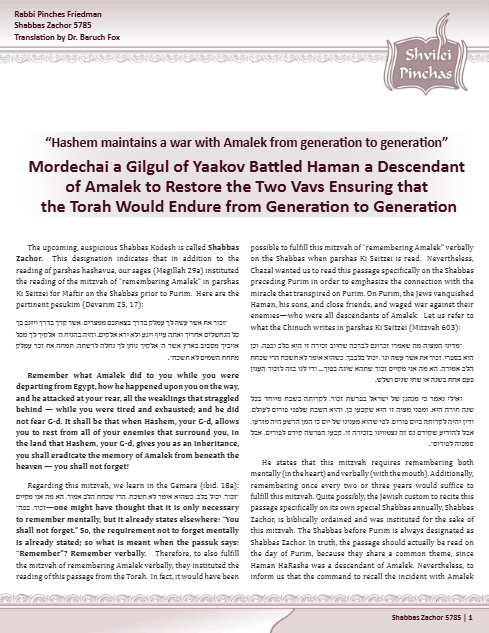
Amalek Strove to Extract the Two Vavs from the Phrase "מדור דור"

I had a marvelous idea concerning the connection between the kedushah of Shabbas and the military victory over Amalek. Let us refer to a passuk related to that battle (ibid. 17, 16): "ויאמר כי יד על כס יה מלחמה לה' בעמלק מדור דור"—and he (Moshe) said, “For there is a hand on the throne of G-d; Hashem maintains a war against Amalek from generation to generation.” Now, in a sefer Torah, these last two words are written as "מדר דר", without the two “vavs,” even though they are read as "מדור דור", with the two “vavs.” It behooves us to explore the significance of this curious modification of the text.

We will begin to shed some light on the matter by referring to a teaching in the Gemara (Kiddushin 30a): "אמר רבי יהושע בן לוי, כל המלמד את בן בנו תורה, מעלה עליו הכתוב כאילו קבלה מהר סיני, שנאמר והודעתם לבניך ולבני בניך, וסמיך ליה יום אשר עמדת לפני ה' אלקיך בחורב". Rabbi Yehoshua ben Levi said: Anyone who teaches his grandson Torah, Scripture deems it as if he had personally received it (the Torah) from Har Sinai, as it states (Devarim 4, 9): “You shall make them known to your sons and your grandsons”; juxtaposed to it, it says (ibid. 10): “The day that you stood before Hashem, your G-d, at Choreiv.” Why does it specify teaching your grandchildren Torah?

It appears that we can explain the matter based on a teaching elsewhere in the Gemara (B.M. 85a): "אמר רבי פרנך אמר רבי יוחנן, כל שהוא תלמיד חכם ובנו תלמיד חכם ובן בנו תלמיד חכם, שוב אין תורה פוסקת מזרעו לעולם, שנאמר ואני זאת בריתי וגו', לא ימושו מפיך ומפי זרעך ומפי זרע זרעך אמר ה' מעתה ועד עולם. מאי אמר ה', אמר הקב"ה אני ערב לך בדבר זה, מאי מעתה ועד עולם, אמר רבי ירמיה, מכאן ואילך תורה מחזרת על אכסניא שלה". Rabbi Parnach said that Rabbi Yocḥanan said: Anyone who is a Torah scholar, and whose son is a Torah scholar, and whose grandson is a Torah scholar, the Torah will never again cease from his descendants, as it is stated (Yeshayah 59, 21): “And as for Me, this is My covenant . . . they shall not depart from your mouth, nor from the mouth of your offspring, nor from the mouth of the children of your offspring, says Hashem, from now and forever.” What is the implication of the phrase “says Hashem”? The Gemara answers: HKB”H said, “I am your guarantor in this matter.” What is the meaning of the phrase “from now and forever”? Rabbi Yirmiyah said: From this point forward, the Torah returns to its lodging, i.e., the Torah is now lodged in the family forever.

Regarding this phenomenon, the Gemara (B.B. 59a) cites the passuk (Koheles 4, 12): "והחוט המשולש לא במהרה ינתק"—and the three-ply cord will not be severed easily (unraveled quickly). There Tosafos note that there have been many cases where this did not hold true. So, they explain that it is speaking of cases where three generations coexisted, i.e., their lives overlapped, and they learned Torah together; only then is it guaranteed that the Torah will never cease from their family.

This can be explained simply based on the concept of “chazakah.” When something is repeated three times, it is considered a “chazakah”—an established fact or status. For instance, when someone occupies a field for three consecutive years (B.B. 28a): אמר ר' יוחנן שמעתי מהולכי אושא שהיו אומרים, מנין לחזקה ג' שנים, משור המועד, מה שור המועד כיון שנגח ג' נגיחות נפק ליה מחזקת תם וקם ליה בחזקת מועד, הכי נמי כיון דאכלה תלת שנין, נפק לה מרשות מוכר וקיימא לה ברשות לוקח". Rabbi Yochanan said: I heard from those who traveled to Usha that they would say: From where do we derive the concept of a three-year “chazakah”? From the law of “shor ha’muad.” Just as a “shor ha’muad,” once it has gored three times, it leaves the status of a “tam” and assumes the status of a “muad”; here, too, once the occupant has used the property for three years, it leaves the possession of the seller and is established in the possession of the buyer.

Similarly, if someone teaches his son and his grandson Torah, there are three consecutive generations studying Torah; thus, it establishes a “chazakah” that the light of the Torah will be perpetuated in their family for all future generations. This then is the message conveyed by the passuk (Devarim 4, 9): "רק השמר לך ושמור נפשך מאד פן תשכח את הדברים אשר ראו עיניך, ופן יסורו מלבבך כל ימי חייך, והודעתם לבניך ולבני בניך, יום אשר עמדת לפני ה' אלקיך בחורב". Only beware and guard your soul exceedingly, lest you forget the things your eyes have beheld, and lest you remove them from your heart all the days of your life; and make them known to your children and your children’s children—the day that you stood before Hashem, your G-d, at Choreiv. Note that the passuk emphasizes making them known “to your children and your children’s children,” so that the Torah will be ingrained and inculcated in three generations. If this condition is met, HKB”H guarantees that the Torah will continue to illuminate one’s future generations.

PDF Preview