Bring Aharon your brother close to yourself
Print This Article
View Original PDF

Bring Aharon your brother close to yourself

טיב הקהילה English | June 27, 2025

It is told of a certain man whom everyone knew as a “man of kindness,” and his custom was that every Friday he would walk through the streets and markets, looking for people carrying heavy baskets. Whenever he found someone like that, he would gladly help them carry their heavy loads to their homes. One day, he noticed a woman carrying heavy baskets. Although he was careful to guard his eyes and did not look at the woman, still, being a man of kindness, he immediately approached her to help. As he took several heavy baskets into his hands, he heard her voice—and suddenly realized that the voice was familiar to him. It was his wife’s voice! Immediately, he put down the baskets, saying, “My wife will manage on her own,” and ran off to look for more mitzvot and acts of kindness.

HaKadosh Baruch Hu says to Moshe Rabeinu, ’ואתה הקרב אליך את אהרן אחיך ואת בניו אתו מתוך בני ישראל’ - “And you, bring near to yourself Aharon your brother and his sons with him from among the Children of Israel.” There is no doubt that HaKadosh Baruch Hu has great and lofty reasons for choosing specifically Aharon HaKohen. However, the holy Torah is eternal, and there is always something for us to learn from it. From these pasukim, we can learn that Hashem is teaching Moshe Rabeinu—and us—an important principle: Are you in an important position? Do you hold a significant role? Are you engaged in acts of kindness? Do not forget your close ones! Bring them near, help them, even if in that setting you receive fewer thanks, or perhaps none at all—because in their eyes, it is simply expected that you assist your family. But that is true kindness!

Chazal say (Sanhedrin 76b): “One who loves his neighbors, brings his relatives closer, marries his sister’s daughter, and lends a coin to a poor person in his time of need—regarding them, the pasuk says: ’אז תקרא וה’ יענה’ - ’Then you shall call, and Hashem will answer.’” (Yeshaya 58:9) This means that aside from the obligation to bring one’s relatives closer, there is also a special segulah—that one who behaves this way is promised by the Torah: “Then you shall call, and Hashem will answer,” that Hashem will respond to his prayers. Could there be a greater segulah than this?!

And it has already been ruled in halacha (Tur Yoreh Deah 251:3) that “The poor of one’s household come first.” This is what we saw among all the great leaders of Israel—they would first do chesed with their own household. And even when they engaged in kindness, they were careful that it would not come at the expense of their family. Because true chesed begins at home, then extends to the close circle, and only afterward to the wider community.
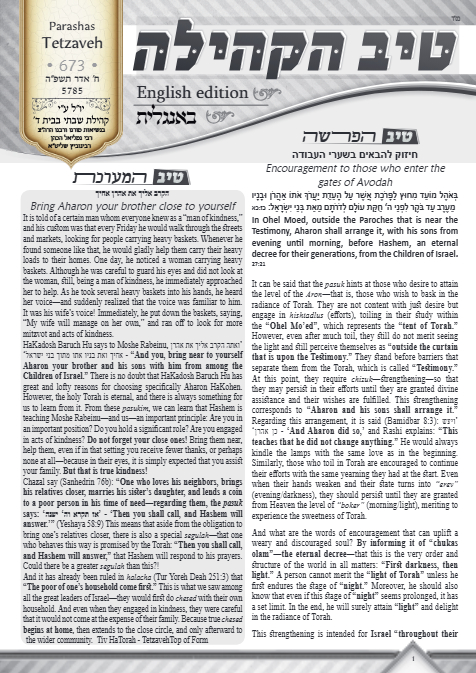

It is told of a certain man whom everyone knew as a “man of kindness,” and his custom was that every Friday he would walk through the streets and markets, looking for people carrying heavy baskets. Whenever he found someone like that, he would gladly help them carry their heavy loads to their homes. One day, he noticed a woman carrying heavy baskets. Although he was careful to guard his eyes and did not look at the woman, still, being a man of kindness, he immediately approached her to help. As he took several heavy baskets into his hands, he heard her voice—and suddenly realized that the voice was familiar to him. It was his wife’s voice! Immediately, he put down the baskets, saying, “My wife will manage on her own,” and ran off to look for more mitzvot and acts of kindness.

HaKadosh Baruch Hu says to Moshe Rabeinu, ’ואתה הקרב אליך את אהרן אחיך ואת בניו אתו מתוך בני ישראל’ - “And you, bring near to yourself Aharon your brother and his sons with him from among the Children of Israel.” There is no doubt that HaKadosh Baruch Hu has great and lofty reasons for choosing specifically Aharon HaKohen. However, the holy Torah is eternal, and there is always something for us to learn from it. From these pasukim, we can learn that Hashem is teaching Moshe Rabeinu—and us—an important principle: Are you in an important position? Do you hold a significant role? Are you engaged in acts of kindness? Do not forget your close ones! Bring them near, help them, even if in that setting you receive fewer thanks, or perhaps none at all—because in their eyes, it is simply expected that you assist your family. But that is true kindness!

Chazal say (Sanhedrin 76b): “One who loves his neighbors, brings his relatives closer, marries his sister’s daughter, and lends a coin to a poor person in his time of need—regarding them, the pasuk says: ’אז תקרא וה’ יענה’ - ’Then you shall call, and Hashem will answer.’” (Yeshaya 58:9) This means that aside from the obligation to bring one’s relatives closer, there is also a special segulah—that one who behaves this way is promised by the Torah: “Then you shall call, and Hashem will answer,” that Hashem will respond to his prayers. Could there be a greater segulah than this?!

And it has already been ruled in halacha (Tur Yoreh Deah 251:3) that “The poor of one’s household come first.” This is what we saw among all the great leaders of Israel—they would first do chesed with their own household. And even when they engaged in kindness, they were careful that it would not come at the expense of their family. Because true chesed begins at home, then extends to the close circle, and only afterward to the wider community.

PDF Preview


