Carry Them on Your Heart
Nefesh Shimshon | March 07, 2025
Print This Article
View Original PDF

Carry Them on Your Heart

Nefesh Shimshon | June 27, 2025

Our parshah speaks about the holy and splendid garments that the Kohen Gadol wore when he performed his service in Beis Hamikdash. These special articles of clothing have rich symbolism. They teach us profound lessons about the nature of the human soul.

A person’s clothing naturally tells about who he is. For instance, if he dresses like a talmid chacham, we can assume that Torah learning is probably the main thing in his life. By contrast, a person who just hangs out and engages in empty pleasures will probably dress in a way that reflects this.

What about the garments a kohen wears when he serves Hashem in Beis Hamikdash? They reflect the qualities of a perfected human being who serves his Creator. In fact, all Jews are called “kohanim,” as it says: You shall be for Me a kingdom of kohanim and a holy nation.

We can thus learn from the Bigdei Kehunah a lot of important lessons about ourselves and our avodah. Let’s look at a couple points.

There are two places where the names of the Twelve Tribes were engraved on the garments of the Kohen Gadol. And both places teach us really amazing ideas.

The Torah says that the names of the Children of Yisrael were engraved on the Choshen Hamishpat. And Aharon carried these names on his heart when he served in Beis Hamikdash. This shows that every individual can carry the entire Jewish people on his heart. He does this by loving and caring for all of Am Yisrael.

And also on the shoulder straps of the Eifod, the names of all Bnei Yisrael were engraved: You shall take two shoham stones and engrave upon them the names of the people of Yisrael.

So we see that a person can also carry the whole Jewish people on his shoulders. He does this by holding up all of Am Yisrael through his greatness in Torah. This is what the giants of our people did. About Rashi it is said that without him, the Torah would have been forgotten by the Jewish people. Also the Rif, the Rambam and the Gedolim of every generation carried the whole Jewish people in their hearts and on their shoulders.

But there is a difference. The names of the people of Yisrael as carried on the heart were engraved on twelve separate stones, one stone for the name of each tribe. Whereas the names carried on Aharon’s shoulders were grouped together on only two stones, six names on each stone. What does this teach us?

When we bring spiritual benefit to the public by teaching them Torah and yiras Shamayim, this generally relates to the public as a whole. It includes all the individuals together. But when it comes to loving our fellow Jew, it is not sufficient to just love the Jewish nation. We need to love each person individually, as he is.

This latter point is brought out by the twelve individual stones on the Choshen Mishpat. Each represented one of the Twelve Tribes. And each of the Tribes was considered in many aspects to be a people on its own.

Just as the different nations in the world have significantly different qualities and characteristics, which engenders hatred and war between them, so the Twelve Tribes of the Jewish people had different natures, which led to fights and conflicts between the Tribes.

Hashem commanded for each tribe to have its own unique holy stone. Each tribe was represented on the Choshen by a different kind of gem or precious stone, each with its own color and characteristics. And the Kohen Gadol bore all the stones together on his heart because one must love each individual Jew, as he is, with his own unique nature, with the practices that characterize his community and the minhagim he inherited from his family and ancestors, with all the differences that exist between various Jewish communities and places of origin.

And then, when we love our fellow Jew in this way, all of Am Yisrael will be remembered before Hashem, and Heaven will open to bestow a flood of blessings upon us, forever.
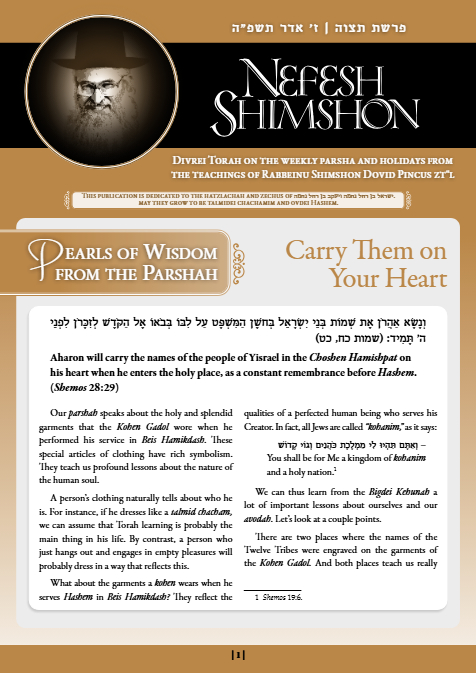
Our parshah speaks about the holy and splendid garments that the Kohen Gadol wore when he performed his service in Beis Hamikdash. These special articles of clothing have rich symbolism. They teach us profound lessons about the nature of the human soul.

A person’s clothing naturally tells about who he is. For instance, if he dresses like a talmid chacham, we can assume that Torah learning is probably the main thing in his life. By contrast, a person who just hangs out and engages in empty pleasures will probably dress in a way that reflects this.

What about the garments a kohen wears when he serves Hashem in Beis Hamikdash? They reflect the qualities of a perfected human being who serves his Creator. In fact, all Jews are called “kohanim,” as it says: You shall be for Me a kingdom of kohanim and a holy nation.

We can thus learn from the Bigdei Kehunah a lot of important lessons about ourselves and our avodah. Let’s look at a couple points.

There are two places where the names of the Twelve Tribes were engraved on the garments of the Kohen Gadol. And both places teach us really amazing ideas.

The Torah says that the names of the Children of Yisrael were engraved on the Choshen Hamishpat. And Aharon carried these names on his heart when he served in Beis Hamikdash. This shows that every individual can carry the entire Jewish people on his heart. He does this by loving and caring for all of Am Yisrael.

And also on the shoulder straps of the Eifod, the names of all Bnei Yisrael were engraved: You shall take two shoham stones and engrave upon them the names of the people of Yisrael.

So we see that a person can also carry the whole Jewish people on his shoulders. He does this by holding up all of Am Yisrael through his greatness in Torah. This is what the giants of our people did. About Rashi it is said that without him, the Torah would have been forgotten by the Jewish people. Also the Rif, the Rambam and the Gedolim of every generation carried the whole Jewish people in their hearts and on their shoulders.

But there is a difference. The names of the people of Yisrael as carried on the heart were engraved on twelve separate stones, one stone for the name of each tribe. Whereas the names carried on Aharon’s shoulders were grouped together on only two stones, six names on each stone. What does this teach us?

When we bring spiritual benefit to the public by teaching them Torah and yiras Shamayim, this generally relates to the public as a whole. It includes all the individuals together. But when it comes to loving our fellow Jew, it is not sufficient to just love the Jewish nation. We need to love each person individually, as he is.

This latter point is brought out by the twelve individual stones on the Choshen Mishpat. Each represented one of the Twelve Tribes. And each of the Tribes was considered in many aspects to be a people on its own.

Just as the different nations in the world have significantly different qualities and characteristics, which engenders hatred and war between them, so the Twelve Tribes of the Jewish people had different natures, which led to fights and conflicts between the Tribes.

Hashem commanded for each tribe to have its own unique holy stone. Each tribe was represented on the Choshen by a different kind of gem or precious stone, each with its own color and characteristics. And the Kohen Gadol bore all the stones together on his heart because one must love each individual Jew, as he is, with his own unique nature, with the practices that characterize his community and the minhagim he inherited from his family and ancestors, with all the differences that exist between various Jewish communities and places of origin.

And then, when we love our fellow Jew in this way, all of Am Yisrael will be remembered before Hashem, and Heaven will open to bestow a flood of blessings upon us, forever.

PDF Preview