Encouragement to those who enter the gates of Avodah
Print This Article
View Original PDF

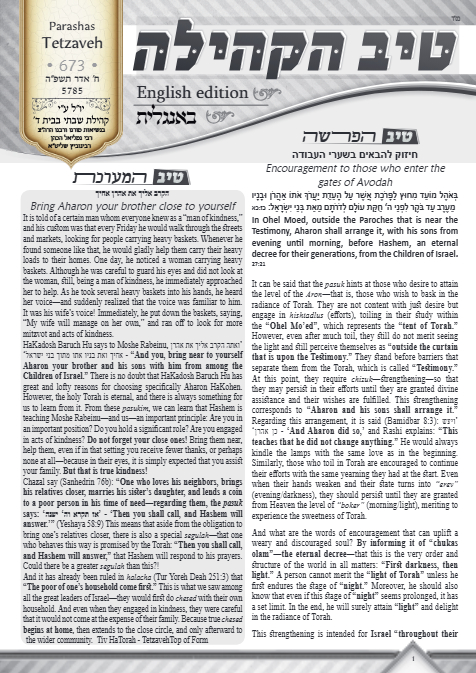
Encouragement to those who enter the gates of Avodah

טיב הקהילה English | June 27, 2025

בְּאֹהֶל מוֹעֵד מִחוּץ לַפָּרֹכֶת אֲשֶׁר עַל הָעֵדֻת יַעֲרֹךְ אֹתוֹ אַהֲרֹן וּבָנָיו כז:כאמֵעֶרֶב עַד בֹּקֶר לִפְנֵי ה’ חֻקַּת עוֹלָם לְדֹרֹתָם מֵאֵת בְּנֵי יִשְׂרָאֵל:

In Ohel Moed, outside the Paroches that is near the Testimony, Aharon shall arrange it, with his sons from evening until morning, before Hashem, an eternal decree for their generations, from the Children of Israel. 27:21

It can be said that the pasuk hints at those who desire to attain the level of the Aron—that is, those who wish to bask in the radiance of Torah. They are not content with just desire but engage in hishtadlus (efforts), toiling in their study within the “Ohel Mo’ed”, which represents the “tent of Torah.” However, even after much toil, they still do not merit seeing the light and still perceive themselves as “outside the curtain that is upon the Testimony.” They stand before barriers that separate them from the Torah, which is called “Testimony.” At this point, they require chizuk—strengthening—so that they may persist in their efforts until they are granted divine assistance and their wishes are fulfilled. This strengthening corresponds to “Aharon and his sons shall arrange it.”

Regarding this arrangement, it is said (Bamidbar 8:3): ’ויעש כן אהרן’ - ’And Aharon did so,’ and Rashi explains: “This teaches that he did not change anything.” He would always kindle the lamps with the same love as in the beginning. Similarly, those who toil in Torah are encouraged to continue their efforts with the same yearning they had at the start. Even when their hands weaken and their state turns into “erev” (evening/darkness), they should persist until they are granted from Heaven the level of “boker” (morning/light), meriting to experience the sweetness of Torah.

And what are the words of encouragement that can uplift a weary and discouraged soul? By informing it of “chukas olam”—the eternal decree—that this is the very order and structure of the world in all matters: “First darkness, then light.” A person cannot merit the “light of Torah” unless he first endures the stage of “night.” Moreover, he should also know that even if this stage of “night” seems prolonged, it has a set limit. In the end, he will surely attain “light” and delight in the radiance of Torah.

This strengthening is intended for Israel “throughout their generations”—until the end of time. For, as mentioned, this is the very order of the world, and there is no change in the act of Creation.

And how will this awareness be established? To this, it says: “from the Children of Israel”—meaning that those who have already merited the level of “Yisrael,” which signifies greatness, should illuminate the path for those who are still at the level of “Yaakov,” which signifies smallness. That is, those who are still in the stage of “Yaakov” should receive inspiration and encouragement from those who have already attained the level of “Yisrael”—for even they underwent the same process. They, too, did not attain “greatness” until they first passed through the stages of “smallness.”

This is what the wisest of men, Shlomo HaMelech, said (Koheles 2:9): ’אף חכמתי עמדה לי’ - “Even my wisdom stood by me.” Chazal explain (Yalkut Shimoni, remez 968): Rabbi Chanina bar Papa said: “The Torah that I studied with difficulty is what endured for me.” In other words, the Torah that he learned at a time when studying was extremely difficult for him—that very struggle is what ultimately brought him to merit enjoying its light.

Even in the later generations, there were several righteous individuals who etched into eternal memory how they merited the light of Torah only after they had already tasted the taste of death in their service of Hashem. Among these righteous individuals was the holy Gaon of Komarno, who wrote that in the beginning of his learning, he experienced the taste of death a thousand times. Similarly, it is well known that Rebbe Nachman of Breslov testified about the immense toil he endured in his youth. He also emphasized the necessity of strengthening young scholars who struggle, saying that if he had been told back in his youth that a day would come when he would merit feeling the sweetness and delight of Torah and divine service, his efforts would have been far easier. However, he did not even receive this encouragement.

This is what the verse (Micah 7:8) says: ’כי אשב בחושך ה’ אור לי’ – ‘For when I sit in darkness, Hashem is my light.’ When a person finds himself in a state of “darkness,” it is a sign that he is on the path toward “light.” For, as mentioned, this is the way of the world—darkness precedes light. As long as a person has not yet struggled through the thick bonds of “darkness,” it is a sign that he has not even truly begun the necessary work. He remains distant from the light, and there is no guarantee that he will ever merit reaching it...

Based on this, we can also explain the words of the Rambam (Hilchos Talmud Torah 3:13) regarding Torah study at night: “Even though there is a mitzvah to study both by day and by night, a person acquires most of his wisdom specifically at night. Therefore, one who desires to merit the crown of Torah should be meticulous with all his nights, not wasting even one of them on sleep, eating, drinking, idle talk, or anything similar, but rather dedicating them to the study of Torah and words of wisdom.

Chazal said (Eruvin 65a): ‘There is no song of Torah except at night,’ as it says (Eichah 2:19),’קומי רוני בלילה’ - ‘Arise, sing out at night.’ Furthermore, anyone who engages in Torah study at night will have a thread of kindness drawn over him during the day, as it says (Psalms 42:9), ’יומם יצוה השם חסדו ובלילה שירה עמי תפילה לא-ל חיי’ - ’By day, Hashem will command His kindness, and at night, His song is with me—a prayer to the God of my life.’ (Sanhedrin 92a): ’Any house where Torah is not heard at night will be consumed by fire,’ as it says (Job 20:26), ’כל חושך טמון לצפוניו תאכלהו אש לא נופח’ - ’All darkness is laid up in store for his treasures; a fire not blown shall consume him.’ And (Sanhedrin 99a), ’כי דבר ה’ בזה’ - ’For he has despised the word of Hashem’ (Bamidbar 15:31)—this refers to one who has completely disregarded words of Torah.’”

We see from his words that the Rambam places great emphasis on Torah study at night. On a simple level, his intent is that one must literally study Torah at night. However, his words can also be understood as an allusion—that he is referring to any time in a person’s life that is considered a “night” for him. That is, when he feels a heaviness in all his limbs and does not sense the delight of Torah. On this, the Rambam said that one must not waste even a single “night”—meaning, specifically at a time when one is in darkness, he should ensure to exert himself in Torah study without weakening. For in doing so, he draws himself closer to the light.

This is the very idea I heard nearly sixty years ago from my teacher and rabbi, the holy Gaon Rabbi Neta Freund, who explained in the name of tzaddikim the meaning of Rashi’s commentary on the pasuk (27:20): ’Crushed for illumination, not crushed for offerings.’ He explained that if a person undergoes the experience of being “crushed”, feeling broken and despondent because he sees no success or blessing in his efforts, he should strengthen himself and understand that from this very darkness he will merit the “light”—that is, the light of Torah. “Not crushed for offerings” means that this crushing should not lead to despair or cessation from the work. One should not think that because he feels inadequate or unable to receive the light of Torah, he should stop trying.

Similarly, Chazal said (Shir HaShirim Rabbah 8:10): “What is the meaning of ’the thousand for you, Shlomo’? Rabbi Chiya, son of Rabbi Abba of Yifto, said: ’One who learns Torah with difficulty receives a thousand (reward), while one who learns without difficulty receives two hundred for his reward.’ From whom do we learn this? From the tribe of Yissachar and the tribe of Naphtali. The tribe of Naphtali, because they learned Torah with difficulty, received a reward of a thousand, as it says (Divrei Hayamim I 12:35), ומנפתלי שרים אלף’ - ’And from Naphtali, commanders of a thousand.’ However, the tribe of Yissachar, because they learned Torah without difficulty, received a reward of two hundred, as it says (Divrei Hayamim I 12:33), ’ראשיהם מאתים וכל אחיהם על פיהם’ - ’Their chiefs were two hundred, and all their brothers were at their command.’”
בְּאֹהֶל מוֹעֵד מִחוּץ לַפָּרֹכֶת אֲשֶׁר עַל הָעֵדֻת יַעֲרֹךְ אֹתוֹ אַהֲרֹן וּבָנָיו כז:כאמֵעֶרֶב עַד בֹּקֶר לִפְנֵי ה’ חֻקַּת עוֹלָם לְדֹרֹתָם מֵאֵת בְּנֵי יִשְׂרָאֵל:

In Ohel Moed, outside the Paroches that is near the Testimony, Aharon shall arrange it, with his sons from evening until morning, before Hashem, an eternal decree for their generations, from the Children of Israel. 27:21

It can be said that the pasuk hints at those who desire to attain the level of the Aron—that is, those who wish to bask in the radiance of Torah. They are not content with just desire but engage in hishtadlus (efforts), toiling in their study within the “Ohel Mo’ed”, which represents the “tent of Torah.” However, even after much toil, they still do not merit seeing the light and still perceive themselves as “outside the curtain that is upon the Testimony.” They stand before barriers that separate them from the Torah, which is called “Testimony.” At this point, they require chizuk—strengthening—so that they may persist in their efforts until they are granted divine assistance and their wishes are fulfilled. This strengthening corresponds to “Aharon and his sons shall arrange it.”

Regarding this arrangement, it is said (Bamidbar 8:3): ’ויעש כן אהרן’ - ’And Aharon did so,’ and Rashi explains: “This teaches that he did not change anything.” He would always kindle the lamps with the same love as in the beginning. Similarly, those who toil in Torah are encouraged to continue their efforts with the same yearning they had at the start. Even when their hands weaken and their state turns into “erev” (evening/darkness), they should persist until they are granted from Heaven the level of “boker” (morning/light), meriting to experience the sweetness of Torah.

And what are the words of encouragement that can uplift a weary and discouraged soul? By informing it of “chukas olam”—the eternal decree—that this is the very order and structure of the world in all matters: “First darkness, then light.” A person cannot merit the “light of Torah” unless he first endures the stage of “night.” Moreover, he should also know that even if this stage of “night” seems prolonged, it has a set limit. In the end, he will surely attain “light” and delight in the radiance of Torah.

This strengthening is intended for Israel “throughout their generations”—until the end of time. For, as mentioned, this is the very order of the world, and there is no change in the act of Creation.

And how will this awareness be established? To this, it says: “from the Children of Israel”—meaning that those who have already merited the level of “Yisrael,” which signifies greatness, should illuminate the path for those who are still at the level of “Yaakov,” which signifies smallness. That is, those who are still in the stage of “Yaakov” should receive inspiration and encouragement from those who have already attained the level of “Yisrael”—for even they underwent the same process. They, too, did not attain “greatness” until they first passed through the stages of “smallness.”

This is what the wisest of men, Shlomo HaMelech, said (Koheles 2:9): ’אף חכמתי עמדה לי’ - “Even my wisdom stood by me.” Chazal explain (Yalkut Shimoni, remez 968): Rabbi Chanina bar Papa said: “The Torah that I studied with difficulty is what endured for me.” In other words, the Torah that he learned at a time when studying was extremely difficult for him—that very struggle is what ultimately brought him to merit enjoying its light.

Even in the later generations, there were several righteous individuals who etched into eternal memory how they merited the light of Torah only after they had already tasted the taste of death in their service of Hashem. Among these righteous individuals was the holy Gaon of Komarno, who wrote that in the beginning of his learning, he experienced the taste of death a thousand times. Similarly, it is well known that Rebbe Nachman of Breslov testified about the immense toil he endured in his youth. He also emphasized the necessity of strengthening young scholars who struggle, saying that if he had been told back in his youth that a day would come when he would merit feeling the sweetness and delight of Torah and divine service, his efforts would have been far easier. However, he did not even receive this encouragement.

This is what the verse (Micah 7:8) says: ’כי אשב בחושך ה’ אור לי’ – ‘For when I sit in darkness, Hashem is my light.’ When a person finds himself in a state of “darkness,” it is a sign that he is on the path toward “light.” For, as mentioned, this is the way of the world—darkness precedes light. As long as a person has not yet struggled through the thick bonds of “darkness,” it is a sign that he has not even truly begun the necessary work. He remains distant from the light, and there is no guarantee that he will ever merit reaching it...

Based on this, we can also explain the words of the Rambam (Hilchos Talmud Torah 3:13) regarding Torah study at night: “Even though there is a mitzvah to study both by day and by night, a person acquires most of his wisdom specifically at night. Therefore, one who desires to merit the crown of Torah should be meticulous with all his nights, not wasting even one of them on sleep, eating, drinking, idle talk, or anything similar, but rather dedicating them to the study of Torah and words of wisdom.

Chazal said (Eruvin 65a): ‘There is no song of Torah except at night,’ as it says (Eichah 2:19),’קומי רוני בלילה’ - ‘Arise, sing out at night.’ Furthermore, anyone who engages in Torah study at night will have a thread of kindness drawn over him during the day, as it says (Psalms 42:9), ’יומם יצוה השם חסדו ובלילה שירה עמי תפילה לא-ל חיי’ - ’By day, Hashem will command His kindness, and at night, His song is with me—a prayer to the God of my life.’ (Sanhedrin 92a): ’Any house where Torah is not heard at night will be consumed by fire,’ as it says (Job 20:26), ’כל חושך טמון לצפוניו תאכלהו אש לא נופח’ - ’All darkness is laid up in store for his treasures; a fire not blown shall consume him.’ And (Sanhedrin 99a), ’כי דבר ה’ בזה’ - ’For he has despised the word of Hashem’ (Bamidbar 15:31)—this refers to one who has completely disregarded words of Torah.’”

We see from his words that the Rambam places great emphasis on Torah study at night. On a simple level, his intent is that one must literally study Torah at night. However, his words can also be understood as an allusion—that he is referring to any time in a person’s life that is considered a “night” for him. That is, when he feels a heaviness in all his limbs and does not sense the delight of Torah. On this, the Rambam said that one must not waste even a single “night”—meaning, specifically at a time when one is in darkness, he should ensure to exert himself in Torah study without weakening. For in doing so, he draws himself closer to the light.

This is the very idea I heard nearly sixty years ago from my teacher and rabbi, the holy Gaon Rabbi Neta Freund, who explained in the name of tzaddikim the meaning of Rashi’s commentary on the pasuk (27:20): ’Crushed for illumination, not crushed for offerings.’ He explained that if a person undergoes the experience of being “crushed”, feeling broken and despondent because he sees no success or blessing in his efforts, he should strengthen himself and understand that from this very darkness he will merit the “light”—that is, the light of Torah. “Not crushed for offerings” means that this crushing should not lead to despair or cessation from the work. One should not think that because he feels inadequate or unable to receive the light of Torah, he should stop trying.

Similarly, Chazal said (Shir HaShirim Rabbah 8:10): “What is the meaning of ’the thousand for you, Shlomo’? Rabbi Chiya, son of Rabbi Abba of Yifto, said: ’One who learns Torah with difficulty receives a thousand (reward), while one who learns without difficulty receives two hundred for his reward.’ From whom do we learn this? From the tribe of Yissachar and the tribe of Naphtali. The tribe of Naphtali, because they learned Torah with difficulty, received a reward of a thousand, as it says (Divrei Hayamim I 12:35), ומנפתלי שרים אלף’ - ’And from Naphtali, commanders of a thousand.’ However, the tribe of Yissachar, because they learned Torah without difficulty, received a reward of two hundred, as it says (Divrei Hayamim I 12:33), ’ראשיהם מאתים וכל אחיהם על פיהם’ - ’Their chiefs were two hundred, and all their brothers were at their command.’”

PDF Preview