Haftorah of Sidra Tetzaveh
Questions on the Sidra | February 19, 2024
Print This Article
View Original PDF

Haftorah of Sidra Tetzaveh

Questions on the Sidra | December 10, 2025

This week’s Haftorah is taken from Sefer Yechezkel, from Chapter 43 verse 10 till the end of that Chapter.

1. Last week’s Sidra was about the making of the Mishkan and the Haftorah was about the building of the Beis HaMikdash. This week’s Sidra continues the topic of the Mishkan, going into detail about the garments of the Kohannim and then describes at greater length the ceremony of the consecration of the Mizbayach. And the Haftorah likewise describes the inauguration of the Mizbayach in the rebuilt Beis HaMikdash.

2. Yechezkel HaNovvi and Yirmiyohu HaNovvi were contemporaries. But whereas Yirmiyohu was given the unhappy task of warning of the Destruction of the First Beis HaMikdash (his prophecies began forty years before the Destruction) and of bringing words of comfort to the people after that terrible event, Yechezkel is, as it were, the Novvi of the Exile, in Babylon.

3. As mentioned before in these Haftorah sheets, every Novvi had his own style and distinctive expressions — but these were more than merely a manner of speaking: they were part of the prophecy. Indeed, Yechezkel often tells us how HaShem addresses him as “בֶּן אָדָם,” that is, “son of Man.” This title is indicative of his mission, that it is broader and more inclusive than being a prophet exclusively to the Jewish People. For although Yechezkel was sent by HaShem to the Jewish People, nevertheless he was to be HaShem’s prophet to all humanity, too. Yechezkel’s message is directed to the Jewish People in Exile, where despite their exile — or perhaps indeed because they are in exile amongst the nations of the world — they must remember to be HaShem’s “kingdom of priests and holy nation,” to bring the nations of the world to the realization of HaShem as the Father and Sovereign of all Mankind, to worship Him in the rebuilt Beis HaMikdash, the truly universal House of Prayer and to learn and obey His commandments.

4. The very name given to the first Man, "אָדָם", has a number of meanings. The word "אָדָם" has been associated with the word אֲדָמָה (“earth”) from which he was made. But this association should more be a lesson to him to be humble rather than a description of who he is for Man is to rise far above the earth from which he is taken. Mankind is much rather to be the הֲדֹם, the footstool, as it were, of HaShem, that is, by his conduct and interaction with others and with all of HaShem’s Creation, אָדָם is to be the bearer of HaShem’s Presence in this world. Through his acts of kindness, of consideration, of sincerity, which should imitate those of his Maker, so that Man can sincerely declare, “I am similar, אַדַמֶה, to Him,” Man is charged to make this world a fitting place for the Divine Presence. This is the task of all Mankind, led by HaShem’s Chosen People. Now that exile among the nations of the world has sadly become a reality for the Jewish People, Yechezkel warns us repeatedly against causing any kind of Chillul HaShem.

5. This Haftorah is the prophecy of Yechezkel concerning the rebuilt Beis HaMikdash. It is deliberately worded so that it can be referring to the Second Beis HaMikdash or indeed to the Third. His words are intended to be an encouragement to the Jewish People so that whether his listeners are looking forward to the rebuilt Second Beis HaMikdash or whether his listeners are us today who are looking forward to the rebuilt Third Beis HaMikdash, the message is the same, namely, that with true repentance and by returning to HaShem in sincerity, we will merit to return to Eretz Yisroel and rebuild the Beis HaMikdash and in our Haftorah Yechezkel describes in some detail the rebuilt Beis HaMikdash and the inauguration of the Mizbayach.
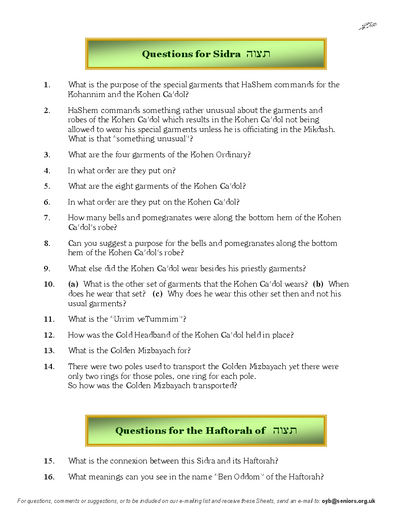
This week’s Haftorah is taken from Sefer Yechezkel, from Chapter 43 verse 10 till the end of that Chapter.

1. Last week’s Sidra was about the making of the Mishkan and the Haftorah was about the building of the Beis HaMikdash. This week’s Sidra continues the topic of the Mishkan, going into detail about the garments of the Kohannim and then describes at greater length the ceremony of the consecration of the Mizbayach. And the Haftorah likewise describes the inauguration of the Mizbayach in the rebuilt Beis HaMikdash.

2. Yechezkel HaNovvi and Yirmiyohu HaNovvi were contemporaries. But whereas Yirmiyohu was given the unhappy task of warning of the Destruction of the First Beis HaMikdash (his prophecies began forty years before the Destruction) and of bringing words of comfort to the people after that terrible event, Yechezkel is, as it were, the Novvi of the Exile, in Babylon.

3. As mentioned before in these Haftorah sheets, every Novvi had his own style and distinctive expressions — but these were more than merely a manner of speaking: they were part of the prophecy. Indeed, Yechezkel often tells us how HaShem addresses him as “בֶּן אָדָם,” that is, “son of Man.” This title is indicative of his mission, that it is broader and more inclusive than being a prophet exclusively to the Jewish People. For although Yechezkel was sent by HaShem to the Jewish People, nevertheless he was to be HaShem’s prophet to all humanity, too. Yechezkel’s message is directed to the Jewish People in Exile, where despite their exile — or perhaps indeed because they are in exile amongst the nations of the world — they must remember to be HaShem’s “kingdom of priests and holy nation,” to bring the nations of the world to the realization of HaShem as the Father and Sovereign of all Mankind, to worship Him in the rebuilt Beis HaMikdash, the truly universal House of Prayer and to learn and obey His commandments.

4. The very name given to the first Man, "אָדָם", has a number of meanings. The word "אָדָם" has been associated with the word אֲדָמָה (“earth”) from which he was made. But this association should more be a lesson to him to be humble rather than a description of who he is for Man is to rise far above the earth from which he is taken. Mankind is much rather to be the הֲדֹם, the footstool, as it were, of HaShem, that is, by his conduct and interaction with others and with all of HaShem’s Creation, אָדָם is to be the bearer of HaShem’s Presence in this world. Through his acts of kindness, of consideration, of sincerity, which should imitate those of his Maker, so that Man can sincerely declare, “I am similar, אַדַמֶה, to Him,” Man is charged to make this world a fitting place for the Divine Presence. This is the task of all Mankind, led by HaShem’s Chosen People. Now that exile among the nations of the world has sadly become a reality for the Jewish People, Yechezkel warns us repeatedly against causing any kind of Chillul HaShem.

5. This Haftorah is the prophecy of Yechezkel concerning the rebuilt Beis HaMikdash. It is deliberately worded so that it can be referring to the Second Beis HaMikdash or indeed to the Third. His words are intended to be an encouragement to the Jewish People so that whether his listeners are looking forward to the rebuilt Second Beis HaMikdash or whether his listeners are us today who are looking forward to the rebuilt Third Beis HaMikdash, the message is the same, namely, that with true repentance and by returning to HaShem in sincerity, we will merit to return to Eretz Yisroel and rebuild the Beis HaMikdash and in our Haftorah Yechezkel describes in some detail the rebuilt Beis HaMikdash and the inauguration of the Mizbayach.

PDF Preview