Intent and Deed: A Question of Priorities
Torah Papers | February 23, 2024
Print This Article
View Original PDF

Intent and Deed: A Question of Priorities

Torah Papers | December 10, 2025

Intent and Deed: A Question of Priorities

Produced from the shiur delivered at Beit Knesset Hagadol Bnei Brak on י"ד אדר א׳ תשפ״ד (2/22/24).

Sponsored by R’ Fishel Klein of Miami Beach, Florida, in the merit of a refuah shleima for his wife ברכה בת רבקה מאטיל - b’toch she’ar cholei Yisrael. Sponsored in the merit of a refuah shleima for בתוך שח"י אביבה בת מלכה. Dedicated in memory of our fallen soldiers הי"ד, and in the merit of a refuah shleima, b’nefesh uv’ guf, for all those injured.

Building on this distinction between the divine names represented in the garments, the Ohr HaChaim elaborates on another concept. The eight garments were prescribed so that eight types of sin could be atoned for. This helps explain their specific commandment for Aharon rather than Moshe, as Aharon's official role was to atone for the sins of Bnei Yisrael through the offering of Korbanot, whereas Moshe’s temporary role in the Mishkan was specific to setting it up and consecrating it.

The Gemara (Zevachim 88b) elaborates on the eight garments of the Kohen Gadol and the specific sins each garment atones for: The כֻּתֹּנֶת (tunic) atones for the sin of murder. The מִכְנְסַיִם (pants) atone for sins of immoral relations. The מִצְנֶפֶת (turban) atones for sins of arrogance. The אַבְנֵט (sash) atones for sinful thoughts. The חֹשֶׁן (breastplate) atones for dinim – judgments. The אֵפוֹד (apron) atones for idol worship. The מְעִיל (robe) atones for lashon hara – slander. The צִיץ (frontlet) atones for brazenness. All this teaches us that, similar to sacrifices, the garments of the Kohen Gadol also serve a role in atonement.

The sefer Yefeh To’ar raises a question regarding the array of other sins not directly mentioned in the scope of these eight garments, such as Chilul Shabbat, eating non-kosher, or taking revenge. Why are only these eight sins addressed? He answers, these eight are foundational in essence and include עֲנִיָּה רְחָבָה – punishment that spreads and affects people beyond the one who may have eaten non-kosher privately at home. Their transgression also influences a wider range of sinful behaviors and punishments, thereby including those individual sins within the broader category of the master sin addressed by each garment. This approach suggests that the atonement facilitated by the Kohen Gadol's garments extends beyond the specific sins listed, covering a broader spectrum of transgressions through association.

The Shelah HaKadosh (Torah Ohr, Rosh Hashanah) asks how it could be that the Beit HaMikdash was destroyed if these garments atoned for the very same sins we’re told led to its destruction. He points out, very importantly, that the garments atoned only for the arvut – i.e., standing by as murder, idolatry, and immoral relations ran rampant. The garments atoned for that areivut (following Teshuva) and not for the transgressions themselves. Rabbi Eliyahu HaKohen M'izmir adds (Chut Shel Chesed), the garments on their own do not atone, just as looking at the color of techeilet in Tzitzit and seeing a Korban bring sacrificed don’t doesn’t achieve the intended final result. If this were the case, everyone living along the shore would be a Satmar Chassid and all pilots would be Alexander Chassidim! Being reminded of the blue sky or your own accountability are merely actions meant to serve as a springboard for your own reaction – namely, self-improvement and Teshuva. The same is true for the Kohen Gadol’s garments. Seeing them is meant to trigger one to examine the Kohen Gadol and strive for growth. Chut Shel Chesed then itemizes each item in terms of how it should influence a person and lead them to the abolition of particular sins.

Chazal pose several questions regarding the sequence in which the garments are introduced and detailed. Initially, when Hakadosh Baruch Hu introduces all the garments collectively, the חֹשֶׁן is mentioned first, followed by the אֵפוֹד:

וְאֵלֶּה הַבְּגָדִים אֲשֶׁר יַעֲשׂוּ חֹשֶׁן וְאֵפוֹד וּמְעִיל וּכְתֹנֶת תַּשְׁבֵּץ מִצְנֶפֶת וְאַבְנֵט וְעָשׂוּ בִגְדֵי־קֹדֶשׁ לְאַהֲרֹן אָחִיךָ וּלְבָנָיו לְכַהֲנוֹ־לִי׃

These are the garments that they shall make: a breastplate, an eiphod, a robe, a checkered undershirt, a turban and a sash-belt. Have them make sacred garments for your brother Aharon, and for his sons, to serve Me.

However, when subsequently commanding the details on how they are to be made, the אֵפוֹד is presented first: וְעָשׂוּ אֶת הָאֵפוֹד. Why is the initial order not maintained? There is deep significance here, and we’ll work to uncover it.

Another question asked by Chazal pertains to the number of articles of clothing. The introduction lists eight articles whereas the detailed instructions only cover six – notably, the צִיץ and מִכְנְסַיִם are missing. This prompts questions from the Ibn Ezra, Ba’al HaTurim, and Rashbam as to why. The answer provided sheds light on the nature of these garments. The צִיץ is not classified as a garment in the traditional sense and is more akin to a crown than a piece of clothing. Consequently, it is not included in the detailed list of garments. However, the מִכְנְסַיִם, undoubtedly a form of clothing, require a different explanation. Their omission from the instructions is attributed not to their classification but to their purpose. Unlike the other garments, which are worn לְכָבוֹד וּלְתִפְאֶרֶת (for honor and glory), the מִכְנְסַיִם are intended for modesty.

The Kli Yakar, Tzror Hamor, and the Netziv all pose the question regarding the Torah's presentation order and the חֹשֶׁן being listed first but the אֵפוֹד being made first. They answer, the חֹשֶׁן was the most important garment due to it containing the אוּרִים וְתֻמִּים, which bore the שֵׁם הַמְּפוֹרָשׁ (explicit name). However, the construction sequence starts with the אֵפוֹד because the חֹשֶׁן achieves its designated status and function only when it is mounted upon the אֵפוֹד.

An analogy from our day-to-day world can help us understand this sequence. If one were to receive a valuable painting, its value and beauty can only be appreciated once it is properly displayed. This requires preliminary steps, such as installing an anchor, nail, or hook, and attaching a wire for hanging. The painting, while being the centerpiece, depends on the preparatory arrangements for its display. Similarly, the אֵפוֹד serves as the foundational garment that enables the חֹשֶׁן to fulfill its purpose. Thus, the construction order prioritizes the אֵפוֹד, ensuring the חֹשֶׁן can be correctly placed and affixed upon it: יִזַּח הַחֹשֶׁן מֵעַל חֵשֶׁב הָאֵפוֹד וְלֹא לִהְיוֹת עַל הָאֵפוֹד.

The Kli Yakar also explores the unique use of the plural form וְעָשׂוּ in the command to make the אֵפוֹד, contrasting it with the singular form וְעָשִׂיתָ used for all other items except for the אָרוֹן (Ark). Regarding the Aron, the Midrash suggests that the plural form is used to encourage collective participation, symbolizing that everyone should have a part in the Torah. However, the question remains with regards to the אֵפוֹד, where Chazal do not seem as bothered by the language as they are with the Aron. The Kli Yakar addresses this, referencing the Gemara in Zevachim which states that the eight garments of the Kohen Gadol serve to atone for eight specific types of sins. The חֹשֶׁן, which atones for matters of dinim (judgments), is presented first in the introduction due to its significance. However, in the construction sequence, the אֵפוֹד, which atones for idol worship, is prioritized. This prioritization reflects Bnei Yisrael's immediate need for atonement following Cheit HaEigel. Despite only the eirev rav – 3000 people – having actively participated in the sin, the collective bore the burden due to their lack of protest.

Furthermore, the designation of the אֵפוֹד as a חֹשֵׁב מַעֲשֵׂה – a work of thoughtful craftsmanship, echoes the sin of idolatry, which can be incurred through mere thought, as articulated in the Gemara (Kiddushin 42a): מַּחְשָׁבָה כְּמַעֲשֶׂה – thought is like action. The sin of Avodah Zara is one that a person is guilty of just by way of thought and intent, without even acting on the impulse.

I’d like to continue to a beautiful idea offered by the Chida regarding this unique treatment of the sin of Avodah Zara, where mere thought is considered equivalent to the act of sinning itself. But first, a brief introduction from the Ba’al HaTurim and Rokeach.

וְחֵשֶׁב אֲפֻדָּתוֹ אֲשֶׁר עָלָיו כְּמַעֲשֵׂהוּ מִמֶּנּוּ יִהְיֶה זָהָב תְּכֵלֶת וְאַרְגָּמָן וְתוֹלַעַת שָׁנִי וְשֵׁשׁ מָשְׁזָר׃ וְלָקַחְתָּ אֶת־שְׁתֵּי אַבְנֵי־שֹׁהַם וּפִתַּחְתָּ עֲלֵיהֶם שְׁמוֹת בְּנֵי יִשְׂרָאֵל׃ שִׁשָּׁה מִשְּׁמֹתָם עַל הָאֶבֶן הָאֶחָת וְאֶת־שְׁמוֹת הַשִּׁשָּׁה הַנּוֹתָרִים עַל־הָאֶבֶן הַשֵּׁנִית כְּתוֹלְדֹתָם׃

The eiphod’s belt, which is on it, shall be made in the same manner as the eiphod, it shall be woven with it. Gold, greenish blue wool, dark red wool, crimson wool and fine twined linen. Take two shoham stones and engrave on them the names of Bnei Yisrael. Six of their names on the one stone, and the remaining six names on the second stone, in the order of their birth.

When examining the אֵפוֹד, one can't help but notice the unique placement of the אַבְנֵי שֹׁהַם – onyx stones, on its shoulders. In addition to appearing on the Urim v’Tumim, the names of the twelve tribes were inscribed on these two stones, with six names engraved on each. This raises a question: If the אֵפוֹד is meant to atone for Avodah Zara, why then are the names of all twelve tribes inscribed upon it?

The Ba’al HaTurim provides an amazing observation. The initial letters of the words שִׁשָּׁה מִשְׁמוֹתָם עַל spell out שְׁמַע, hinting at a deeper significance held by these two stones. The Chatam Sofer interprets this as a reference to Har Grizim and Har Eival, where the tribes all stood for brachot and klalot and committed to remain faithful to Hakadosh Baruch Hu, while the Levi’im stood in between them, represented by the head of the Kohen Gadol which turns to both sides of the אֵפוֹד.

The Rokeach delves in further, drawing on the Gemara (Pesachim 56a). בִּיקֵּשׁ יַעֲקֹב לְגַלּוֹת לְבָנָיו קֵץ הַיָמִין – Yaakov Avinu wanted to reveal to his sons when the complete redemption would arrive at the end of days but was suddenly unable to. He immediately feared he lost his prophetic vision due to a flaw (פְּסוּל) among them, just as his ancestors had unfit descendants (פְּסוֹלֶת) – i.e., Yishmael was born to Avraham and Eisav was born to Yitzchak. Notice the letters ק and צ (representing קֵץ, the end) are absent from the names of Yaakov's sons. To his suspicion, the sons reassured him: just as there was no ק and צ, there is also no ח and ט – representing חטא (sin) – in their names. They assured their father of their purity and unity in faith by collectively proclaiming שְׁמַע יִשְׂרָאֵל ה׳ אֱלֹהֵינוּ ה׳ אֶחָד, to which Yaakov responded בָּרוּךְ שֵׁם כְּבוֹד מַלְכוּתוֹ לְעוֹלָם וָעֶד. The Rokeach says, each set of six words aligns with the stone and six names on the Kohen Gadol’s shoulders, symbolizing complete faith and a disavowal of idolatry.
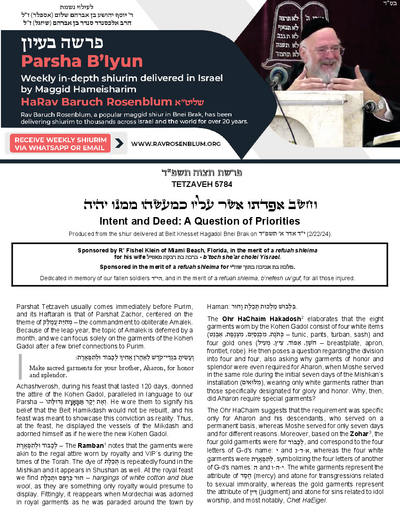

Intent and Deed: A Question of Priorities

Produced from the shiur delivered at Beit Knesset Hagadol Bnei Brak on י"ד אדר א׳ תשפ״ד (2/22/24).

Sponsored by R’ Fishel Klein of Miami Beach, Florida, in the merit of a refuah shleima for his wife ברכה בת רבקה מאטיל - b’toch she’ar cholei Yisrael. Sponsored in the merit of a refuah shleima for בתוך שח"י אביבה בת מלכה. Dedicated in memory of our fallen soldiers הי"ד, and in the merit of a refuah shleima, b’nefesh uv’ guf, for all those injured.

Building on this distinction between the divine names represented in the garments, the Ohr HaChaim elaborates on another concept. The eight garments were prescribed so that eight types of sin could be atoned for. This helps explain their specific commandment for Aharon rather than Moshe, as Aharon's official role was to atone for the sins of Bnei Yisrael through the offering of Korbanot, whereas Moshe’s temporary role in the Mishkan was specific to setting it up and consecrating it.

The Gemara (Zevachim 88b) elaborates on the eight garments of the Kohen Gadol and the specific sins each garment atones for: The כֻּתֹּנֶת (tunic) atones for the sin of murder. The מִכְנְסַיִם (pants) atone for sins of immoral relations. The מִצְנֶפֶת (turban) atones for sins of arrogance. The אַבְנֵט (sash) atones for sinful thoughts. The חֹשֶׁן (breastplate) atones for dinim – judgments. The אֵפוֹד (apron) atones for idol worship. The מְעִיל (robe) atones for lashon hara – slander. The צִיץ (frontlet) atones for brazenness. All this teaches us that, similar to sacrifices, the garments of the Kohen Gadol also serve a role in atonement.

The sefer Yefeh To’ar raises a question regarding the array of other sins not directly mentioned in the scope of these eight garments, such as Chilul Shabbat, eating non-kosher, or taking revenge. Why are only these eight sins addressed? He answers, these eight are foundational in essence and include עֲנִיָּה רְחָבָה – punishment that spreads and affects people beyond the one who may have eaten non-kosher privately at home. Their transgression also influences a wider range of sinful behaviors and punishments, thereby including those individual sins within the broader category of the master sin addressed by each garment. This approach suggests that the atonement facilitated by the Kohen Gadol's garments extends beyond the specific sins listed, covering a broader spectrum of transgressions through association.

The Shelah HaKadosh (Torah Ohr, Rosh Hashanah) asks how it could be that the Beit HaMikdash was destroyed if these garments atoned for the very same sins we’re told led to its destruction. He points out, very importantly, that the garments atoned only for the arvut – i.e., standing by as murder, idolatry, and immoral relations ran rampant. The garments atoned for that areivut (following Teshuva) and not for the transgressions themselves. Rabbi Eliyahu HaKohen M'izmir adds (Chut Shel Chesed), the garments on their own do not atone, just as looking at the color of techeilet in Tzitzit and seeing a Korban bring sacrificed don’t doesn’t achieve the intended final result. If this were the case, everyone living along the shore would be a Satmar Chassid and all pilots would be Alexander Chassidim! Being reminded of the blue sky or your own accountability are merely actions meant to serve as a springboard for your own reaction – namely, self-improvement and Teshuva. The same is true for the Kohen Gadol’s garments. Seeing them is meant to trigger one to examine the Kohen Gadol and strive for growth. Chut Shel Chesed then itemizes each item in terms of how it should influence a person and lead them to the abolition of particular sins.

Chazal pose several questions regarding the sequence in which the garments are introduced and detailed. Initially, when Hakadosh Baruch Hu introduces all the garments collectively, the חֹשֶׁן is mentioned first, followed by the אֵפוֹד:

וְאֵלֶּה הַבְּגָדִים אֲשֶׁר יַעֲשׂוּ חֹשֶׁן וְאֵפוֹד וּמְעִיל וּכְתֹנֶת תַּשְׁבֵּץ מִצְנֶפֶת וְאַבְנֵט וְעָשׂוּ בִגְדֵי־קֹדֶשׁ לְאַהֲרֹן אָחִיךָ וּלְבָנָיו לְכַהֲנוֹ־לִי׃

These are the garments that they shall make: a breastplate, an eiphod, a robe, a checkered undershirt, a turban and a sash-belt. Have them make sacred garments for your brother Aharon, and for his sons, to serve Me.

However, when subsequently commanding the details on how they are to be made, the אֵפוֹד is presented first: וְעָשׂוּ אֶת הָאֵפוֹד. Why is the initial order not maintained? There is deep significance here, and we’ll work to uncover it.

Another question asked by Chazal pertains to the number of articles of clothing. The introduction lists eight articles whereas the detailed instructions only cover six – notably, the צִיץ and מִכְנְסַיִם are missing. This prompts questions from the Ibn Ezra, Ba’al HaTurim, and Rashbam as to why. The answer provided sheds light on the nature of these garments. The צִיץ is not classified as a garment in the traditional sense and is more akin to a crown than a piece of clothing. Consequently, it is not included in the detailed list of garments. However, the מִכְנְסַיִם, undoubtedly a form of clothing, require a different explanation. Their omission from the instructions is attributed not to their classification but to their purpose. Unlike the other garments, which are worn לְכָבוֹד וּלְתִפְאֶרֶת (for honor and glory), the מִכְנְסַיִם are intended for modesty.

The Kli Yakar, Tzror Hamor, and the Netziv all pose the question regarding the Torah's presentation order and the חֹשֶׁן being listed first but the אֵפוֹד being made first. They answer, the חֹשֶׁן was the most important garment due to it containing the אוּרִים וְתֻמִּים, which bore the שֵׁם הַמְּפוֹרָשׁ (explicit name). However, the construction sequence starts with the אֵפוֹד because the חֹשֶׁן achieves its designated status and function only when it is mounted upon the אֵפוֹד.

An analogy from our day-to-day world can help us understand this sequence. If one were to receive a valuable painting, its value and beauty can only be appreciated once it is properly displayed. This requires preliminary steps, such as installing an anchor, nail, or hook, and attaching a wire for hanging. The painting, while being the centerpiece, depends on the preparatory arrangements for its display. Similarly, the אֵפוֹד serves as the foundational garment that enables the חֹשֶׁן to fulfill its purpose. Thus, the construction order prioritizes the אֵפוֹד, ensuring the חֹשֶׁן can be correctly placed and affixed upon it: יִזַּח הַחֹשֶׁן מֵעַל חֵשֶׁב הָאֵפוֹד וְלֹא לִהְיוֹת עַל הָאֵפוֹד.

The Kli Yakar also explores the unique use of the plural form וְעָשׂוּ in the command to make the אֵפוֹד, contrasting it with the singular form וְעָשִׂיתָ used for all other items except for the אָרוֹן (Ark). Regarding the Aron, the Midrash suggests that the plural form is used to encourage collective participation, symbolizing that everyone should have a part in the Torah. However, the question remains with regards to the אֵפוֹד, where Chazal do not seem as bothered by the language as they are with the Aron. The Kli Yakar addresses this, referencing the Gemara in Zevachim which states that the eight garments of the Kohen Gadol serve to atone for eight specific types of sins. The חֹשֶׁן, which atones for matters of dinim (judgments), is presented first in the introduction due to its significance. However, in the construction sequence, the אֵפוֹד, which atones for idol worship, is prioritized. This prioritization reflects Bnei Yisrael's immediate need for atonement following Cheit HaEigel. Despite only the eirev rav – 3000 people – having actively participated in the sin, the collective bore the burden due to their lack of protest.

Furthermore, the designation of the אֵפוֹד as a חֹשֵׁב מַעֲשֵׂה – a work of thoughtful craftsmanship, echoes the sin of idolatry, which can be incurred through mere thought, as articulated in the Gemara (Kiddushin 42a): מַּחְשָׁבָה כְּמַעֲשֶׂה – thought is like action. The sin of Avodah Zara is one that a person is guilty of just by way of thought and intent, without even acting on the impulse.

I’d like to continue to a beautiful idea offered by the Chida regarding this unique treatment of the sin of Avodah Zara, where mere thought is considered equivalent to the act of sinning itself. But first, a brief introduction from the Ba’al HaTurim and Rokeach.

וְחֵשֶׁב אֲפֻדָּתוֹ אֲשֶׁר עָלָיו כְּמַעֲשֵׂהוּ מִמֶּנּוּ יִהְיֶה זָהָב תְּכֵלֶת וְאַרְגָּמָן וְתוֹלַעַת שָׁנִי וְשֵׁשׁ מָשְׁזָר׃ וְלָקַחְתָּ אֶת־שְׁתֵּי אַבְנֵי־שֹׁהַם וּפִתַּחְתָּ עֲלֵיהֶם שְׁמוֹת בְּנֵי יִשְׂרָאֵל׃ שִׁשָּׁה מִשְּׁמֹתָם עַל הָאֶבֶן הָאֶחָת וְאֶת־שְׁמוֹת הַשִּׁשָּׁה הַנּוֹתָרִים עַל־הָאֶבֶן הַשֵּׁנִית כְּתוֹלְדֹתָם׃

The eiphod’s belt, which is on it, shall be made in the same manner as the eiphod, it shall be woven with it. Gold, greenish blue wool, dark red wool, crimson wool and fine twined linen. Take two shoham stones and engrave on them the names of Bnei Yisrael. Six of their names on the one stone, and the remaining six names on the second stone, in the order of their birth.

When examining the אֵפוֹד, one can't help but notice the unique placement of the אַבְנֵי שֹׁהַם – onyx stones, on its shoulders. In addition to appearing on the Urim v’Tumim, the names of the twelve tribes were inscribed on these two stones, with six names engraved on each. This raises a question: If the אֵפוֹד is meant to atone for Avodah Zara, why then are the names of all twelve tribes inscribed upon it?

The Ba’al HaTurim provides an amazing observation. The initial letters of the words שִׁשָּׁה מִשְׁמוֹתָם עַל spell out שְׁמַע, hinting at a deeper significance held by these two stones. The Chatam Sofer interprets this as a reference to Har Grizim and Har Eival, where the tribes all stood for brachot and klalot and committed to remain faithful to Hakadosh Baruch Hu, while the Levi’im stood in between them, represented by the head of the Kohen Gadol which turns to both sides of the אֵפוֹד.

The Rokeach delves in further, drawing on the Gemara (Pesachim 56a). בִּיקֵּשׁ יַעֲקֹב לְגַלּוֹת לְבָנָיו קֵץ הַיָמִין – Yaakov Avinu wanted to reveal to his sons when the complete redemption would arrive at the end of days but was suddenly unable to. He immediately feared he lost his prophetic vision due to a flaw (פְּסוּל) among them, just as his ancestors had unfit descendants (פְּסוֹלֶת) – i.e., Yishmael was born to Avraham and Eisav was born to Yitzchak. Notice the letters ק and צ (representing קֵץ, the end) are absent from the names of Yaakov's sons. To his suspicion, the sons reassured him: just as there was no ק and צ, there is also no ח and ט – representing חטא (sin) – in their names. They assured their father of their purity and unity in faith by collectively proclaiming שְׁמַע יִשְׂרָאֵל ה׳ אֱלֹהֵינוּ ה׳ אֶחָד, to which Yaakov responded בָּרוּךְ שֵׁם כְּבוֹד מַלְכוּתוֹ לְעוֹלָם וָעֶד. The Rokeach says, each set of six words aligns with the stone and six names on the Kohen Gadol’s shoulders, symbolizing complete faith and a disavowal of idolatry.

PDF Preview


