Linking the Apron and the Breastplate
BET Journal | February 23, 2024
Print This Article
View Original PDF

Linking the Apron and the Breastplate

BET Journal | December 10, 2025

There is an intriguing mitzvah (commandment) recorded in this week’s Torah portion: “And they shall bind the choshen (breastplate) by its rings to the rings of the ephod (apron) ... so that the choshen shall not budge from the ephod.”

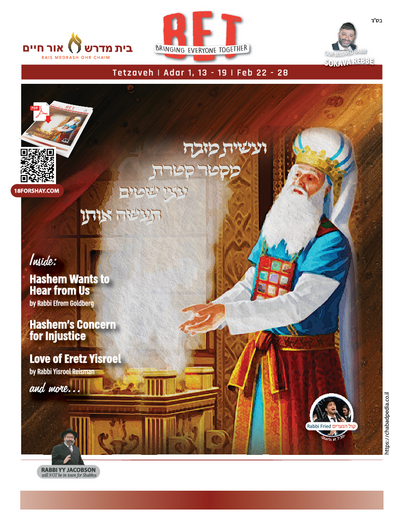
The meaning of these words is this: The choshen (breastplate) and the ephod (apron) were two of the eight special garments worn by the High Priest (Kohen Gadol) while performing the services in the Tabernacle. The choshen was a breastplate set with twelve precious stones, each inscribed with the name of one of the twelve tribes of Israel. It was worn on the breast, over the heart. The ephod was an apron-like garment, covering the lower back of the body, from the waist to the ankles, with a belt that tied in the front.

Two gold rings sewn on the ephod’s belt lined up with two gold rings sewn to the bottom corners of the choshen; these were bound together with ribbons of blue wool. It is of vital importance, the Torah stresses, that the two should remain securely fastened at all times that the priestly garments are worn. “The choshen shall not budge from the ephod.”

But why? Why the insistence that the breastplate and apron must be tightly linked at all times? Why bother if they are disconnected or only loosely connected?

A tale of two garments

One answer, presented in the mystical tradition, is deeply moving.

The two garments – the breastplate seated atop the heart and the apron hanging on the lower back – represent the “upper” and “lower” dimensions of life, or the “forward” and “backward” aspects of human existence. The breast-plate represented those individuals whose hearts were aflame with spiritual passion and ecstasy, while the apron symbolized the people who struggled with backward temptations, the crass and lowly impulses and dispositions.

UFARATZTA

Emuna and Bitachon

... We must know that faith and trust [in Hashem] is not something that remains in our thoughts only, rather, it should permeate our entire being.

There is no doubt that you are a ma’amin [believer.] The first thing about emunah is that Hashem runs the world. So, if he can take care of billions of people, then you can be sure that also, in your personal matters it will be fulfilled what it says in the Pasuk [Yeshaya 46,4]: “Ani osi’si va’ani eso va’ani esbol va’amaleit -- I have made you, and I will carry you, I will sustain and rescue you.”

==== Igros Kodesh V4, P255.

This is not merely a distinction between two types of people; it is rather a distinction between two aspects existing in each of our lives.

Few are the people who can be defined as “breastplates” or “aprons” exclusively. Most of us vacillate between backward and frontward tendencies, between lower and higher aspirations. We celebrate moments of light but we must also quarrel with darkness, trauma, addiction, and emotional prisons. At times life is a cruise through a tranquil seabed, yet at other times it consists of navigation through turbulent waves, battle fields and war zones. There are moments we sense our calling, yet at other times we yearn to discover our true selves, we struggle to find our place in the world. Crudeness, superficiality and lowliness may at any moment consume our multi-dimensional personalities.

Hence, the Torah instructs us to tightly link the breastplate to the apron, “so that the choshen shall not budge from the ephod.” We must somehow learn to integrate the two parts of the self, without escaping into either element. Do not retreat, the Torah is saying, into your “higher” self and forget about your “lower” self, for when the lower self resurfaces you might fall hard. On the other hand, do not allow yourself to be swept away by your lower self and ignore your transcendental aspirations, for such a life is likely to leave you deeply thirsty and anxious.

You must learn the art of integration. You must come to terms with the truth that the “breastplate” and the “apron” together constitute the very objective of existence, to confront darkness and transform it into light, to create harmony out of the building blocks of diversity.
There is an intriguing mitzvah (commandment) recorded in this week’s Torah portion: “And they shall bind the choshen (breastplate) by its rings to the rings of the ephod (apron) ... so that the choshen shall not budge from the ephod.”

The meaning of these words is this: The choshen (breastplate) and the ephod (apron) were two of the eight special garments worn by the High Priest (Kohen Gadol) while performing the services in the Tabernacle. The choshen was a breastplate set with twelve precious stones, each inscribed with the name of one of the twelve tribes of Israel. It was worn on the breast, over the heart. The ephod was an apron-like garment, covering the lower back of the body, from the waist to the ankles, with a belt that tied in the front.

Two gold rings sewn on the ephod’s belt lined up with two gold rings sewn to the bottom corners of the choshen; these were bound together with ribbons of blue wool. It is of vital importance, the Torah stresses, that the two should remain securely fastened at all times that the priestly garments are worn. “The choshen shall not budge from the ephod.”

But why? Why the insistence that the breastplate and apron must be tightly linked at all times? Why bother if they are disconnected or only loosely connected?

A tale of two garments

One answer, presented in the mystical tradition, is deeply moving.

The two garments – the breastplate seated atop the heart and the apron hanging on the lower back – represent the “upper” and “lower” dimensions of life, or the “forward” and “backward” aspects of human existence. The breast-plate represented those individuals whose hearts were aflame with spiritual passion and ecstasy, while the apron symbolized the people who struggled with backward temptations, the crass and lowly impulses and dispositions.

UFARATZTA

Emuna and Bitachon

... We must know that faith and trust [in Hashem] is not something that remains in our thoughts only, rather, it should permeate our entire being.

There is no doubt that you are a ma’amin [believer.] The first thing about emunah is that Hashem runs the world. So, if he can take care of billions of people, then you can be sure that also, in your personal matters it will be fulfilled what it says in the Pasuk [Yeshaya 46,4]: “Ani osi’si va’ani eso va’ani esbol va’amaleit -- I have made you, and I will carry you, I will sustain and rescue you.”

==== Igros Kodesh V4, P255.

This is not merely a distinction between two types of people; it is rather a distinction between two aspects existing in each of our lives.

Few are the people who can be defined as “breastplates” or “aprons” exclusively. Most of us vacillate between backward and frontward tendencies, between lower and higher aspirations. We celebrate moments of light but we must also quarrel with darkness, trauma, addiction, and emotional prisons. At times life is a cruise through a tranquil seabed, yet at other times it consists of navigation through turbulent waves, battle fields and war zones. There are moments we sense our calling, yet at other times we yearn to discover our true selves, we struggle to find our place in the world. Crudeness, superficiality and lowliness may at any moment consume our multi-dimensional personalities.

Hence, the Torah instructs us to tightly link the breastplate to the apron, “so that the choshen shall not budge from the ephod.” We must somehow learn to integrate the two parts of the self, without escaping into either element. Do not retreat, the Torah is saying, into your “higher” self and forget about your “lower” self, for when the lower self resurfaces you might fall hard. On the other hand, do not allow yourself to be swept away by your lower self and ignore your transcendental aspirations, for such a life is likely to leave you deeply thirsty and anxious.

You must learn the art of integration. You must come to terms with the truth that the “breastplate” and the “apron” together constitute the very objective of existence, to confront darkness and transform it into light, to create harmony out of the building blocks of diversity.

PDF Preview