Parashas Haketores – A Tikkun for the Neshamah
Vechol Maaminim | March 06, 2025
Print This Article
View Original PDF

Parashas Haketores – A Tikkun for the Neshamah

Vechol Maaminim | June 27, 2025

Peninei Emunim

Pearls of Tefillah in the Parashah

(א ל) “אתו תעשה שטים עצי קטרת מקטר מזבח ועשית”

The Kli Yakar explains that the two mizbechos are mechaper on the sinner: The mizbei’ach hanechoshes atones for the material and physical part, and therefore, animals are brought upon it. The Mizbei’ach Hazahav atones for the part of the lofty neshamah, and therefore the ketores is sacrificed upon it, because the cloud of the ketores rises on High like the soul of a person (see Brachos 43b).

Thus the Teshuvos Vehanhagos explains he great virtue of saying Parashas Haketores before davening: One who says this parashah discovers that the main goal in his tefillah is to do the Ratzon Shamayim and to be mesaken his neshamah, and therefore, he merits that his tefillah is accepted.

Ta’am Veda’as

Parashas Haketores Binds the Tefillah

(א ל) “אתו תעשה שטים עצי קטרת מקטר מזבח ועשית”

The description of the work of the Mishkan closes out with Parashas Mizbe’ach Haketores, and we also conclude the tefillah with Parashas Haketores. Rabi Avraham Saba, author of Tzeror Hamor, explained that this is intentional. He writes: “And that is why he concluded all the divrei haMishkan with the Mizbei’ach Haketores, because it connects all the things in the Mishkan and binds the lower things with the Higher things and the Higher with the lower. That is why it is called “ketores” – a term of “kishur” like (Zohar Bo 38a): “שרי קטרין” – untying knots, because it connects all the things...And that is the actual reason why we say the ketores each day in the morning and evening, after each tefillah, because the ketores is what seals it all and connects it all. And the seal of the tefillah is the ketores, which connects every tefillah and makes from it a crown that is bound to his Creator, yisbarach.”
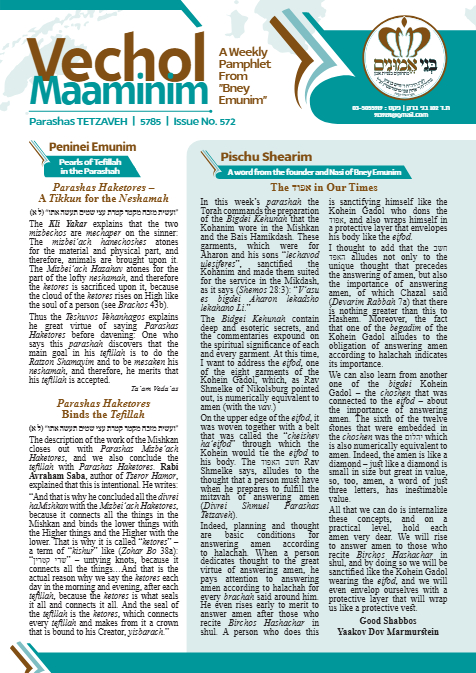
Peninei Emunim

Pearls of Tefillah in the Parashah

(א ל) “אתו תעשה שטים עצי קטרת מקטר מזבח ועשית”

The Kli Yakar explains that the two mizbechos are mechaper on the sinner: The mizbei’ach hanechoshes atones for the material and physical part, and therefore, animals are brought upon it. The Mizbei’ach Hazahav atones for the part of the lofty neshamah, and therefore the ketores is sacrificed upon it, because the cloud of the ketores rises on High like the soul of a person (see Brachos 43b).

Thus the Teshuvos Vehanhagos explains he great virtue of saying Parashas Haketores before davening: One who says this parashah discovers that the main goal in his tefillah is to do the Ratzon Shamayim and to be mesaken his neshamah, and therefore, he merits that his tefillah is accepted.

Ta’am Veda’as

Parashas Haketores Binds the Tefillah

(א ל) “אתו תעשה שטים עצי קטרת מקטר מזבח ועשית”

The description of the work of the Mishkan closes out with Parashas Mizbe’ach Haketores, and we also conclude the tefillah with Parashas Haketores. Rabi Avraham Saba, author of Tzeror Hamor, explained that this is intentional. He writes: “And that is why he concluded all the divrei haMishkan with the Mizbei’ach Haketores, because it connects all the things in the Mishkan and binds the lower things with the Higher things and the Higher with the lower. That is why it is called “ketores” – a term of “kishur” like (Zohar Bo 38a): “שרי קטרין” – untying knots, because it connects all the things...And that is the actual reason why we say the ketores each day in the morning and evening, after each tefillah, because the ketores is what seals it all and connects it all. And the seal of the tefillah is the ketores, which connects every tefillah and makes from it a crown that is bound to his Creator, yisbarach.”

PDF Preview