Permitting Doubt
Wonders | March 01, 2026
Print This Article
View Original PDF

Permitting Doubt

Wonders | March 02, 2026

Permitting Doubt

One of the Ba’al Shem Tov’s most famous gematriot is that Amalek has the same value as doubt. In a farbrengen given in English a few days before Purim, and focusing on how Torah can mend a broken world, HaRav Ginsburgh delved into one of his favorite (and often misunderstood) topics: doubt, where it resides in the mind, and whether there are different options for dealing with it.

In this excerpt, he challenges the notion that all doubt is negative and reveals a surprising source that can be understood to encourage certain types of doubt.

Excerpted from a farbrengen given on the 11th of Second Adar, 5779 (2019) in Crown Heights.

One of the meanings of the word “Torah” (הָרוּת) is derived from the word meaning to release or to permit (הָרָּתַה)—the freedom or permission of something that was previously forbidden. It could also mean the untying of a knot, liberating something that was bound. Great wisdom is required to untie something complex and entangled. The Torah’s power to untie is explicitly expressed in the concept known as “resolution of doubts” (תֹקוֵפְסַת הַרָּתַה). A doubt is like an intricate knot that is difficult to release. If you have doubts in your studies or in the foundations of faith, you are—in your consciousness—entangled, bound, and in Hebrew, we would say, “forbidden” (רּסוָא), which also means imprisoned, or tied up.

What did the Ba’al Shem Tov teach us regarding doubts? On Shabbat Zachor, we read, “Remember what Amalek did to you,” and on Purim, we also engage in the obliteration of Amalek. The numerical value of Amalek (קֵלָמֲע) and “doubt” (קֵפָס) is 240, as the Ba’al Shem Tov taught. Amalek signifies doubt—existential doubt. There are all kinds of doubts.

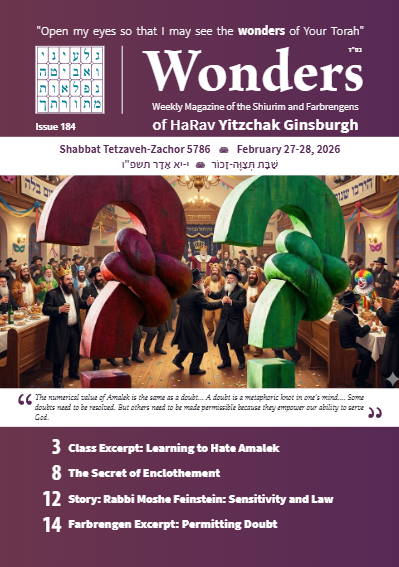
A doubt is a metaphoric knot in one’s mind, and the Torah can either resolve the doubt or it can free the individual from the doubt. These are two opposite approaches to a doubt. To resolve the doubt means to prove that the Torah holds one side of the doubt but not the other. For instance, if someone doubts if reality is real or not, the Torah resolves this doubt by writing, “In the beginning, God created the heavens and the earth.” According to the Torah, reality is real.

We might think that to free or release the knot of the doubt is just another way to say the same thing. But, if we allow ourselves a bit of wit in understanding the sages, we can introduce a new, clever, and ultimately deeper meaning to what to do with a doubt we might have.

There is a famous statement (whose origin we will explore below) that states, “There is no joy like the freeing [or untying] of doubts” (תֹקוֵפְסַת הַרָּתַהְה כָּחְמִׂין שֵא). But, because untying or freeing (תַרָּתַה) can also mean to make something permissible (רַּתּמו), then the meaning of the statement becomes, “There is no joy like permitting doubts.” In other words, it is permitted (mutar) to remain in doubt—the doubt is not terrible; it is okay. A simple example of a doubt that is permitted would be that chasidim used to doubt whether they themselves existed; God certainly exists, but whether I exist as an independent entity is a good question, an existential doubt.

Doubting the verity of my own existence is an example of a positive doubt—something that we should permit ourselves to have. Having this doubt does wonders for helping us attain the Zohar’s dictum, “joy in the heart from this side, weeping in the heart from that side.” Indeed, it is possible therefore that there are “permissible” doubts” that can affect our service of God positively.

How can we understand the fact that there are permissible doubts in terms of the sefirot? Amalek who is the representative of negative, destructive doubts is considered the unholy opposite (הֶת זַּמּעוְּלַה) of the sefirah of knowledge (da'at), which is the faculty that makes it possible for us to know God. It creates the unification (דּחוִי) or connection (תּרוְּׁשַקְתִה) we have with God. If you have a knot in your sefirah of knowledge, if you have a doubt, then you cannot properly unite or connect to God. In such a case, the evil Amalek-doubt must be resolved; one must eliminate the doubt, the Amalek, that weakens one’s mind and prevents them from connecting to God.

There Is No Joy Like Resolving Doubts

We already mentioned that when a doubt is resolved, the mind feels joy. In fact, as quoted, “There is no joy like resolving doubts.” Purim is the peak of joy for the entire year. We feel this joy because on Purim, we obliterate Amalek/doubts, those negative doubts that prevent us from connecting to God and “there is no joy like resolving doubts.”

It is worth knowing that the source of this famous expression is not from the Talmudic sages. Rather, it was coined by the Metzudat David, an important commentator on the Tanach, on the verse, “What brightens the eye gladdens the heart” (בֵח לַּמַׂשְם יִיַינֵר עֹאוְמ). The Metzudat David explains that whatever brings clarity (symbolized by the “light of the eyes”) in a doubtful thing gladdens the heart, because in the world there is no joy comparable to resolving doubt. Note that the value of his exact wording in Hebrew (יןֵאתֹקוֵפְסַת הַרָּתַהְה כָּחְמִׂם שָלֹעוָּב) together with the value of the phrase in Proverbs (חַּמַׂשְם יִיַינֵר עֹאוְמ בֵל) equals 3055, which is 5 times the value of “Torah” (הָרוּת), which we said earlier is also cognate with the word meaning “resolving” or “permitting” (הָרָּתַה). The multiplication by 5 alludes to what we have discussed elsewhere regarding the 5 basic existential doubts and the 5 essential doubts in Kabbalah discussed by the Arizal.

Resolving and Permitting Doubt in Knowledge

When the doubt is resolved allowing for the full functioning of the sefirah of knowledge, joy is immediately awakened. Regarding this, it is written: “If there is no knowledge, there is no understanding.” The inner experience of the sefirah of understanding is joy.

Resolving and permitting doubt in our faculty of knowledge correspond to the two sides of knowledge known as the two coronets of knowledge. Resolving a doubt corresponds to the left coronet of knowledge, since the left side represents the act of cutting through the knot that is the doubt, cutting it out like a surgery to remove a tumor. Making the doubt permissible by recognizing that it itself is not evil, it is not terrible to carry some doubts, and perhaps it even causes you to have a broken heart, which is certainly a positive thing regarding serving God, that corresponds to the right coronet of knowledge. So, the left side of our knowledge resolves or eliminates negative impacting doubt and the right side of our knowledge can sustain positive doubts that augment our Divine service.

Permitting Doubt

One of the Ba’al Shem Tov’s most famous gematriot is that Amalek has the same value as doubt. In a farbrengen given in English a few days before Purim, and focusing on how Torah can mend a broken world, HaRav Ginsburgh delved into one of his favorite (and often misunderstood) topics: doubt, where it resides in the mind, and whether there are different options for dealing with it.

In this excerpt, he challenges the notion that all doubt is negative and reveals a surprising source that can be understood to encourage certain types of doubt.

Excerpted from a farbrengen given on the 11th of Second Adar, 5779 (2019) in Crown Heights.

One of the meanings of the word “Torah” (הָרוּת) is derived from the word meaning to release or to permit (הָרָּתַה)—the freedom or permission of something that was previously forbidden. It could also mean the untying of a knot, liberating something that was bound. Great wisdom is required to untie something complex and entangled. The Torah’s power to untie is explicitly expressed in the concept known as “resolution of doubts” (תֹקוֵפְסַת הַרָּתַה). A doubt is like an intricate knot that is difficult to release. If you have doubts in your studies or in the foundations of faith, you are—in your consciousness—entangled, bound, and in Hebrew, we would say, “forbidden” (רּסוָא), which also means imprisoned, or tied up.

What did the Ba’al Shem Tov teach us regarding doubts? On Shabbat Zachor, we read, “Remember what Amalek did to you,” and on Purim, we also engage in the obliteration of Amalek. The numerical value of Amalek (קֵלָמֲע) and “doubt” (קֵפָס) is 240, as the Ba’al Shem Tov taught. Amalek signifies doubt—existential doubt. There are all kinds of doubts.

A doubt is a metaphoric knot in one’s mind, and the Torah can either resolve the doubt or it can free the individual from the doubt. These are two opposite approaches to a doubt. To resolve the doubt means to prove that the Torah holds one side of the doubt but not the other. For instance, if someone doubts if reality is real or not, the Torah resolves this doubt by writing, “In the beginning, God created the heavens and the earth.” According to the Torah, reality is real.

We might think that to free or release the knot of the doubt is just another way to say the same thing. But, if we allow ourselves a bit of wit in understanding the sages, we can introduce a new, clever, and ultimately deeper meaning to what to do with a doubt we might have.

There is a famous statement (whose origin we will explore below) that states, “There is no joy like the freeing [or untying] of doubts” (תֹקוֵפְסַת הַרָּתַהְה כָּחְמִׂין שֵא). But, because untying or freeing (תַרָּתַה) can also mean to make something permissible (רַּתּמו), then the meaning of the statement becomes, “There is no joy like permitting doubts.” In other words, it is permitted (mutar) to remain in doubt—the doubt is not terrible; it is okay. A simple example of a doubt that is permitted would be that chasidim used to doubt whether they themselves existed; God certainly exists, but whether I exist as an independent entity is a good question, an existential doubt.

Doubting the verity of my own existence is an example of a positive doubt—something that we should permit ourselves to have. Having this doubt does wonders for helping us attain the Zohar’s dictum, “joy in the heart from this side, weeping in the heart from that side.” Indeed, it is possible therefore that there are “permissible” doubts” that can affect our service of God positively.

How can we understand the fact that there are permissible doubts in terms of the sefirot? Amalek who is the representative of negative, destructive doubts is considered the unholy opposite (הֶת זַּמּעוְּלַה) of the sefirah of knowledge (da'at), which is the faculty that makes it possible for us to know God. It creates the unification (דּחוִי) or connection (תּרוְּׁשַקְתִה) we have with God. If you have a knot in your sefirah of knowledge, if you have a doubt, then you cannot properly unite or connect to God. In such a case, the evil Amalek-doubt must be resolved; one must eliminate the doubt, the Amalek, that weakens one’s mind and prevents them from connecting to God.

There Is No Joy Like Resolving Doubts

We already mentioned that when a doubt is resolved, the mind feels joy. In fact, as quoted, “There is no joy like resolving doubts.” Purim is the peak of joy for the entire year. We feel this joy because on Purim, we obliterate Amalek/doubts, those negative doubts that prevent us from connecting to God and “there is no joy like resolving doubts.”

It is worth knowing that the source of this famous expression is not from the Talmudic sages. Rather, it was coined by the Metzudat David, an important commentator on the Tanach, on the verse, “What brightens the eye gladdens the heart” (בֵח לַּמַׂשְם יִיַינֵר עֹאוְמ). The Metzudat David explains that whatever brings clarity (symbolized by the “light of the eyes”) in a doubtful thing gladdens the heart, because in the world there is no joy comparable to resolving doubt. Note that the value of his exact wording in Hebrew (יןֵאתֹקוֵפְסַת הַרָּתַהְה כָּחְמִׂם שָלֹעוָּב) together with the value of the phrase in Proverbs (חַּמַׂשְם יִיַינֵר עֹאוְמ בֵל) equals 3055, which is 5 times the value of “Torah” (הָרוּת), which we said earlier is also cognate with the word meaning “resolving” or “permitting” (הָרָּתַה). The multiplication by 5 alludes to what we have discussed elsewhere regarding the 5 basic existential doubts and the 5 essential doubts in Kabbalah discussed by the Arizal.

Resolving and Permitting Doubt in Knowledge

When the doubt is resolved allowing for the full functioning of the sefirah of knowledge, joy is immediately awakened. Regarding this, it is written: “If there is no knowledge, there is no understanding.” The inner experience of the sefirah of understanding is joy.

Resolving and permitting doubt in our faculty of knowledge correspond to the two sides of knowledge known as the two coronets of knowledge. Resolving a doubt corresponds to the left coronet of knowledge, since the left side represents the act of cutting through the knot that is the doubt, cutting it out like a surgery to remove a tumor. Making the doubt permissible by recognizing that it itself is not evil, it is not terrible to carry some doubts, and perhaps it even causes you to have a broken heart, which is certainly a positive thing regarding serving God, that corresponds to the right coronet of knowledge. So, the left side of our knowledge resolves or eliminates negative impacting doubt and the right side of our knowledge can sustain positive doubts that augment our Divine service.

PDF Preview