Shaul Hamelech Versus Amalek
Toras Avigdor | February 28, 2026
Print This Article
View Original PDF

Shaul Hamelech Versus Amalek

Toras Avigdor | February 28, 2026

Shaul Hamelech Versus Amalek

Soon after Shaul became the first king over the Am Yisroel, Shmuel Hanavi came to him and told him about one of the most important functions he would have to carry out as the melech Yisroel. And that was to fulfill the Torah obligation of destroying Amalek. That’s a mitzvah of the Torah:

ך¿ל הָׂ ָ̆ﬠ ר∆ׁ ֲ̆‡ ̇≈‡ רֹכוָז םƒיַר¿ˆƒּמƒמ ם∆כ¿ ̇‡≈ˆ¿ ב ¿ך∆ר∆ּ„ַּב ̃≈לָמֲﬠ – Remember what Amalek did to you as soon as you left Mitzrayim; and as a result of that memory, םƒיָמַָּׁ̆ה ַ̇חַּ̇ƒמ ̃≈לָמֲﬠ ר∆כ≈ז ̇‡ מחה ̇ – you should wipe out any zeicher of Amalek from under the heavens (Devarim 25:17-19). Because when we went out of Mitzrayim, יםƒּמַﬠּעו¿מƒׁ̆ – all the nations heard what Hashem did to Pharaoh and his army, how He made miracles for them and split the Yam Suf, and ןּזוָּ‚¿רƒי – everybody trembled. All the nations were afraid. Only one chatzuf remained unimpressed. ̃≈לָמֲﬠ ‡ֹבָיַו – Amalek was the insolent one, who disregarded what he saw was the will of Hashem to help His people, and he came and attacked us.

And so Hashem says, “I will not forgive and forget! Such effrontery? Such boldness? You saw all the things that I did for My people, and you had the boldness to attack them? I’ll never forgive you. And therefore םƒיָמַָּׁ̆ה ַ̇חַּ̇ƒמ ̃≈לָמֲﬠ ר∆כ≈ז ̇∆‡ ה∆ח¿מƒּ̇.”

Now, in order to fulfill this mitzvah and destroy Amalek entirely, or even partially, we needed somebody who has power, someone who can muster the entire nation to battle and complete the job, and so they waited until there was a melech. Once they have a king, so now it’s his function to fulfill this mitzvah, to attempt to wipe out Amalek. And so Shaul was commissioned now al pi Hashem, by means of Shmuel Hanavi, to attack Amalek.

Shaul’s Successful Campaign

So we’ll say first the story as it’s told by the Navi — it’s read in the shul on Parshas Zachor, the Shabbos before Purim — and then we’ll begin with our subject. When Shaul received the command, he didn’t hesitate. He gathered troops and went out to meet Amalek on the battlefield. And he fought a successful campaign. ב∆רָח יƒפ¿ל יםƒר¡ח∆ה םָﬠָה לָּכ ̇∆‡¿ו – The entire nation he destroyed by the edge of the sword (Shmuel I 15:8).

Now, don’t think that it’s an easy mitzvah. You have to know that to kill little children, Amalek or not, is not an easy task. Take, l’havdil, a typical American Orthodox Jew off the street, give him a sword and tell him he has to go kill women and children, little babies; a mitzvah. He couldn’t do it. He’d turn tail and find a place to hide. He can’t help it — it's against his nature.

Shaul did it, however. He was a very great tzaddik and so רּוָׁ̆ךֲ‡ֹוּב הָילƒוֲח≈מ ̃≈לָמֲﬠ ̇∆‡ לּו‡ָׁ̆¿ךַּיַו – he struck down Amalek from Chavilah to the approach to Shur (ibid. 7). It means he did a very comprehensive job. A lot of Amalekis were sent to warmer climates that day.

And yet the Chachomim tell us something that we wouldn't have known on our own. They say that when Shaul went to battle, in his heart there was a little bit of regret that he had to kill little children too — he was thinking that it’s not so right.

Shaul’s Unsuccessful Campaign

And so, even though he fulfilled his duty and ב∆רָיַו לַחָּנַּב – he battled with Amalek, the Gemara (Yoma 22b, Shabbos 56b), however tells us that the words ב∆רָיַו לַחָּנַּב are only superficially explained that way. That’s the plain meaning. ב∆רָיַו – he carried on a fight. But there’s another deep and profound meaning to these words. ֹנוֹו ̃ םƒע הָיבƒר¿מ הָׂ ָ̆ﬠ – He was quarreling with Hakadosh Baruch Hu. It doesn’t mean he was fighting with Hashem, chas v’shalom, but there was a war going on, inside of Shaul’s mind! He had a certain distaste for the mitzvah of killing women and children, and according to our Chachomim that’s enough to be called quarreling with your Creator.

Now Shaul didn't say it. Nobody knew about it. Only the ruach hakodesh of our Chachomim were able to look into his heart, and they saw what nobody else knew, that in his heart there was a certain reservation, a certain feeling of unhappiness. After all, Shaul was a kind-hearted man, a man with excellent middos. It was against his nature to do it. To cut down women and children?

And that’s why he didn’t finish the job entirely. He went out to the battlefield, a brave general leading his soldiers, and he did his duty, but something happened. When he came back from the war, he brought back the meitav, the choicest of the livestock of Amalek. And he also brought back Agag, the king of Amalek. He brought him in chains, but he was alive. His heart couldn’t allow him to kill this poor man who had lost everything now. He lost his people; he lost his power, and Shaul was a big anav, you know. The Gemara says that. He was a tzaddik and an anav. And he was thinking, “What would I do if I was conquered? Would I want to be killed?”

And so he brought back Agag in chains instead of killing him on the battlefield. Now what he intended to do, I cannot tell you. Maybe he intended to imprison him, and he should die, maybe of starvation, but the story is that he brought him back alive.

Shmuel Hanavi Campaigns for Hashem

And so Shaul was returning now from his big victory full of happiness at fulfilling the mitzvah — he destroyed Amalek, all the people, men and women and children; all he did was leave the cattle and the king — and he said to Shmuel, “‘ה רַב¿ּ„ ̇∆‡ יƒ ֹ̇ימוƒ ֲ̃ה – See, I fulfilled the word of Hashem”.

So Shmuel said, “You said you did the will of Hashem, but what’s this I hear the noise of the cattle lowing in the distance? I hear the cattle you brought back. You were told to destroy everything, including the cattle.”

So Shaul said, “Well, the people wanted to bring the cattle as karbanos to Hashem. Instead of destroying them there, we can shecht them as sacrifices of gratitude to the One Who achieved victory for us.”

Talking Truth to Power

Now, to us that seems like a beautiful idea, but when Shmuel Hanavi saw this, he became very greatly disturbed. Not only disturbed — he told Shaul that he’s in rebellion against Hashem. The command was to wipe out all the possessions of Amalek too, and you didn’t listen fully. Offerings? No! “חַב∆זƒמ ,ַﬠֹמוָׁ̆ ה≈ּנƒה בֹטו – It’s better to listen to Hashem than to bring offerings, יםƒיל≈‡ ב∆ל≈ח≈מ ,יבƒׁ̆¿ ַ̃ה¿ל – to pay attention to the words of Hashem is more important than the fat of even the most expensive oxen that are sacrificed. And so you rebelled against Hakadosh Baruch Hu when you allowed the cattle to remain alive. The fact that you want to bring now offerings to thank Hashem for the victory, that’s no excuse. And why did you leave Agag alive? You had pity on Amalek when Hashem said ה∆ח¿מƒּ̇ הָחָמ, that you should destroy them?!”

And the Navi criticized him as follows: “ ̇‡ַּטַח יƒּכ יƒר∆מ ם∆ס∆ ̃ – When a person is rebellious against Hashem it’s the same as the sin of sorcery” (ibid. 23). It means this. Shaul was famous because he fought against kesem, against witchcraft. Some people practiced sorcery in those days and Shaul made it his business to eradicate the whole business. To him, it was a disgusting thing and so he investigated and searched and he cleansed the entire nation of sorcerers. If he found one, he didn’t let him remain alive. And we praise him for that. He was a very frum man, Shaul Hamelech, a very pious man!

But the Navi was criticizing him now. “ם∆ס∆ ̃ ̇‡ַּטַח יƒר∆מ – What you did by rebelling against the word of Hashem, is the same as sorcery that you hate so much. רַˆ¿פַה יםƒפָר¿ ּ̇ו ןֹוָﬠ¿ו – Because if you have to be persuaded and urged to do the devar Hashem, because it’s in conflict with your character, your ideas, it’s the same as avodah zarah (ibid.).”

Shmuel’s Exposé

Shmuel was saying a big principle here. A person who is subject to his own ideas, his shittahs — even to his good middos — and he has to be pressured therefore to do something that’s required by the Torah, that’s already like worshipping idols.

Idol worship?! Yes; because if you’re a servant to your character, even a good character, if you’re a slave to your emotions, even good emotions, and you have to be therefore urged and pushed to toe the line of the devar Hashem, that’s already avodah zarah. You’re worshipping yourself instead of Hashem!

And now he told Shaul the sad news. “Hashem has rejected you from being a king. You’re a tzaddik, a great man, but this flaw is too big to ignore; it’s something that has to be exposed so that the entire nation can learn a lesson from the story.”

And what did Shmuel Hanavi do? He picked up a big ax and he walked up to Agag who was in chains. He lifted the ax up over his head and he leaped up and he split Agag in half. ‚ָ‚ֲ‡ ̇∆‡ ל≈‡ּמוׁ¿̆ ףּ≈סַׁ̆¿יַו – He split him in half, from top to bottom. The most cruel kind of death.

Bending the Good Character

Now, when American Jews hear about what Shmuel did, it's distasteful to them. They would like to hear that Agag was given, let's say, a job, maybe as a servant. Or he should promise to be on good behavior, and then we’ll put him on parole. “We have better ways, better ideas, how to deal with it,” they think. “A man with good character doesn't do such a thing.”

So along comes Shmuel and he says no and no and no. Because what Hashem says, that’s the right way to think, that’s the right way to do, that’s the right character to have. Shmuel Hanavi, you should know, was a man of excellent character. No question about it. Every Navi was a man of perfect character, and Shmuel was one of the greatest Neviim. He was a kindhearted and humble man. But he took an ax and he chopped Agag in half, from his head to his feet, to demonstrate that his feelings, his principles of character, cannot be an obstacle to fulfilling the words of Hashem.

The Missing Title

And that’s the answer to a big puzzle. You know, if you look in the Tanach, you can look far and wide but you’ll never find that Shaul is called ‘eved Hashem’. Moshe Rabbeinu is called eved Hashem. Yehoshua is called eved Hashem, Dovid is called eved Hashem. But Shaul, no. Nowhere in the Neviim is he called eved Hashem.

You’ll find that he’s called bechir Hashem, the chosen one of Hashem, yes. And he’s given other titles of praise by our Sages too. The Tosefta says about Shaul that he was a ben Torah and an anav and a chas al mamonam shel Yisrael. He tried his best to save the money of the people, not to impose any heavy taxes. He didn't require them to support him in royal style. He wanted to bother them as little as possible.

This you have to know, that first melech in Am Yisrael was chosen because of his virtues. He was a very big tzaddik and a big talmid chacham too. We don’t have anybody like Shaul today – we haven’t had anybody like him for many many generations. And still it’s important to note that he wasn’t called eved Hashem. And it’s not an accident. There’s something there.

And the answer is because Hashem saw — great people are inspected by Hashem with a magnifying glass — and He saw that Shaul was an eved to his good character, to his emotions and his principles. His mind veered a little bit from the path of Torah onto the path of his own reasoning. He yielded to his mind instead of to the Word of Hashem.

That’s what it means ֹנוֹו ̃ םƒע הָיבƒר¿מ הָׂ ָ̆ﬠ. He had rachmanus on the fallen king and he couldn't bring himself to destroy him because he was a servant of his kindly emotions. And that’s why he’s criticized, so that the Am Yisroel should learn this lesson forever — he was punished because he was subject to his good character.
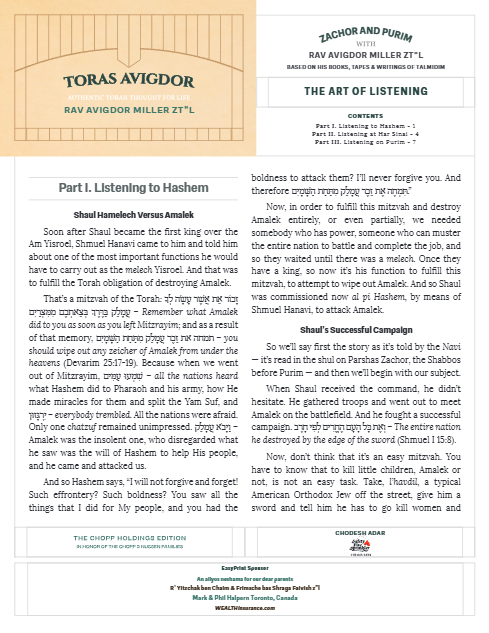
Shaul Hamelech Versus Amalek

Soon after Shaul became the first king over the Am Yisroel, Shmuel Hanavi came to him and told him about one of the most important functions he would have to carry out as the melech Yisroel. And that was to fulfill the Torah obligation of destroying Amalek. That’s a mitzvah of the Torah:

ך¿ל הָׂ ָ̆ﬠ ר∆ׁ ֲ̆‡ ̇≈‡ רֹכוָז םƒיַר¿ˆƒּמƒמ ם∆כ¿ ̇‡≈ˆ¿ ב ¿ך∆ר∆ּ„ַּב ̃≈לָמֲﬠ – Remember what Amalek did to you as soon as you left Mitzrayim; and as a result of that memory, םƒיָמַָּׁ̆ה ַ̇חַּ̇ƒמ ̃≈לָמֲﬠ ר∆כ≈ז ̇‡ מחה ̇ – you should wipe out any zeicher of Amalek from under the heavens (Devarim 25:17-19). Because when we went out of Mitzrayim, יםƒּמַﬠּעו¿מƒׁ̆ – all the nations heard what Hashem did to Pharaoh and his army, how He made miracles for them and split the Yam Suf, and ןּזוָּ‚¿רƒי – everybody trembled. All the nations were afraid. Only one chatzuf remained unimpressed. ̃≈לָמֲﬠ ‡ֹבָיַו – Amalek was the insolent one, who disregarded what he saw was the will of Hashem to help His people, and he came and attacked us.

And so Hashem says, “I will not forgive and forget! Such effrontery? Such boldness? You saw all the things that I did for My people, and you had the boldness to attack them? I’ll never forgive you. And therefore םƒיָמַָּׁ̆ה ַ̇חַּ̇ƒמ ̃≈לָמֲﬠ ר∆כ≈ז ̇∆‡ ה∆ח¿מƒּ̇.”

Now, in order to fulfill this mitzvah and destroy Amalek entirely, or even partially, we needed somebody who has power, someone who can muster the entire nation to battle and complete the job, and so they waited until there was a melech. Once they have a king, so now it’s his function to fulfill this mitzvah, to attempt to wipe out Amalek. And so Shaul was commissioned now al pi Hashem, by means of Shmuel Hanavi, to attack Amalek.

Shaul’s Successful Campaign

So we’ll say first the story as it’s told by the Navi — it’s read in the shul on Parshas Zachor, the Shabbos before Purim — and then we’ll begin with our subject. When Shaul received the command, he didn’t hesitate. He gathered troops and went out to meet Amalek on the battlefield. And he fought a successful campaign. ב∆רָח יƒפ¿ל יםƒר¡ח∆ה םָﬠָה לָּכ ̇∆‡¿ו – The entire nation he destroyed by the edge of the sword (Shmuel I 15:8).

Now, don’t think that it’s an easy mitzvah. You have to know that to kill little children, Amalek or not, is not an easy task. Take, l’havdil, a typical American Orthodox Jew off the street, give him a sword and tell him he has to go kill women and children, little babies; a mitzvah. He couldn’t do it. He’d turn tail and find a place to hide. He can’t help it — it's against his nature.

Shaul did it, however. He was a very great tzaddik and so רּוָׁ̆ךֲ‡ֹוּב הָילƒוֲח≈מ ̃≈לָמֲﬠ ̇∆‡ לּו‡ָׁ̆¿ךַּיַו – he struck down Amalek from Chavilah to the approach to Shur (ibid. 7). It means he did a very comprehensive job. A lot of Amalekis were sent to warmer climates that day.

And yet the Chachomim tell us something that we wouldn't have known on our own. They say that when Shaul went to battle, in his heart there was a little bit of regret that he had to kill little children too — he was thinking that it’s not so right.

Shaul’s Unsuccessful Campaign

And so, even though he fulfilled his duty and ב∆רָיַו לַחָּנַּב – he battled with Amalek, the Gemara (Yoma 22b, Shabbos 56b), however tells us that the words ב∆רָיַו לַחָּנַּב are only superficially explained that way. That’s the plain meaning. ב∆רָיַו – he carried on a fight. But there’s another deep and profound meaning to these words. ֹנוֹו ̃ םƒע הָיבƒר¿מ הָׂ ָ̆ﬠ – He was quarreling with Hakadosh Baruch Hu. It doesn’t mean he was fighting with Hashem, chas v’shalom, but there was a war going on, inside of Shaul’s mind! He had a certain distaste for the mitzvah of killing women and children, and according to our Chachomim that’s enough to be called quarreling with your Creator.

Now Shaul didn't say it. Nobody knew about it. Only the ruach hakodesh of our Chachomim were able to look into his heart, and they saw what nobody else knew, that in his heart there was a certain reservation, a certain feeling of unhappiness. After all, Shaul was a kind-hearted man, a man with excellent middos. It was against his nature to do it. To cut down women and children?

And that’s why he didn’t finish the job entirely. He went out to the battlefield, a brave general leading his soldiers, and he did his duty, but something happened. When he came back from the war, he brought back the meitav, the choicest of the livestock of Amalek. And he also brought back Agag, the king of Amalek. He brought him in chains, but he was alive. His heart couldn’t allow him to kill this poor man who had lost everything now. He lost his people; he lost his power, and Shaul was a big anav, you know. The Gemara says that. He was a tzaddik and an anav. And he was thinking, “What would I do if I was conquered? Would I want to be killed?”

And so he brought back Agag in chains instead of killing him on the battlefield. Now what he intended to do, I cannot tell you. Maybe he intended to imprison him, and he should die, maybe of starvation, but the story is that he brought him back alive.

Shmuel Hanavi Campaigns for Hashem

And so Shaul was returning now from his big victory full of happiness at fulfilling the mitzvah — he destroyed Amalek, all the people, men and women and children; all he did was leave the cattle and the king — and he said to Shmuel, “‘ה רַב¿ּ„ ̇∆‡ יƒ ֹ̇ימוƒ ֲ̃ה – See, I fulfilled the word of Hashem”.

So Shmuel said, “You said you did the will of Hashem, but what’s this I hear the noise of the cattle lowing in the distance? I hear the cattle you brought back. You were told to destroy everything, including the cattle.”

So Shaul said, “Well, the people wanted to bring the cattle as karbanos to Hashem. Instead of destroying them there, we can shecht them as sacrifices of gratitude to the One Who achieved victory for us.”

Talking Truth to Power

Now, to us that seems like a beautiful idea, but when Shmuel Hanavi saw this, he became very greatly disturbed. Not only disturbed — he told Shaul that he’s in rebellion against Hashem. The command was to wipe out all the possessions of Amalek too, and you didn’t listen fully. Offerings? No! “חַב∆זƒמ ,ַﬠֹמוָׁ̆ ה≈ּנƒה בֹטו – It’s better to listen to Hashem than to bring offerings, יםƒיל≈‡ ב∆ל≈ח≈מ ,יבƒׁ̆¿ ַ̃ה¿ל – to pay attention to the words of Hashem is more important than the fat of even the most expensive oxen that are sacrificed. And so you rebelled against Hakadosh Baruch Hu when you allowed the cattle to remain alive. The fact that you want to bring now offerings to thank Hashem for the victory, that’s no excuse. And why did you leave Agag alive? You had pity on Amalek when Hashem said ה∆ח¿מƒּ̇ הָחָמ, that you should destroy them?!”

And the Navi criticized him as follows: “ ̇‡ַּטַח יƒּכ יƒר∆מ ם∆ס∆ ̃ – When a person is rebellious against Hashem it’s the same as the sin of sorcery” (ibid. 23). It means this. Shaul was famous because he fought against kesem, against witchcraft. Some people practiced sorcery in those days and Shaul made it his business to eradicate the whole business. To him, it was a disgusting thing and so he investigated and searched and he cleansed the entire nation of sorcerers. If he found one, he didn’t let him remain alive. And we praise him for that. He was a very frum man, Shaul Hamelech, a very pious man!

But the Navi was criticizing him now. “ם∆ס∆ ̃ ̇‡ַּטַח יƒר∆מ – What you did by rebelling against the word of Hashem, is the same as sorcery that you hate so much. רַˆ¿פַה יםƒפָר¿ ּ̇ו ןֹוָﬠ¿ו – Because if you have to be persuaded and urged to do the devar Hashem, because it’s in conflict with your character, your ideas, it’s the same as avodah zarah (ibid.).”

Shmuel’s Exposé

Shmuel was saying a big principle here. A person who is subject to his own ideas, his shittahs — even to his good middos — and he has to be pressured therefore to do something that’s required by the Torah, that’s already like worshipping idols.

Idol worship?! Yes; because if you’re a servant to your character, even a good character, if you’re a slave to your emotions, even good emotions, and you have to be therefore urged and pushed to toe the line of the devar Hashem, that’s already avodah zarah. You’re worshipping yourself instead of Hashem!

And now he told Shaul the sad news. “Hashem has rejected you from being a king. You’re a tzaddik, a great man, but this flaw is too big to ignore; it’s something that has to be exposed so that the entire nation can learn a lesson from the story.”

And what did Shmuel Hanavi do? He picked up a big ax and he walked up to Agag who was in chains. He lifted the ax up over his head and he leaped up and he split Agag in half. ‚ָ‚ֲ‡ ̇∆‡ ל≈‡ּמוׁ¿̆ ףּ≈סַׁ̆¿יַו – He split him in half, from top to bottom. The most cruel kind of death.

Bending the Good Character

Now, when American Jews hear about what Shmuel did, it's distasteful to them. They would like to hear that Agag was given, let's say, a job, maybe as a servant. Or he should promise to be on good behavior, and then we’ll put him on parole. “We have better ways, better ideas, how to deal with it,” they think. “A man with good character doesn't do such a thing.”

So along comes Shmuel and he says no and no and no. Because what Hashem says, that’s the right way to think, that’s the right way to do, that’s the right character to have. Shmuel Hanavi, you should know, was a man of excellent character. No question about it. Every Navi was a man of perfect character, and Shmuel was one of the greatest Neviim. He was a kindhearted and humble man. But he took an ax and he chopped Agag in half, from his head to his feet, to demonstrate that his feelings, his principles of character, cannot be an obstacle to fulfilling the words of Hashem.

The Missing Title

And that’s the answer to a big puzzle. You know, if you look in the Tanach, you can look far and wide but you’ll never find that Shaul is called ‘eved Hashem’. Moshe Rabbeinu is called eved Hashem. Yehoshua is called eved Hashem, Dovid is called eved Hashem. But Shaul, no. Nowhere in the Neviim is he called eved Hashem.

You’ll find that he’s called bechir Hashem, the chosen one of Hashem, yes. And he’s given other titles of praise by our Sages too. The Tosefta says about Shaul that he was a ben Torah and an anav and a chas al mamonam shel Yisrael. He tried his best to save the money of the people, not to impose any heavy taxes. He didn't require them to support him in royal style. He wanted to bother them as little as possible.

This you have to know, that first melech in Am Yisrael was chosen because of his virtues. He was a very big tzaddik and a big talmid chacham too. We don’t have anybody like Shaul today – we haven’t had anybody like him for many many generations. And still it’s important to note that he wasn’t called eved Hashem. And it’s not an accident. There’s something there.

And the answer is because Hashem saw — great people are inspected by Hashem with a magnifying glass — and He saw that Shaul was an eved to his good character, to his emotions and his principles. His mind veered a little bit from the path of Torah onto the path of his own reasoning. He yielded to his mind instead of to the Word of Hashem.

That’s what it means ֹנוֹו ̃ םƒע הָיבƒר¿מ הָׂ ָ̆ﬠ. He had rachmanus on the fallen king and he couldn't bring himself to destroy him because he was a servant of his kindly emotions. And that’s why he’s criticized, so that the Am Yisroel should learn this lesson forever — he was punished because he was subject to his good character.

PDF Preview