Some Purim Kotan Related Halachos
Limuday Moshe | February 22, 2024
Print This Article
View Original PDF

Some Purim Kotan Related Halachos

Limuday Moshe | December 10, 2025

Panim Chadashos by Sheva Berachos on Purim Kotan

The Shulchan HaEzer (2:14, end of s.k. 14) is in doubt if one needs a panim chadashos [a new face] for sheva berachos on Purim Kotan in order to be able to recite the sheva berachos, or if perhaps there is no need, as there is an opinion (mentioned in the Rema 697) that there is a chiyuv mishteh v’simcha on Purim Kotan [an obligation to increase in feasting and happiness]. He ends off inconclusive and says that the matter needs more looking into.

The truth is, in regard to Purim itself it’s not so simple as to what the din is in regard to requiring a panim chadoshos. First, we have to establish what the din is in regard to real Purim. If real Purim requires a panim chadoshos then there is nothing to talk about, if however, the halachah is, that real Purim doesn’t require a panim chadoshos due to the fact that there is a chiyuv mishteh v’simcha, then we can work backwards and try and work out what the din is in regard to Purim Kotan.

The Be’er Heitev (Even HaEzer 62:10) cites the Knesses HaGedolah who says, tzorich iyun [it needs looking into] if Purim itself counts as the panim chadoshos, or if a real panim chadoshos [a person who hasn’t yet attended one of the previous sheva berachos must attend] is needed.

The Otzer HaPoskim (Even HaEzer 62:43 ois 3) cites the Gufei Halachos who maintains that it’s obvious that on the night of the 14th of Adar and the following day, there is no need for a panim chadoshos. The reason that a panim chadoshos is needed in order to be able to recite sheva berachos is because normally more food is added for them which creates additional simcha, this is why Shabbos is considered a panim chadoshos, as people normally have extra food on Shabbos. If so, being that the idea behind a panim chadoshos is the increased simcha, certainly Purim should be able to act as a panim chadoshos, as there is no bigger chiyuv mishteh v’simcha than Purim. Moreover, on Shabbos and Yom Tov, there is an opinion that if one wants to learn all day and forgo making a seudah he may, yet we still fine that the Shabbos meal counts as a panim chadoshos. If so, certainly on Purim where everyone agrees that one must have a seudah it should count as a panim chadoshos. Moreover, if Yom Tov Sheini [second day Yom Tov] which is only a chiyuv derabonon counts as panim chadoshos, then certainly the Purim seudah which is a chiyuv from Kabbolah (which has more weight than a regular derabonon) should count.

The Sova Semachos (Perek 1, He’orah 63) cites many poskim who maintain that the Purim seudah may serve as the panim chadoshos. He writes that even the Knesses HaGedolah (who we mentioned was in doubt) holds that strictly speaking the Purim seudah counts. However, the Knesses HaGedolah held that minhag was not to count it. In light of the above, the Sova Semachos in the main part of his sefer only mentions that the real Purim counts and doesn’t mention Purim Kotan.

The Shu”t Hisorarus Teshuvah (2:120) proves that Purim doesn’t count as a panim chadoshos. Yom Tov is sanctified with issur melachah [one isn’t allowed to work], we bring a Korban Mussaf and recite full Hallel, therefore, it counts as a panim chadoshos. Purim, however, has no issur melachah, and no Korban Mussaf is brought etc. Moreover, Rosh Chodesh has a Korban Mussaf, is called a Mo’ed, and we insert a special berachah in davening of, מקדש ישראל וראשי חדשים, yet we still find that we don’t count Rosh Chodesh as a panim chadoshos, therefore, certainly Purim which is not on the same level as Rosh Chodesh, won’t count.

However, the Shu”t Betzel HaChochman (2:1, s.k. 7) points out, that on the other hand we find that the chiyuv simcha on Purim is greater than on Rosh Chodesh. The Rema (696:4) writes: The minhag [custom] is, that we don’t keep dinei aveilus [laws of mourning] on Purim, on the 14th or the 15th of Adar. On Rosh Chodesh, however, we do. However, he concludes, that since there are opinions in the Rishonim that even Yom Tov doesn’t count as a panim chadoshos, one shouldn’t treat Purim as a panim chadoshos unless the minhag in that particular place is that they do.

Seemingly, we can bring further proof from the Sha’arei Teshuvah (695) who says that one doesn’t need to eat bread for his Purim seuda. If there is no obligation to eat bread, then the Purim seudah is no better than shalosh seudas where we find that since one can be yoitsa without bread it’s not considered a panim chadoshos. Although the minhag ha’olam [general custom] is to eat bread for their Purim seudah, it’s not enough to make it considered an important seudah, as by shalosh seudas also, most people eat bread, and we still find it’s not good enough.

However, we could differentiate between shalosh seudas and the Purim seudah, as even if there may be no chiyuv to eat bread by the Purim seudah, there may still be a chiyuv to eat meat, unlike shalosh seudas. The Rambam (Hilchos Megillah 2:15) writes: כיצד חובת זו שיאכל בשר ויתקן סעודה נאה – “How should one go about the obligation to eat a feast on Purim? One should eat meat and prepare a nice feast”. Similarly, the Shulchan Aruch (Orach Chaim 696:7) rules that an oinen is allowed to eat meat for his Purim seudah. Normally, the Shulchan Aruch (Yoreh De’ah 341:1) rules that an oinen isn’t allowed to eat meat or drink wine, yet we find he can eat meat for Purim? It must be that there is a chiyuv to eat meat for the Purim seudah. The Shu”t Divrei Moshe (40) even maintains that the chiyuv to eat meat on Purim is more important than on Yom Tov (for more on this see last year’s Purim Kuntros, “The Chiyuv to Eat Meat at the Purim Seudah”).

However, although personally I feel meat brings about greater excitement than bread, we don’t find in the poskim that a nice meaty meal counts as a panim chadoshos. Even if it would, there is a big machlokes if there is a chiyuv to eat meat at the Purim seudah, and it’s not much better than bread where we also find a big machlokes.

Since on Purim itself, it is difficult to rely on the opinions that the Purim seudah counts as a panim chadoshos, certainly one shouldn’t be lenient when it comes to Purim Kotan (see Nimukei Orach Chaim 697).

Is There a Chiyuv of Mishteh V’simcha on Purim Kotan

The Rema (697) writes: “Some say there is an obligation to increase in mishteh and simcha on the 14th of Adar Rishon, the custom is not like this. Regardless, one should increase slightly in order to fulfill the opinion of those who are stringent”. The Rema then concludes with his famous words: טוב לב משתה תמיד – “One who is good hearted, constantly has feasts”.

The source for the above dispute is the Mishnah in Megillah (6b). The Mishnah teaches:אין בין אדר ראשון לאדר שני אלא קריאת המגילה ומתנות לאביונים – “There is no difference between the Adar Rishon and Adar Sheini, except for the mitzvah of reading Megillah, and giving matonas l’evyonim”.

Tosfos writes, that implied from the Mishnah is, that the chiyuv mishteh and simcha is the same in both Adar Rishon and Adar Sheini. The Mishnah only mentioned a difference in regard to Megillah and matonas l’evyonim, which sounds like everything else is the same.

However, Tosfos argues and is medayek [makes an implication] from the Gemara the exact opposite. The Gemara is medayek from the Mishnah:הא לענין הספד ותענית זה וזה שוין - “In regards to hespedim and fasting they are the same”, from the fact that the Gemara is medayek that in regards to hespedim and fasting they are the same, it would seem that in regards to mishteh and simcha they are not. Moreover, if there was a chiyuv mishteh and simcha in both Adar’s, then the Gemara could learn from the fact that there is a chiyuv of mishteh and simcha that there is an issur hesped and ta’anis. Since the Gemara doesn’t do this, we see there is no chiyuv of mishteh and simcha in Adar Rishon. Tosfos concludes, practically there is no need to be stringent in regard to increasing in mishteh and simcha in Adar Rishon.

We see that there are two opinions in the Rishonim as to whether there is a chiyuv of mishteh and simcha in Adar Rishon, these are the two opinions cited by the Rema.

Is There a Chiyuv to Give Mishloach Manos on Purim Kotan

The aforementioned Mishnah only excludes Megillah and matonas l’evyonim, what’s with mishloach manos? The Beis Yosef (697) cites the Ran, which says, mishloach manos and matonas l’evyonim go together, and since there is no chiyuv matonas l’evyonim in Adar Rishon, there is also no mitzvah of mishloach manos.

The Chiddush of the Kesav Sofer that Mishteh V’simcha and Mishloach Manos Go Together

On the other hand, the Kesav Sofer (Al HaTorah, end of Tetzaveh) asks why Tosfos makes no mention of mishloach manos. He explains, that mishloach manos goes together with the seudah: כמו שמצאנו דחבירים היושבים בסעודתם ואוכלים ג"כ שולחים זל "ז מתוך הסעודה – “Like we find that when friends eat together, they send gifts of food to each other”.

The Kesav Sofer proves that mishloach manos and the seudah go together from the aforementioned Ran. The Ran asks: “If there is no mitzvah of mishloach manos in Adar Rishon as it is similar to matanos l’evyonim, then why in the keforim [villages] do they give matanos l’evyonim early on the day that they read Megillah, and not give mishloach manos? The Ran answers: “On market day people don’t make the seudah, therefore, they don’t send each other mishloach manos.” We see that one only sends mishloach manos when he eats a seudah. Based on this, the Kesav Sofer explains, that since Tosfos talks about whether there is a chiyuv mishteh and simcha in Adar Rishon or not, there is no need to talk about mishloach manos as both mitzvos are intertwined.

The Kesav Sofer concludes: One who is stringent to increase in mishteh and simcha should also give mishloach manos:ולא יאחז החבל בשני ראשים להתענג נפשו ולא יתהנה אחרים ומי שלבו רע להנות אחרים לא ירבה במשתה לעצמו – “ He shouldn’t grab the rope on both ends, and ensure he enjoys himself, and not worry about others. One who doesn’t want to help out others, shouldn’t rejoice himself either.

The Kesav Sofer explains that this is what the Rema means when he says: טוב לב משתה תמיד – “One who is good hearted, constantly has feasts”.טוב לב - one who has a good heart and looks to help benefit others, like in our case of giving mishloach manos, such a person can be, משתה תמיד – always rejoicing.

Answering Up the General Minhag Not to Send Mishloach Manos on Purim Kotan

However, it seems that the general minhag is to be worried for the opinion of the Kesav Sofer, how come?

The Shu”t Divrei Yisroel (Orach Chaim 215) explains that the Rema concludes: “We don’t go like those who are stringent to increase in mishteh v’simcha on Purim Kotan, however, we increase a bit in order to take into account the opinion of those who are stringent”. Since on Purim Kotan we don’t have a real seudah like on the real Purim, and we just increase in mishteh v’simcha slightly, the minhag is not to send mishloach manos.

It answers up the minhag slightly, however, the simple understanding of the Kesav Sofer is, that if one is stringent in regard to increasing mishteh v’simcha (even a little bit) he should send mishloach manos, and that this is peshat in טוב לב משתה תמיד. Only someone who benefits others may rejoice and increase in mishteh v’simcha even on Purim Kotan.

The Case of the Merchant Who Gave Matonas L’evyonim On Purim Kotan by Mistake

There was a story with a merchant who knew he had to be out of town for the real Purim, and that he wouldn’t be able to fulfill the mitzvah of matonas l’evyonim. He decided that he would give matonas l’evyonim already on Purim Kotan. When distributing the money to the poor he mentioned that he was giving it in order to fulfill the mitzvah of matonas l’evyonim. A few days later he realized that one is only able to fulfill the mitzvah of matonas l’evyonim on the real Purim, in Adar Sheini. Upon realizing this, the merchant went to poor people who had distributed the money to and being that he gave it in order to fulfill the mitzvah of matonas l’evyonim and he wasn’t able to, he asked for the money back.

The Sefas Emes (Megillah 6b) is in doubt about such a case and ends off without a conclusion.

Seemingly, the poor people could argue, that even if the merchant giving the money doesn’t fulfill the mitzvah of matonas l’evyonim, in the end of the day they are poor and entitled to receive tzedokah, and when the merchant gave them money, he is fulfilling the mitzvah of tzedokah, therefore, they should be entitled to keep it.

On the other hand, perhaps the merchant could argue back, that normally he doesn’t give out that much tzedokah in one day. From the fact that he gave out so much in one day, it’s clear to everyone that he had intended to fulfill the mitzvah of matonas l’evyonim, and since it was in Adar Rishon it’s clear it was a mistake, therefore, he is entitled to receive the money back.

Does One Fulfill the Mitzvah of Tzedokah When Giving Matonas L’evyonim on Purim

When one gives matonas l’evyonim on Purim does he also fulfill the mitzvah of tzedokah (פתוח תפתח and ונתון תתן ), or do we say that he only fulfills the mitzvah of matonas l’evyonim?

Is the idea behind the mitzvah of matonas l’evyonim to provide for the needs of the poor, like the regular mitzvah of tzedokah, or is it a special mitzvah to make happy and gladden the hearts of poor people specifically on Purim?

The Kesav Sofer proves from the Maharil that the mitzvah of matonas l’evyonim is also a mitzvah of tzedokah, therefore, one can’t fulfil the mitzvah with maaser money, as: אין דבר שבחובה בא אלא מן החולין – “when fulfilling an obligatory mitzvah, one has to use regular mundane money”. If the mitzvah of matonas l’evyonim was simply to make the poor people happy on Purim, what difference does it make where the money comes from, if, however, it is also a mitzvah of tzedokah then we can understand that one must use non-maaser money.

Since it is also a mitzvah of tzedokah, in our case of the merchant who gave matonas l’evyonim on Purim Kotan, even if he hasn’t fulfilled the mitzvah of matonas l’evyonim, he fulfilled the mitzvah of tzedokah, therefore it would seem that he can’t retract.

Can We Compare This Case to the Gemara in Kiddushin

The Gemara in Kiddushin (46b) discusses a case, where one is mekadesh his sister [performs kiddushin with his sister. Rav maintains that it doesn’t work, and the money used for kiddushin must be returned. Shmuel agrees that the kiddushin doesn’t work, however, he maintains that the money doesn’t need to be returned and it is given to the sister as a present. Rav explains, that the money must be returned, as a person knows that he can’t marry his sister and he meant to give it her as a deposit. The Gemara asks: Why didn’t he tell his sister this? The Gemara answers: He knew she wouldn’t take the money as a deposit. Shmuel, however, maintains that the money is a present, as a person knows that he can’t marry his sister, and when he gave it to her, it must be he wanted to give a present. The Gemara asks: Why didn’t he simply say that he wants to give a present? And the Gemara answers: He thought that she would be embarrassed to accept a present.

The Shulchan Aruch (Even HaEzer 50:2) rules like Shmuel, that if one is mekadesh his sister the money is given to her as a present: דהכל יודעים שאין קידושין ת ופסים בעריות ואין זה טועה אלא גמר ונתן לשום מתנה – “As everyone knows that kiddushin doesn’t work with one’s sister, and one who did so wasn’t making a mistake, rather he intended on giving it to her as a present”.

Seemingly our case is similar to the case of one performing kiddushin with his sister, as everyone knows that matonas l’evyonim can’t be given in Adar Rishon, just like everyone knows one can’t get married to his sister. Consequently, just like the sister can keep the money and we say it is a present, the same thing should be with the poor people, and we should say the money is a present and they can keep it. Now the merchant is regretting the present, therefore, he is pretending to make a mistake, however, since it was originally given as a present, we should say that it’s too late.

However, there is still room for doubt, as the Shulchan Aruch (Even HaEzer 50:1) rules that if a man is mekadesh a woman with a mistaken kiddushin (kiddushei to’us), the money is returned. Kiddushei to’us is different to being mekadash a sister. Kiddushei to’us is for example a case such as a woman whose husband went overseas and she was informed that he died, so she went and remarried, and then her original husband returned. In such a case she doesn’t need to receive a get [divorce document] from the second husband, and the money used to perform the kiddushin is returned. We see that if one is a mekadesh a woman under circumstances where it is understandable to make a mistake, the money is returned. The question is, is our case like the case of one being mekadesh his sister where everyone knows it doesn’t work, and therefore the money is a present, or is it perhaps like the case of kiddushei to’us, and therefore the merchant may claim his money back?

It would seem that since we don’t read Megillah on Purim Kotan, and we don’t keep the dinim of Purim, everyone knows that one can’t fulfil the mitzvah of matonas l’evyonim and it is like the case of one performing kiddushin with his sister. However, in the kiddushin case absolutely everyone knows this, in our case, although unlikely, the merchant did seem to make a genuine mistake. He mentioned that he wanted to fulfill the mitzvah of matonas l’evyonim, and although he may be ignorant, but it did seem like this was his intention, therefore, perhaps there is room to say he is entitled to ask for his money back.

It would seem that the best thing for him to do, is to see if the poor people still have the money, if they do they should give it back, and the merchant should promise them that he will give it them again on the real Purim (if he is out of town, he can appoint an agent).
Panim Chadashos by Sheva Berachos on Purim Kotan

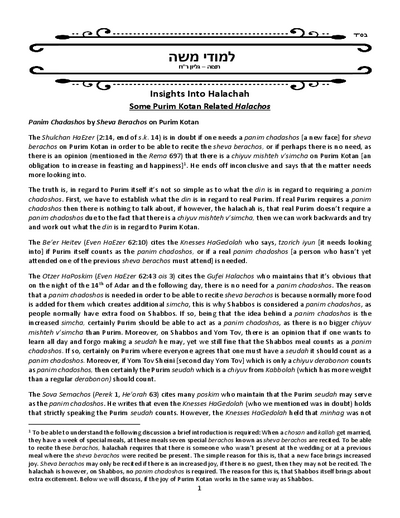
The Shulchan HaEzer (2:14, end of s.k. 14) is in doubt if one needs a panim chadashos [a new face] for sheva berachos on Purim Kotan in order to be able to recite the sheva berachos, or if perhaps there is no need, as there is an opinion (mentioned in the Rema 697) that there is a chiyuv mishteh v’simcha on Purim Kotan [an obligation to increase in feasting and happiness]. He ends off inconclusive and says that the matter needs more looking into.

The truth is, in regard to Purim itself it’s not so simple as to what the din is in regard to requiring a panim chadoshos. First, we have to establish what the din is in regard to real Purim. If real Purim requires a panim chadoshos then there is nothing to talk about, if however, the halachah is, that real Purim doesn’t require a panim chadoshos due to the fact that there is a chiyuv mishteh v’simcha, then we can work backwards and try and work out what the din is in regard to Purim Kotan.

The Be’er Heitev (Even HaEzer 62:10) cites the Knesses HaGedolah who says, tzorich iyun [it needs looking into] if Purim itself counts as the panim chadoshos, or if a real panim chadoshos [a person who hasn’t yet attended one of the previous sheva berachos must attend] is needed.

The Otzer HaPoskim (Even HaEzer 62:43 ois 3) cites the Gufei Halachos who maintains that it’s obvious that on the night of the 14th of Adar and the following day, there is no need for a panim chadoshos. The reason that a panim chadoshos is needed in order to be able to recite sheva berachos is because normally more food is added for them which creates additional simcha, this is why Shabbos is considered a panim chadoshos, as people normally have extra food on Shabbos. If so, being that the idea behind a panim chadoshos is the increased simcha, certainly Purim should be able to act as a panim chadoshos, as there is no bigger chiyuv mishteh v’simcha than Purim. Moreover, on Shabbos and Yom Tov, there is an opinion that if one wants to learn all day and forgo making a seudah he may, yet we still fine that the Shabbos meal counts as a panim chadoshos. If so, certainly on Purim where everyone agrees that one must have a seudah it should count as a panim chadoshos. Moreover, if Yom Tov Sheini [second day Yom Tov] which is only a chiyuv derabonon counts as panim chadoshos, then certainly the Purim seudah which is a chiyuv from Kabbolah (which has more weight than a regular derabonon) should count.

The Sova Semachos (Perek 1, He’orah 63) cites many poskim who maintain that the Purim seudah may serve as the panim chadoshos. He writes that even the Knesses HaGedolah (who we mentioned was in doubt) holds that strictly speaking the Purim seudah counts. However, the Knesses HaGedolah held that minhag was not to count it. In light of the above, the Sova Semachos in the main part of his sefer only mentions that the real Purim counts and doesn’t mention Purim Kotan.

The Shu”t Hisorarus Teshuvah (2:120) proves that Purim doesn’t count as a panim chadoshos. Yom Tov is sanctified with issur melachah [one isn’t allowed to work], we bring a Korban Mussaf and recite full Hallel, therefore, it counts as a panim chadoshos. Purim, however, has no issur melachah, and no Korban Mussaf is brought etc. Moreover, Rosh Chodesh has a Korban Mussaf, is called a Mo’ed, and we insert a special berachah in davening of, מקדש ישראל וראשי חדשים, yet we still find that we don’t count Rosh Chodesh as a panim chadoshos, therefore, certainly Purim which is not on the same level as Rosh Chodesh, won’t count.

However, the Shu”t Betzel HaChochman (2:1, s.k. 7) points out, that on the other hand we find that the chiyuv simcha on Purim is greater than on Rosh Chodesh. The Rema (696:4) writes: The minhag [custom] is, that we don’t keep dinei aveilus [laws of mourning] on Purim, on the 14th or the 15th of Adar. On Rosh Chodesh, however, we do. However, he concludes, that since there are opinions in the Rishonim that even Yom Tov doesn’t count as a panim chadoshos, one shouldn’t treat Purim as a panim chadoshos unless the minhag in that particular place is that they do.

Seemingly, we can bring further proof from the Sha’arei Teshuvah (695) who says that one doesn’t need to eat bread for his Purim seuda. If there is no obligation to eat bread, then the Purim seudah is no better than shalosh seudas where we find that since one can be yoitsa without bread it’s not considered a panim chadoshos. Although the minhag ha’olam [general custom] is to eat bread for their Purim seudah, it’s not enough to make it considered an important seudah, as by shalosh seudas also, most people eat bread, and we still find it’s not good enough.

However, we could differentiate between shalosh seudas and the Purim seudah, as even if there may be no chiyuv to eat bread by the Purim seudah, there may still be a chiyuv to eat meat, unlike shalosh seudas. The Rambam (Hilchos Megillah 2:15) writes: כיצד חובת זו שיאכל בשר ויתקן סעודה נאה – “How should one go about the obligation to eat a feast on Purim? One should eat meat and prepare a nice feast”. Similarly, the Shulchan Aruch (Orach Chaim 696:7) rules that an oinen is allowed to eat meat for his Purim seudah. Normally, the Shulchan Aruch (Yoreh De’ah 341:1) rules that an oinen isn’t allowed to eat meat or drink wine, yet we find he can eat meat for Purim? It must be that there is a chiyuv to eat meat for the Purim seudah. The Shu”t Divrei Moshe (40) even maintains that the chiyuv to eat meat on Purim is more important than on Yom Tov (for more on this see last year’s Purim Kuntros, “The Chiyuv to Eat Meat at the Purim Seudah”).

However, although personally I feel meat brings about greater excitement than bread, we don’t find in the poskim that a nice meaty meal counts as a panim chadoshos. Even if it would, there is a big machlokes if there is a chiyuv to eat meat at the Purim seudah, and it’s not much better than bread where we also find a big machlokes.

Since on Purim itself, it is difficult to rely on the opinions that the Purim seudah counts as a panim chadoshos, certainly one shouldn’t be lenient when it comes to Purim Kotan (see Nimukei Orach Chaim 697).

Is There a Chiyuv of Mishteh V’simcha on Purim Kotan

The Rema (697) writes: “Some say there is an obligation to increase in mishteh and simcha on the 14th of Adar Rishon, the custom is not like this. Regardless, one should increase slightly in order to fulfill the opinion of those who are stringent”. The Rema then concludes with his famous words: טוב לב משתה תמיד – “One who is good hearted, constantly has feasts”.

The source for the above dispute is the Mishnah in Megillah (6b). The Mishnah teaches:אין בין אדר ראשון לאדר שני אלא קריאת המגילה ומתנות לאביונים – “There is no difference between the Adar Rishon and Adar Sheini, except for the mitzvah of reading Megillah, and giving matonas l’evyonim”.

Tosfos writes, that implied from the Mishnah is, that the chiyuv mishteh and simcha is the same in both Adar Rishon and Adar Sheini. The Mishnah only mentioned a difference in regard to Megillah and matonas l’evyonim, which sounds like everything else is the same.

However, Tosfos argues and is medayek [makes an implication] from the Gemara the exact opposite. The Gemara is medayek from the Mishnah:הא לענין הספד ותענית זה וזה שוין - “In regards to hespedim and fasting they are the same”, from the fact that the Gemara is medayek that in regards to hespedim and fasting they are the same, it would seem that in regards to mishteh and simcha they are not. Moreover, if there was a chiyuv mishteh and simcha in both Adar’s, then the Gemara could learn from the fact that there is a chiyuv of mishteh and simcha that there is an issur hesped and ta’anis. Since the Gemara doesn’t do this, we see there is no chiyuv of mishteh and simcha in Adar Rishon. Tosfos concludes, practically there is no need to be stringent in regard to increasing in mishteh and simcha in Adar Rishon.

We see that there are two opinions in the Rishonim as to whether there is a chiyuv of mishteh and simcha in Adar Rishon, these are the two opinions cited by the Rema.

Is There a Chiyuv to Give Mishloach Manos on Purim Kotan

The aforementioned Mishnah only excludes Megillah and matonas l’evyonim, what’s with mishloach manos? The Beis Yosef (697) cites the Ran, which says, mishloach manos and matonas l’evyonim go together, and since there is no chiyuv matonas l’evyonim in Adar Rishon, there is also no mitzvah of mishloach manos.

The Chiddush of the Kesav Sofer that Mishteh V’simcha and Mishloach Manos Go Together

On the other hand, the Kesav Sofer (Al HaTorah, end of Tetzaveh) asks why Tosfos makes no mention of mishloach manos. He explains, that mishloach manos goes together with the seudah: כמו שמצאנו דחבירים היושבים בסעודתם ואוכלים ג"כ שולחים זל "ז מתוך הסעודה – “Like we find that when friends eat together, they send gifts of food to each other”.

The Kesav Sofer proves that mishloach manos and the seudah go together from the aforementioned Ran. The Ran asks: “If there is no mitzvah of mishloach manos in Adar Rishon as it is similar to matanos l’evyonim, then why in the keforim [villages] do they give matanos l’evyonim early on the day that they read Megillah, and not give mishloach manos? The Ran answers: “On market day people don’t make the seudah, therefore, they don’t send each other mishloach manos.” We see that one only sends mishloach manos when he eats a seudah. Based on this, the Kesav Sofer explains, that since Tosfos talks about whether there is a chiyuv mishteh and simcha in Adar Rishon or not, there is no need to talk about mishloach manos as both mitzvos are intertwined.

The Kesav Sofer concludes: One who is stringent to increase in mishteh and simcha should also give mishloach manos:ולא יאחז החבל בשני ראשים להתענג נפשו ולא יתהנה אחרים ומי שלבו רע להנות אחרים לא ירבה במשתה לעצמו – “ He shouldn’t grab the rope on both ends, and ensure he enjoys himself, and not worry about others. One who doesn’t want to help out others, shouldn’t rejoice himself either.

The Kesav Sofer explains that this is what the Rema means when he says: טוב לב משתה תמיד – “One who is good hearted, constantly has feasts”.טוב לב - one who has a good heart and looks to help benefit others, like in our case of giving mishloach manos, such a person can be, משתה תמיד – always rejoicing.

Answering Up the General Minhag Not to Send Mishloach Manos on Purim Kotan

However, it seems that the general minhag is to be worried for the opinion of the Kesav Sofer, how come?

The Shu”t Divrei Yisroel (Orach Chaim 215) explains that the Rema concludes: “We don’t go like those who are stringent to increase in mishteh v’simcha on Purim Kotan, however, we increase a bit in order to take into account the opinion of those who are stringent”. Since on Purim Kotan we don’t have a real seudah like on the real Purim, and we just increase in mishteh v’simcha slightly, the minhag is not to send mishloach manos.

It answers up the minhag slightly, however, the simple understanding of the Kesav Sofer is, that if one is stringent in regard to increasing mishteh v’simcha (even a little bit) he should send mishloach manos, and that this is peshat in טוב לב משתה תמיד. Only someone who benefits others may rejoice and increase in mishteh v’simcha even on Purim Kotan.

The Case of the Merchant Who Gave Matonas L’evyonim On Purim Kotan by Mistake

There was a story with a merchant who knew he had to be out of town for the real Purim, and that he wouldn’t be able to fulfill the mitzvah of matonas l’evyonim. He decided that he would give matonas l’evyonim already on Purim Kotan. When distributing the money to the poor he mentioned that he was giving it in order to fulfill the mitzvah of matonas l’evyonim. A few days later he realized that one is only able to fulfill the mitzvah of matonas l’evyonim on the real Purim, in Adar Sheini. Upon realizing this, the merchant went to poor people who had distributed the money to and being that he gave it in order to fulfill the mitzvah of matonas l’evyonim and he wasn’t able to, he asked for the money back.

The Sefas Emes (Megillah 6b) is in doubt about such a case and ends off without a conclusion.

Seemingly, the poor people could argue, that even if the merchant giving the money doesn’t fulfill the mitzvah of matonas l’evyonim, in the end of the day they are poor and entitled to receive tzedokah, and when the merchant gave them money, he is fulfilling the mitzvah of tzedokah, therefore, they should be entitled to keep it.

On the other hand, perhaps the merchant could argue back, that normally he doesn’t give out that much tzedokah in one day. From the fact that he gave out so much in one day, it’s clear to everyone that he had intended to fulfill the mitzvah of matonas l’evyonim, and since it was in Adar Rishon it’s clear it was a mistake, therefore, he is entitled to receive the money back.

Does One Fulfill the Mitzvah of Tzedokah When Giving Matonas L’evyonim on Purim

When one gives matonas l’evyonim on Purim does he also fulfill the mitzvah of tzedokah (פתוח תפתח and ונתון תתן ), or do we say that he only fulfills the mitzvah of matonas l’evyonim?

Is the idea behind the mitzvah of matonas l’evyonim to provide for the needs of the poor, like the regular mitzvah of tzedokah, or is it a special mitzvah to make happy and gladden the hearts of poor people specifically on Purim?

The Kesav Sofer proves from the Maharil that the mitzvah of matonas l’evyonim is also a mitzvah of tzedokah, therefore, one can’t fulfil the mitzvah with maaser money, as: אין דבר שבחובה בא אלא מן החולין – “when fulfilling an obligatory mitzvah, one has to use regular mundane money”. If the mitzvah of matonas l’evyonim was simply to make the poor people happy on Purim, what difference does it make where the money comes from, if, however, it is also a mitzvah of tzedokah then we can understand that one must use non-maaser money.

Since it is also a mitzvah of tzedokah, in our case of the merchant who gave matonas l’evyonim on Purim Kotan, even if he hasn’t fulfilled the mitzvah of matonas l’evyonim, he fulfilled the mitzvah of tzedokah, therefore it would seem that he can’t retract.

Can We Compare This Case to the Gemara in Kiddushin

The Gemara in Kiddushin (46b) discusses a case, where one is mekadesh his sister [performs kiddushin with his sister. Rav maintains that it doesn’t work, and the money used for kiddushin must be returned. Shmuel agrees that the kiddushin doesn’t work, however, he maintains that the money doesn’t need to be returned and it is given to the sister as a present. Rav explains, that the money must be returned, as a person knows that he can’t marry his sister and he meant to give it her as a deposit. The Gemara asks: Why didn’t he tell his sister this? The Gemara answers: He knew she wouldn’t take the money as a deposit. Shmuel, however, maintains that the money is a present, as a person knows that he can’t marry his sister, and when he gave it to her, it must be he wanted to give a present. The Gemara asks: Why didn’t he simply say that he wants to give a present? And the Gemara answers: He thought that she would be embarrassed to accept a present.

The Shulchan Aruch (Even HaEzer 50:2) rules like Shmuel, that if one is mekadesh his sister the money is given to her as a present: דהכל יודעים שאין קידושין ת ופסים בעריות ואין זה טועה אלא גמר ונתן לשום מתנה – “As everyone knows that kiddushin doesn’t work with one’s sister, and one who did so wasn’t making a mistake, rather he intended on giving it to her as a present”.

Seemingly our case is similar to the case of one performing kiddushin with his sister, as everyone knows that matonas l’evyonim can’t be given in Adar Rishon, just like everyone knows one can’t get married to his sister. Consequently, just like the sister can keep the money and we say it is a present, the same thing should be with the poor people, and we should say the money is a present and they can keep it. Now the merchant is regretting the present, therefore, he is pretending to make a mistake, however, since it was originally given as a present, we should say that it’s too late.

However, there is still room for doubt, as the Shulchan Aruch (Even HaEzer 50:1) rules that if a man is mekadesh a woman with a mistaken kiddushin (kiddushei to’us), the money is returned. Kiddushei to’us is different to being mekadash a sister. Kiddushei to’us is for example a case such as a woman whose husband went overseas and she was informed that he died, so she went and remarried, and then her original husband returned. In such a case she doesn’t need to receive a get [divorce document] from the second husband, and the money used to perform the kiddushin is returned. We see that if one is a mekadesh a woman under circumstances where it is understandable to make a mistake, the money is returned. The question is, is our case like the case of one being mekadesh his sister where everyone knows it doesn’t work, and therefore the money is a present, or is it perhaps like the case of kiddushei to’us, and therefore the merchant may claim his money back?

It would seem that since we don’t read Megillah on Purim Kotan, and we don’t keep the dinim of Purim, everyone knows that one can’t fulfil the mitzvah of matonas l’evyonim and it is like the case of one performing kiddushin with his sister. However, in the kiddushin case absolutely everyone knows this, in our case, although unlikely, the merchant did seem to make a genuine mistake. He mentioned that he wanted to fulfill the mitzvah of matonas l’evyonim, and although he may be ignorant, but it did seem like this was his intention, therefore, perhaps there is room to say he is entitled to ask for his money back.

It would seem that the best thing for him to do, is to see if the poor people still have the money, if they do they should give it back, and the merchant should promise them that he will give it them again on the real Purim (if he is out of town, he can appoint an agent).

PDF Preview