The Belt of the Ephod
BET Journal | March 06, 2025
Print This Article
View Original PDF

The Belt of the Ephod

BET Journal | June 27, 2025

The cheishev ha-ephod, a belt for the ephod (apron) to beautify it, was made from the same material as the ephod. The Ben Ish Chai shares a lesson from this pasuk to guide parents with the chinuch of children. Though, in the simple meaning, the pasuk speaks about the requirement of the ornamental belt of the ephod, the Ben Ish Chai presents a homiletical meaning. Children are referred to as a person’s clothing; the reason being that they are an external expression of themselves, much like clothing. “The cheishev that was upon him”- a person’s children, who are his responsibility, “according to his actions, his children will be.” If parents wish their children to follow in their ways, they must lead by example.

Once upon a time, there was a traveling doctor who would inform the people in the faraway villages that on a certain date, he would arrive in town to service them. The people would prepare for the arrival of the doctor in a central place, and he would heal them from their illnesses. One day, as he was traveling, a band of robbers jumped him, took away all his money, beat him up, and threw all of his medical supplies into the river. The doctor begged them not to do so because he needed the supplies to save the lives of people. The robbers mocked him and ignored his pleas. After the whole ordeal, the doctor continued to the next town to try to heal the people who were waiting for him. To his disbelief, the first person waiting in line to see him was the head of the band of robbers. The doctor examined the man’s child and said to the father, “Yes, I could have healed your child, but only if I had my medical supplies.” The father realized that he was responsible for his child remaining sick and unable to be healed, and he cried bitterly at his own foolishness.

There are times that parents may disagree on an important issue in chinuch, each insisting that their opinion is the right one. The truth is that they are probably both right to some extent, although one may be more correct. But the debate between them and the argument that will come from it may be more negative than the entire issue at hand. Additionally, if the discussion is about a teacher or a method of education, if they criticize the educator or system of education, the child listening to the dispute will internalize the negative aspect and will not be receptive to the lessons being taught. He cannot respect the system when he heard critical comments about it from his parents. We don’t want to be right; we want to be smart. Educators can only succeed with our children if we inspire them to comply and focus on the positive aspects of the educational body. Let’s face it – there are no perfect systems anywhere, but there is much good everywhere.

When I was a rav in Aventura, I became aware that there was a person who mocked me to his family and friends. One day, he needed me to talk to his child, who was about to do something stupid and hurtful to himself. I asked the father if in his discussions around the Friday night table, he made disparaging comments about me. Too embarrassed, he could not reply and just sat there dumbfounded. I looked him in the eye and said, “I would love to help you, but you destroyed my authority and threw all my tools into the river.”

We want gedolim in our world and positive influences in our lives. Let us not destroy them with words of derision that may satisfy our ego but diminish their respect and authority. Though criticizing them may feel good at the moment, long term doing so is a bad investment. We must never take away the tools from our leaders and educators, for we may need them in the future.
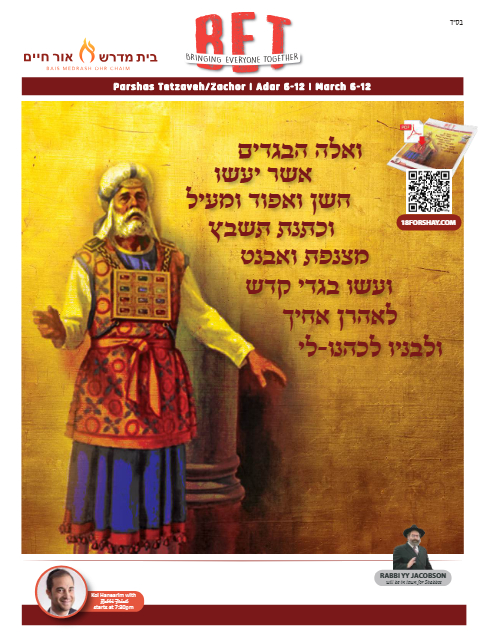
The cheishev ha-ephod, a belt for the ephod (apron) to beautify it, was made from the same material as the ephod. The Ben Ish Chai shares a lesson from this pasuk to guide parents with the chinuch of children. Though, in the simple meaning, the pasuk speaks about the requirement of the ornamental belt of the ephod, the Ben Ish Chai presents a homiletical meaning. Children are referred to as a person’s clothing; the reason being that they are an external expression of themselves, much like clothing. “The cheishev that was upon him”- a person’s children, who are his responsibility, “according to his actions, his children will be.” If parents wish their children to follow in their ways, they must lead by example.

Once upon a time, there was a traveling doctor who would inform the people in the faraway villages that on a certain date, he would arrive in town to service them. The people would prepare for the arrival of the doctor in a central place, and he would heal them from their illnesses. One day, as he was traveling, a band of robbers jumped him, took away all his money, beat him up, and threw all of his medical supplies into the river. The doctor begged them not to do so because he needed the supplies to save the lives of people. The robbers mocked him and ignored his pleas. After the whole ordeal, the doctor continued to the next town to try to heal the people who were waiting for him. To his disbelief, the first person waiting in line to see him was the head of the band of robbers. The doctor examined the man’s child and said to the father, “Yes, I could have healed your child, but only if I had my medical supplies.” The father realized that he was responsible for his child remaining sick and unable to be healed, and he cried bitterly at his own foolishness.

There are times that parents may disagree on an important issue in chinuch, each insisting that their opinion is the right one. The truth is that they are probably both right to some extent, although one may be more correct. But the debate between them and the argument that will come from it may be more negative than the entire issue at hand. Additionally, if the discussion is about a teacher or a method of education, if they criticize the educator or system of education, the child listening to the dispute will internalize the negative aspect and will not be receptive to the lessons being taught. He cannot respect the system when he heard critical comments about it from his parents. We don’t want to be right; we want to be smart. Educators can only succeed with our children if we inspire them to comply and focus on the positive aspects of the educational body. Let’s face it – there are no perfect systems anywhere, but there is much good everywhere.

When I was a rav in Aventura, I became aware that there was a person who mocked me to his family and friends. One day, he needed me to talk to his child, who was about to do something stupid and hurtful to himself. I asked the father if in his discussions around the Friday night table, he made disparaging comments about me. Too embarrassed, he could not reply and just sat there dumbfounded. I looked him in the eye and said, “I would love to help you, but you destroyed my authority and threw all my tools into the river.”

We want gedolim in our world and positive influences in our lives. Let us not destroy them with words of derision that may satisfy our ego but diminish their respect and authority. Though criticizing them may feel good at the moment, long term doing so is a bad investment. We must never take away the tools from our leaders and educators, for we may need them in the future.

PDF Preview