The Connection between the Law of Lokach and Eliminating the Klipah of Amalek
Shvilei Pinchas | February 28, 2026
Print This Article
View Original PDF

The Connection between the Law of Lokach and Eliminating the Klipah of Amalek

Shvilei Pinchas | February 28, 2026

The Connection between the Law of "לוקח" and Eliminating the Klipah of Amalek

We will now proceed to explain the intriguing connection with the third letter of the mnemonic concerning the law of a "לוקח"—a purchaser. We will refer to a passage in the Midrash (S.R. 33, 1) related to the passuk (ibid. 25, 2): "ויקחו לי תרומה מאת כל איש אשר ידבנו לבו תקחו את תרומתי"—and they shall take to Me a portion, from every man whose heart will motivate him you shall take My portion. That is what is written (Mishlei 4, 2): “For I have given you a precious commodity, do not abandon My Torah.” Do not forsake this purchase (acquisition, commodity) that I have given you. The holy Admor, the Maharid of Belz, zy”a, questions why the Midrash adds the clarification: Do not forsake this commodity that I have given you. After all, the passuk states explicitly: “Do not abandon My Torah.”

In his own inimitable way, the Maharid asserts that the Midrash was bothered by a seeming contradiction in the language of the passuk. It initially refers to the Torah as a "לקח טוב"—a commodity that was purchased, implying that a person must pay for it; yet, immediately afterwards, the passuk refers to the Torah as a gift “that I have given you,” implying that payment is not required to acquire it.

He explains the matter based on the following teaching (Megillah 6b): "אם יאמר לך אדם יגעתי ולא מצאתי אל תאמן, לא יגעתי ומצאתי אל תאמן, יגעתי ומצאתי תאמן". If someone tells you, “I labored in my Torah-study but did not succeed,” do not believe him. “I have not labored, yet I have succeeded,” do not believe him. “I have labored, and I have succeeded,” you may believe him. Only when a Jew exerts himself and labors in the study of Torah to the utmost of his abilities does the Almighty assist him to achieve even that which is well beyond his reach. Understood in this light, the Torah is both a precious commodity that must be purchased with exertion and toil, and a gift given to us by HKB”H. The latter is that which the Almighty grants us which is well beyond our capabilities.

We can now interpret the final message of the Midrash: Do not forsake this commodity that I have given you. Even after the Almighty has assisted a Jew and granted him Torah wisdom and knowledge beyond his abilities as a gift; he should not relax and desist from exerting himself and toiling day and night to achieve more as a purchased commodity. For, it is only in that merit that he will be privileged to attain more and more Torah without any limits. This is what the Midrash wishes to teach us with the addendum: "אל תעזובו את המקח שנתתי לכם". This concludes his precious insight.

We have now successfully explained the third letter of the mnemonic עמל"ק, the “lamed,” and its vital connection to the abolition of the klipah of Amalek. We learned that the momentous battle took place in Rephidim, indicating that the hands of Yisrael became lax and remiss regarding their study of Torah. This was due to the influence of the klipah of Amalek of whom the Torah says: "אשר קרך בדרך". This implies that they did not merely happen upon Yisrael, but they caused a “krirut”—a coldness, a lack of enthusiasm—in the hearts of Yisrael with regards to Torah-study. This made them lax and lazy and unwilling to exert themselves; they mistakenly believed that it would be given to them as a gift not requiring any toil on their part. Therefore, the way to abolish the negative influence of this klipah is to apply ourselves vigorously and enthusiastically to the study of Torah demonstrating that we are willing to pay a dear, substantial price to acquire this precious commodity.
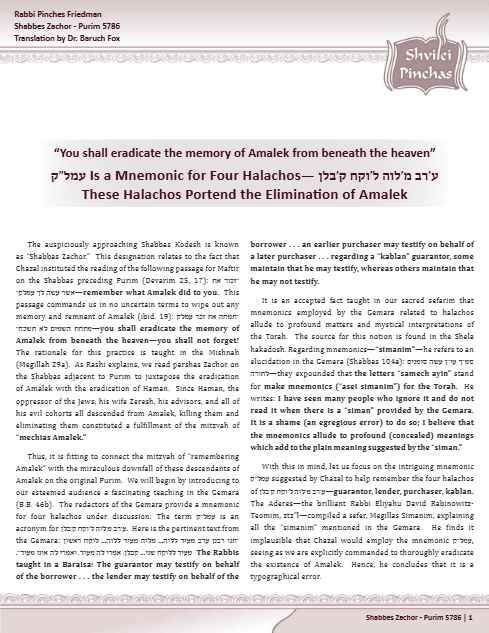
The Connection between the Law of "לוקח" and Eliminating the Klipah of Amalek

We will now proceed to explain the intriguing connection with the third letter of the mnemonic concerning the law of a "לוקח"—a purchaser. We will refer to a passage in the Midrash (S.R. 33, 1) related to the passuk (ibid. 25, 2): "ויקחו לי תרומה מאת כל איש אשר ידבנו לבו תקחו את תרומתי"—and they shall take to Me a portion, from every man whose heart will motivate him you shall take My portion. That is what is written (Mishlei 4, 2): “For I have given you a precious commodity, do not abandon My Torah.” Do not forsake this purchase (acquisition, commodity) that I have given you. The holy Admor, the Maharid of Belz, zy”a, questions why the Midrash adds the clarification: Do not forsake this commodity that I have given you. After all, the passuk states explicitly: “Do not abandon My Torah.”

In his own inimitable way, the Maharid asserts that the Midrash was bothered by a seeming contradiction in the language of the passuk. It initially refers to the Torah as a "לקח טוב"—a commodity that was purchased, implying that a person must pay for it; yet, immediately afterwards, the passuk refers to the Torah as a gift “that I have given you,” implying that payment is not required to acquire it.

He explains the matter based on the following teaching (Megillah 6b): "אם יאמר לך אדם יגעתי ולא מצאתי אל תאמן, לא יגעתי ומצאתי אל תאמן, יגעתי ומצאתי תאמן". If someone tells you, “I labored in my Torah-study but did not succeed,” do not believe him. “I have not labored, yet I have succeeded,” do not believe him. “I have labored, and I have succeeded,” you may believe him. Only when a Jew exerts himself and labors in the study of Torah to the utmost of his abilities does the Almighty assist him to achieve even that which is well beyond his reach. Understood in this light, the Torah is both a precious commodity that must be purchased with exertion and toil, and a gift given to us by HKB”H. The latter is that which the Almighty grants us which is well beyond our capabilities.

We can now interpret the final message of the Midrash: Do not forsake this commodity that I have given you. Even after the Almighty has assisted a Jew and granted him Torah wisdom and knowledge beyond his abilities as a gift; he should not relax and desist from exerting himself and toiling day and night to achieve more as a purchased commodity. For, it is only in that merit that he will be privileged to attain more and more Torah without any limits. This is what the Midrash wishes to teach us with the addendum: "אל תעזובו את המקח שנתתי לכם". This concludes his precious insight.

We have now successfully explained the third letter of the mnemonic עמל"ק, the “lamed,” and its vital connection to the abolition of the klipah of Amalek. We learned that the momentous battle took place in Rephidim, indicating that the hands of Yisrael became lax and remiss regarding their study of Torah. This was due to the influence of the klipah of Amalek of whom the Torah says: "אשר קרך בדרך". This implies that they did not merely happen upon Yisrael, but they caused a “krirut”—a coldness, a lack of enthusiasm—in the hearts of Yisrael with regards to Torah-study. This made them lax and lazy and unwilling to exert themselves; they mistakenly believed that it would be given to them as a gift not requiring any toil on their part. Therefore, the way to abolish the negative influence of this klipah is to apply ourselves vigorously and enthusiastically to the study of Torah demonstrating that we are willing to pay a dear, substantial price to acquire this precious commodity.

PDF Preview