The Essence of Moshe
Ben Chamesh L'Mikra | February 18, 2024
Print This Article
View Original PDF

The Essence of Moshe

Ben Chamesh L'Mikra | December 10, 2025

The Essence of Moshe

Though Parshas Tetzaveh alludes to Moshe multiple times, it makes no mention of Moshe, by name. This Sicha reveals the deeper relevance of this that is expressive of Moshe’s essential character.

When reading Parshas Tetzaveh one will notice, that although most Torah portions are replete with mentions of Moshe, in this week his name is absent. The commentators explain that this in not coincidental, but rather there is a specific reason for this fact.

Text 1

Moshe is not mentioned in this portion, which is not the case for the entire Chumash (Pentateuch); for, from the moment of Moshe’s birth, there is no portion in which he is not mentioned (besides Mishna Torah [Devarim]). The reason is, because Moshe said, “erase me now from Your book, which You have written.” The curse of the wise, even if conditional, comes, and it was fulfilled in this (Torah portion).
Bal Haturim, Shemos 27:20

After the Jewish people had sinned with the Golden Calf, Moshe Rabbeinu prayed that G-d forgive them for their sin. Moshe placed himself on the line and beseeched G-d:

“And now, if You forgive their sin; but if not, erase me now from Your book, which You have written." Moshe requested from the Almighty, that if He does not forgive the Israelites, he wished to be erased from the Torah.

Shemos 32:32.

Although G-d did indeed forgive the Jewish people’s sin, Moshe’s request that he be erased from the Torah was (partially) fulfilled in Parshas Tetzaveh. While Moshe demanded that he be taken out from the entirety of the Torah, his demand was somewhat realized, in that his name is absent in a single parsha. Every detail in the Torah is precise. Being that it was specifically in this parsha that the request was fulfilled, it is understood that there is some correlation between the content of Parshas Tetzaveh and Moshe Rabbeinu’s wish to be erased from the Torah. [This is understood all the more when considering that Moshe’s request that he be erased from the Torah was stated in Parshas Ki Sisa, which comes after the present Torah portion.] This therefore requires further elucidation: What connection is there between Moshe’s plea that he be removed from the Torah and the concepts explained here in Parshas Tetzaveh? Parshas Tetzaveh deals with the commandments concerning the kindling of the Menorah, the making of the priestly clothing, the preparation of Aharon and his sons for the priesthood, and the making of the alter for incense. What do any of these directives have in common with the idea of Moshe being absent from the Torah?

Not mentioned

Furthermore, the following point demands clarification as well: the intent of Moshe not being present in this parsha is not that he is not spoken of, but that he is not mentioned by name. Moshe is indeed referred to in Parshas Tetzaveh numerous times. The very name of the portion, which expresses the intent of its entire content, is “(V’ata) Tetzaveh,” meaning, “And you shall command.” This opening statement is referring to G-d’s instruction to Moshe that he command the Israelites regarding the oil for the Menorah. Not only does the opening word “V’ata” (and you) refer to Moshe, but when the Torah uses the word “you” rather than referring to Moshe’s name, it refers to Moshe on an essential level. When one refers to an individual as he is relating to the person’s very essence, he uses the term “you” and not their given name—as the expression “you” represents the person as they are on a level which transcends their name. The concept of a name is that it serves as an identifying term for others. A name enables another person to refer to the individual. The individual themselves however, does not need any title. This is so, being that the essence of an individual is considerably deeper than his connection to another, and it therefore entirely transcends his name. Consequently, the manner in which Moshe was “erased” in this parsha (with the absence of his name, instead being referred to with the term “you”) is in a manner which brings about the revelation of his essential identity; Moshe’s true self, in the deepest of ways. Instead of Moshe’s identity being erased in this parsha, his very identity shines forth in a way that transcends his name.

Erase me

This idea can be understood through first prefacing with the meaning of Moshe’s request, “erase me now from Your book, which You have written.” Rashi explains that the book that Moshe was referring to was the Torah.

Text 2

From the entire Torah, so that they will not say about me that I was unworthy to beg mercy for them [the Israelites].
Rashi, Shemos 32:32

The Sages explain, that Moshe’s very identity was Torah. Therefore, when Moshe was asking that he be erased from Torah, he was requesting something that affected his very being.

Text 3

Three things Moshe gave his very self for, and they are called in his name, and these are them: Israel, Torah, and the laws. Israel, how much he pained himself over them and they are called on his name, as the verse states “And His people remembered the days of old, [the days of] Moshe.” The Torah, as it states “Keep in remembrance the Torah of Moshe.” The laws, as it states “These are the ordinances that you shall place before them.”
Mechilta, Shemos 15:1

Moshe gave his entire self for the Torah, to the point that it is referred to as “The Torah of Moshe.” When Moshe sacrificed himself to be removed from the Torah, it was in order that the Almighty would forgive those that sinned with the Golden Calf, as Moshe states in the beginning of his declaration to G-d, “And now, if You forgive their sin; but if not...” Moshe was prepared to relinquish his entire identity for individuals who worshipped the Golden Calf—a transgression so severe, that all later sins and their punishments are linked to it! The verse says, “But on the day I make an accounting [of sins upon them], I will bring their sin to account against them." The verse is explained to mean, that any future retribution includes within it some punishment for the sin of the Golden calf as well.

This is surprising: Why did Moshe forgo his entire identity of the Torah for those that sinned with the Golden Calf; for those individuals whose actions were the very opposite of the prohibition not to have false G-ds and who separated themselves from the Torah? Additionally, the connection between Moshe’s request to be removed from the Torah and the sin of the Golden Calf must be understood. Why would Moshe specifically propose this request in order to atone for the sin of the Golden Calf? It must be that there is a correlation between being omitted from the Torah and bringing atonement for this particular transgression. Rashi explained, that Moshe’s requested that he be erased from the Torah was in order to prevent future generation from accusing Moshe - “so that they will not say about me that I was unworthy to beg mercy for them.” According to Rashi, being erased from the Torah did not directly assist the Israelites, but ensured that “they will not say” anything negative concerning him. Nonetheless, this explanation is not clear. It appears from the simple reading of the verse, that Moshe’s entire request to G-d was to atone for the Jewish people, and was not a concern for what would be said about himself or regarding how he would be affected personally. Rashi maintains however, that this was not a request that helped the Israelites, but it rather was a request for Moshe. More importantly, at a time when the entire future of the Jewish people was hanging in the balance, after this tremendous transgression in which G-d wished to destroy his people, how can it be that Moshe, being the dedicated leader he was, would primarily be concerned of something so petty as what would be said about him in future generations?!

One with his people

This question can be clarified through understanding the following fundamental concept: Moshe’s identity was completely one with the Jewish people. Moshe and the Jewish people were united to the extent that the two were inseparable. While Moshe’s identity was indeed one with the Torah, he was even more united with the Jewish people. This is expressed in the following statement made by Rashi:

Text 4

Moshe is Israel, and Israel is Moshe, to teach you that the leader of the generation is equal to the entire generation, because the leader is everything.
Rashi, Bamidbar 21:21

It is for this reason that Moshe was so drastically affected by the sin of the Golden Calf, although he was not present at the scene and was so distant from sin. Because he was one with the Jewish people, when they sinned he too was affected by their actions.

Text 5

And the Lord spoke unto Moshe, “Go down.” What is meant by “Go down?” R. Eleazar said: “The Holy One, blessed be He, said to Moshe: ‘Moshe, descend from your greatness. Have I at all given to you greatness save for the sake of Israel? And now Israel have sinned; then why do I want you?’ Straightway Moshe became powerless and he had no strength to speak.”
Talmud, Berachos 32a

Seemingly, Moshe should not have been affected by the sin of the Israelites, as not only was he physically not there, but his spiritual level was such, that the concept of sinning was completely foreign to him. Since, however, his entire identity was part and parcel of the identity of his people, he was automatically affected by their sin.

Greater unity than Torah

This union that the Moshe had with his people was greater and deeper than Moshe’s unity with the Torah (which, as explained above, represented his essential identity). This is relatable the manner in which G-d too, shares His deepest bond with the Jewish people. Although G-d is one with His Torah, his unity with the Jewish people is even greater. G-d’s unity with the Torah is expressed in the following Talmudic statement:

Text 6

“Anochi - I [am the Lord thy God, etc.]”. [This word serves as an abbreviation for the words:] I (ana) Myself (nafshi) have written Myself into the Script (kesavis yehavis).
Talmud, Shabbos 105a

G-d has placed Himself into His Torah, and is one with it. However, notwithstanding this great union, the manner in which He is united with the Jewish people is considerably deeper.

Text 7

R' Huna and R' Yirmiyah said in the name of R' Shmuel bar R' Yitzchak: The thought of Israel preceded all. This may be compared to a king who married a matron and did not have a son from her. Once, the king was in the market, and he said, "Take this ink and quill to my son." All said, "He has no son, and yet he says, 'Take this ink and quill to my son'? Had he not seen that he would have a son from her, he would not have said, 'Take this ink and quill to my son.'" So, too, had G-d not seen that Israel would receive the Torah after 26 generations, He would not have written in the Torah, "Instruct the Children of Israel," "Speak to the Children of Israel."
Bereishis Rabba 1:4

Similar to the way that G-d is more united with the Jewish people than with His Torah, the leaders of the generations as well, are united with the Jewish people in a way that transcends their unity with Torah.

Moshe’s sacrifice

This is the explanation as to why Moshe said, “Erase me now from Your book, which You have written.” He sacrificed his connection with the Torah due the greater unity that he had with the Jewish people. Since his connection with the Jewish people was so deep, it was expressed in two ways: A) His sacrifice for the entirety of the Jewish people was more important than his sacrifice for the Torah. This idea is similar to what is written concerning the Beis Yosef, R. Yosef Karo. It is said
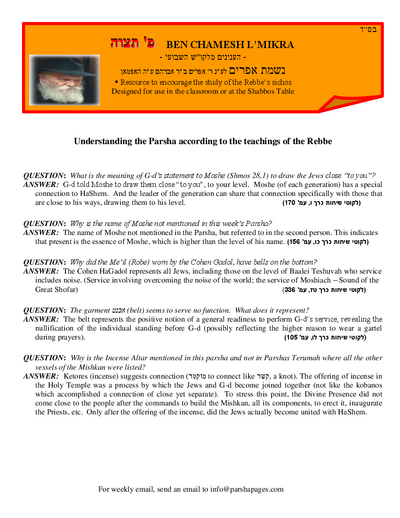
The Essence of Moshe

Though Parshas Tetzaveh alludes to Moshe multiple times, it makes no mention of Moshe, by name. This Sicha reveals the deeper relevance of this that is expressive of Moshe’s essential character.

When reading Parshas Tetzaveh one will notice, that although most Torah portions are replete with mentions of Moshe, in this week his name is absent. The commentators explain that this in not coincidental, but rather there is a specific reason for this fact.

Text 1

Moshe is not mentioned in this portion, which is not the case for the entire Chumash (Pentateuch); for, from the moment of Moshe’s birth, there is no portion in which he is not mentioned (besides Mishna Torah [Devarim]). The reason is, because Moshe said, “erase me now from Your book, which You have written.” The curse of the wise, even if conditional, comes, and it was fulfilled in this (Torah portion).
Bal Haturim, Shemos 27:20

After the Jewish people had sinned with the Golden Calf, Moshe Rabbeinu prayed that G-d forgive them for their sin. Moshe placed himself on the line and beseeched G-d:

“And now, if You forgive their sin; but if not, erase me now from Your book, which You have written." Moshe requested from the Almighty, that if He does not forgive the Israelites, he wished to be erased from the Torah.

Shemos 32:32.

Although G-d did indeed forgive the Jewish people’s sin, Moshe’s request that he be erased from the Torah was (partially) fulfilled in Parshas Tetzaveh. While Moshe demanded that he be taken out from the entirety of the Torah, his demand was somewhat realized, in that his name is absent in a single parsha. Every detail in the Torah is precise. Being that it was specifically in this parsha that the request was fulfilled, it is understood that there is some correlation between the content of Parshas Tetzaveh and Moshe Rabbeinu’s wish to be erased from the Torah. [This is understood all the more when considering that Moshe’s request that he be erased from the Torah was stated in Parshas Ki Sisa, which comes after the present Torah portion.] This therefore requires further elucidation: What connection is there between Moshe’s plea that he be removed from the Torah and the concepts explained here in Parshas Tetzaveh? Parshas Tetzaveh deals with the commandments concerning the kindling of the Menorah, the making of the priestly clothing, the preparation of Aharon and his sons for the priesthood, and the making of the alter for incense. What do any of these directives have in common with the idea of Moshe being absent from the Torah?

Not mentioned

Furthermore, the following point demands clarification as well: the intent of Moshe not being present in this parsha is not that he is not spoken of, but that he is not mentioned by name. Moshe is indeed referred to in Parshas Tetzaveh numerous times. The very name of the portion, which expresses the intent of its entire content, is “(V’ata) Tetzaveh,” meaning, “And you shall command.” This opening statement is referring to G-d’s instruction to Moshe that he command the Israelites regarding the oil for the Menorah. Not only does the opening word “V’ata” (and you) refer to Moshe, but when the Torah uses the word “you” rather than referring to Moshe’s name, it refers to Moshe on an essential level. When one refers to an individual as he is relating to the person’s very essence, he uses the term “you” and not their given name—as the expression “you” represents the person as they are on a level which transcends their name. The concept of a name is that it serves as an identifying term for others. A name enables another person to refer to the individual. The individual themselves however, does not need any title. This is so, being that the essence of an individual is considerably deeper than his connection to another, and it therefore entirely transcends his name. Consequently, the manner in which Moshe was “erased” in this parsha (with the absence of his name, instead being referred to with the term “you”) is in a manner which brings about the revelation of his essential identity; Moshe’s true self, in the deepest of ways. Instead of Moshe’s identity being erased in this parsha, his very identity shines forth in a way that transcends his name.

Erase me

This idea can be understood through first prefacing with the meaning of Moshe’s request, “erase me now from Your book, which You have written.” Rashi explains that the book that Moshe was referring to was the Torah.

Text 2

From the entire Torah, so that they will not say about me that I was unworthy to beg mercy for them [the Israelites].
Rashi, Shemos 32:32

The Sages explain, that Moshe’s very identity was Torah. Therefore, when Moshe was asking that he be erased from Torah, he was requesting something that affected his very being.

Text 3

Three things Moshe gave his very self for, and they are called in his name, and these are them: Israel, Torah, and the laws. Israel, how much he pained himself over them and they are called on his name, as the verse states “And His people remembered the days of old, [the days of] Moshe.” The Torah, as it states “Keep in remembrance the Torah of Moshe.” The laws, as it states “These are the ordinances that you shall place before them.”
Mechilta, Shemos 15:1

Moshe gave his entire self for the Torah, to the point that it is referred to as “The Torah of Moshe.” When Moshe sacrificed himself to be removed from the Torah, it was in order that the Almighty would forgive those that sinned with the Golden Calf, as Moshe states in the beginning of his declaration to G-d, “And now, if You forgive their sin; but if not...” Moshe was prepared to relinquish his entire identity for individuals who worshipped the Golden Calf—a transgression so severe, that all later sins and their punishments are linked to it! The verse says, “But on the day I make an accounting [of sins upon them], I will bring their sin to account against them." The verse is explained to mean, that any future retribution includes within it some punishment for the sin of the Golden calf as well.

This is surprising: Why did Moshe forgo his entire identity of the Torah for those that sinned with the Golden Calf; for those individuals whose actions were the very opposite of the prohibition not to have false G-ds and who separated themselves from the Torah? Additionally, the connection between Moshe’s request to be removed from the Torah and the sin of the Golden Calf must be understood. Why would Moshe specifically propose this request in order to atone for the sin of the Golden Calf? It must be that there is a correlation between being omitted from the Torah and bringing atonement for this particular transgression. Rashi explained, that Moshe’s requested that he be erased from the Torah was in order to prevent future generation from accusing Moshe - “so that they will not say about me that I was unworthy to beg mercy for them.” According to Rashi, being erased from the Torah did not directly assist the Israelites, but ensured that “they will not say” anything negative concerning him. Nonetheless, this explanation is not clear. It appears from the simple reading of the verse, that Moshe’s entire request to G-d was to atone for the Jewish people, and was not a concern for what would be said about himself or regarding how he would be affected personally. Rashi maintains however, that this was not a request that helped the Israelites, but it rather was a request for Moshe. More importantly, at a time when the entire future of the Jewish people was hanging in the balance, after this tremendous transgression in which G-d wished to destroy his people, how can it be that Moshe, being the dedicated leader he was, would primarily be concerned of something so petty as what would be said about him in future generations?!

One with his people

This question can be clarified through understanding the following fundamental concept: Moshe’s identity was completely one with the Jewish people. Moshe and the Jewish people were united to the extent that the two were inseparable. While Moshe’s identity was indeed one with the Torah, he was even more united with the Jewish people. This is expressed in the following statement made by Rashi:

Text 4

Moshe is Israel, and Israel is Moshe, to teach you that the leader of the generation is equal to the entire generation, because the leader is everything.
Rashi, Bamidbar 21:21

It is for this reason that Moshe was so drastically affected by the sin of the Golden Calf, although he was not present at the scene and was so distant from sin. Because he was one with the Jewish people, when they sinned he too was affected by their actions.

Text 5

And the Lord spoke unto Moshe, “Go down.” What is meant by “Go down?” R. Eleazar said: “The Holy One, blessed be He, said to Moshe: ‘Moshe, descend from your greatness. Have I at all given to you greatness save for the sake of Israel? And now Israel have sinned; then why do I want you?’ Straightway Moshe became powerless and he had no strength to speak.”
Talmud, Berachos 32a

Seemingly, Moshe should not have been affected by the sin of the Israelites, as not only was he physically not there, but his spiritual level was such, that the concept of sinning was completely foreign to him. Since, however, his entire identity was part and parcel of the identity of his people, he was automatically affected by their sin.

Greater unity than Torah

This union that the Moshe had with his people was greater and deeper than Moshe’s unity with the Torah (which, as explained above, represented his essential identity). This is relatable the manner in which G-d too, shares His deepest bond with the Jewish people. Although G-d is one with His Torah, his unity with the Jewish people is even greater. G-d’s unity with the Torah is expressed in the following Talmudic statement:

Text 6

“Anochi - I [am the Lord thy God, etc.]”. [This word serves as an abbreviation for the words:] I (ana) Myself (nafshi) have written Myself into the Script (kesavis yehavis).
Talmud, Shabbos 105a

G-d has placed Himself into His Torah, and is one with it. However, notwithstanding this great union, the manner in which He is united with the Jewish people is considerably deeper.

Text 7

R' Huna and R' Yirmiyah said in the name of R' Shmuel bar R' Yitzchak: The thought of Israel preceded all. This may be compared to a king who married a matron and did not have a son from her. Once, the king was in the market, and he said, "Take this ink and quill to my son." All said, "He has no son, and yet he says, 'Take this ink and quill to my son'? Had he not seen that he would have a son from her, he would not have said, 'Take this ink and quill to my son.'" So, too, had G-d not seen that Israel would receive the Torah after 26 generations, He would not have written in the Torah, "Instruct the Children of Israel," "Speak to the Children of Israel."
Bereishis Rabba 1:4

Similar to the way that G-d is more united with the Jewish people than with His Torah, the leaders of the generations as well, are united with the Jewish people in a way that transcends their unity with Torah.

Moshe’s sacrifice

This is the explanation as to why Moshe said, “Erase me now from Your book, which You have written.” He sacrificed his connection with the Torah due the greater unity that he had with the Jewish people. Since his connection with the Jewish people was so deep, it was expressed in two ways: A) His sacrifice for the entirety of the Jewish people was more important than his sacrifice for the Torah. This idea is similar to what is written concerning the Beis Yosef, R. Yosef Karo. It is said

PDF Preview




