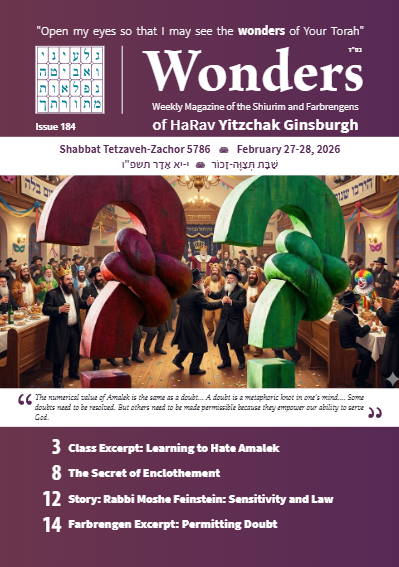
The Secret of Enclothement
The Secret of Enclothement
The portion of Tetzaveh begins with God instructing Moses to command the people to bring pure olive oil to light the lamps of the Menorah.
The numerical value of the opening words “And you shall command” (הֶּוַצְּה תָּתַאְו) is 913, the same as the numerical value of the Torah’s first word, “In the beginning” (יתׁאשֵרְּב). When the letters of the word “and you” (הָּתַאְו) are permuted they read “craving” (הָוֲאַּת).
Although initially it may be difficult to see any connection between the phrases “and you shall command” and “In the beginning” and “craving”; they seem to be linked by nothing more than letter permutations and numerical values. However, upon deeper reflection a profound idea is revealed.
The sages and subsequent Jewish thinkers have posited various reasons for why God created the world. The verse, “They will make for Me a Sanctuary and I will dwell in their midst,” appearing in the previous portion, alludes to perhaps the deepest reason given for God creating the world: “God has a craving to make for Himself a dwelling place in the lower worlds.”
Given this explanation, the Tabernacle clearly represents the fulfillment of God’s craving, or perhaps we might say, His passion to make Himself a dwelling place in the lower worlds, to be present within physical reality through the human soul. He commands the Children of Israel to build him a sanctuary where, on the one hand, He can be approached and experienced and on the other hand, in a deeply mysterious way, He could as it were reveal some of His essence to His creation. That was the function of the Tabernacle and the Temples in Jerusalem—to serve as a meeting place between God and man. Their physical structure and the service performed in them were ultimately meant to symbolize the sanctuary to be built within each human being’s body, heart, mind, and soul. When this is accomplished, the purpose of creation will be fulfilled.
Shining Light
Having linked God’s purpose for creating the world and the Tabernacle, the presence of light in both is instructive. Just as light was the first thing created, God’s first instruction to Moses in this parashah is to command the people to take “pure, pressed olive oil” to light the Menorah daily. The Menorah’s light symbolizes God’s light shining within the material and physical world. Just as God illuminates and sustains the mundane reality with His light, i.e., with His revelation, so too we should constantly spread light throughout the world.
The key ingredient to revealing light is passion. In the reason given above for God creating the world, the word for “craving” (הָוֲאַּת), denoting passion, often has negative connotations. Because it is usually associated with baser, physical desires; however, it also possesses positive connotations: enthusiasm, whole-hearted commitment, and love of life. Passion is a burning flame, which when directed properly creates spiritual light. God had a passion, as it were, to dwell in the lower worlds. Man must imitate this passion for life by pursuing goodness and creating a fitting place for God in the world, as well as within the deepest recesses of the soul.
The Anointed One
The olive oil used in the Menorah in the Tabernacle is described in the first verse of Tetzaveh quoted above as “pure olive oil, beaten to give light.” Olive oil was not only used in the Menorah but also in consecrating the vessels of the Tabernacle. Olive oil was also used to sanctify the cohanim as they were initiated into service in the Tabernacle. Additionally, olive oil was used to anoint kings. It is from this ritualistic act that the title “Mashiach,” which means “the anointed one,” is derived.
Olive oil allegorically represents a profound secret: light emanates from physical matter. When physical matter is probed and beaten like an olive, it reveals a deeper dimension of energy and light. The Zohar teaches that all matter is simply different degrees of thickened light. What is true of olive oil is in effect true of all physical reality. Einstein’s theory of relativity and other modern scientific revelations about energy and light have confirmed that matter is quite literally pure energy.
Mashiach is charged with teaching the world this link between the physical and spiritual worlds. Mashiach’s primary mission is to educate the world, introducing a new level of consciousness to humanity. Ultimately all the people of the world will come to recognize the Divine unity animating all existence and the consummate union between the physical and the spiritual realms. Humanity will then realize that all reality is the light, i.e., the revelation of Godliness. The Menorah symbolizes God’s infinite light and a Jew’s role in revealing that light in all places and at all times.
The Secret of Enclothement
Following Tetzaveh’s opening commandment regarding the Menorah’s lighting, the Torah continues with a detailed description of the unique garments worn by the ordinary cohanim and the additional special garments worn only by the High Priest. These sanctified garments, the Torah informs us, were made for “glory and splendor.” The cohanim, who served simultaneously as the people’s representatives to God and as God’s representatives to the people, were commanded to dress in a manner worthy of their position and spiritual task.
The Torah spends so much time describing every detail of the sacred vestments because garments, in general, signify a much deeper level of meaning: they are a manifestation of the Kabbalistic and Chassidic concept known as enclothement (hitlabshut). This concept was one of the greatest revelations of the Arizal, the leading Kabbalist of the last millennium.