Vata Tetzaveh
Accordingly, we can understand why it is specifically in Parshas Tetzaveh where this idea is expressed.
This great and ultimate unity of the Jewish people with Moshe, alluded to in Moshe’s declaration to be erased from the Torah, is expressed in the first verse of the parsha: “And you shall command (tetzaveh) the children of Israel.”
A deeper meaning to this instruction is that the essence of Moshe should connect all the Jewish people together, in order that they become one entity. The word “tetzaveh” in Hebrew, shares the same etymology as the word “tzavsa,” meaning connection. Moshe was therefore instructed to connect all the Jewish people to each other, to form one entity.
In order for this to be done, Moshe needed to connect with the Jewish people in the way that he exists in his very essence. At the level of Moshe’s “name,” and the corresponding spiritual levels, he is one with the Torah. At this expression of Moshe’s identity, the Jewish people are ordered according to their spiritual level, Hence, when Moshe is expressing himself through his name, he cannot unify all of the nation of Israel.
It is therefore specifically when Moshe’s identity is expressed in the word, “V’ata,” (and you) referring to his essence, when this unity of the Jewish people is possible.
When Moshe is revealed in his essence, in the way in which he himself unites with all the Jewish people no matter their spiritual standing, he can then connect all the Jewish people to each other, even those who had sinned.
Kindling lights
This explanation sheds light as to why Moshe was specifically erased from Parshas Tetzaveh and the connection between revealing the very essence of Moshe and the content of the parhsa.
The beginning verse of “V’ata tetzaveh” continues with the directive to light the Menorah (Candelabra) in the Mishkan (Tabernacle). The verse states:
Text 9
And you shall command the children of Israel, and they shall take to you pure olive oil, crushed for lighting, to kindle the lamps continually.
Shemos 27:20
The idea of uniting the Jewish people is related to the kindling of the Menorah, which was performed by Aharon, the High Priest.
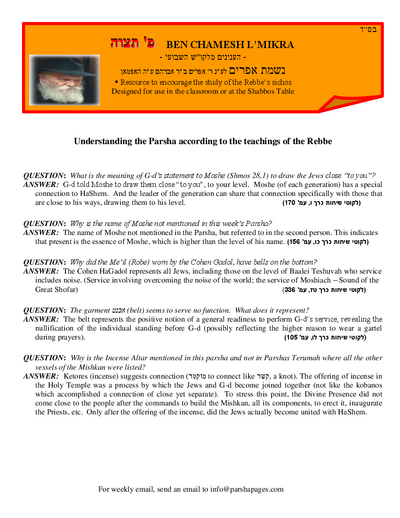
There is a basic question on the above verse; the verse states “and they shall take to you pure olive oil.” The verse states that the oil for the Menorah be brought to Moshe.
This though needs clarification. Why was it necessary for Moshe to be the one who received the oil for the Menorah, if Aharon ultimately was the one to actually kindle the lights? Why could they not bring the oil directly to Aharon?
The reason was however that Aharon was only given the ability to “kindle” the souls of the Jewish people who, as lamps, are in a prepared state to be lit. He was only able to inspire those who were already illuminated with the lights of Torah and mitzvos (G-dly commandments).
Text 10
For a mitzvah is a candle, and the Torah is light and disciplining rebukes are the way of life.
Mishlei 6:23
Aharon on his own, could not inspire all of the Jewish people; only those who were already lamps. He was only able to raise those that were already partially inspired in their service of G-d.
Yet, through the Jewish people first bringing the oil to Moshe—who was able to unite all the Jewish people, and bring out the essence of their soul’s existence—then, even those who were not illuminated with Torah and mitzvos beforehand, were able to be “lit” by Aharon.
The remainder of the parsha
According to the above, it is also understood how the concept of “V’ata Tetzaveh” is connected to the rest of the ideas of the Torah portion.
When the parsha discusses the preparation of Aharon and his sons for their service in the Mishkan, the Torah emphasizes that Moshe should be the one who prepare them for this role.
Text 11
And you bring near to yourself your brother Aharon, and his sons with him, from among the children of Israel to serve Me [as priests]: Aharon, Nadav, and Avihu, Elazar, and Isamar, Aharon's sons. You shall make holy garments for your brother Aharon, for honor and glory.
Shemos 28:1-2
The reason for this is as follows:
Aharon expressed the concept of priesthood and holiness. As an extension of that role, the affect that he had was only upon those that served G-d. He was able to affect only those who had some connection to the Mishkan and to the Menorah. However, through Moshe being the one that consecrated Aharon and his sons as priests, he caused that their affect be felt on all of the Jewish people.
The Alter for incense
Following the preparation of Aharon and his sons for the priesthood, the Torah discusses the construction of the Mizbeach (Alter) for the Kitores, (Incense).
Text 12
You shall make an altar for bringing incense up in smoke; you shall make it out of acacia wood. It shall be one cubit long and one cubit wide, a square, and two cubits high; its horns shall be [one piece] with it. You shall overlay it with pure gold, its top, its walls all around, and its horns; and you shall make for it a golden crown all around. You shall make two golden rings for it underneath its crown on its two corners, you shall make [them] on its two sides, so that it should serve as holders for poles with which to carry it. You shall make the poles out of acacia wood and overlay them with gold.
Shemos 30:1-5
Seemingly, the discussion of the construction of this Alter should have been in Parshas Terumah where the rest of the commandments concerning the construction of the mishkan are found, and not in this week’s parsha.
The reason for its inclusion in Parshas Tetzaveh however, is because the incense too, expresses the unity of the Jewish people.
The Talmud brings out this idea in the following statement:
Text 13
Said R. Hana b. Bizna in the name of R. Chisda the pious: “A fast in which none of the sinners of Israel participate is no fast; for behold the odor of galbanum is unpleasant and yet it was included among the spices for the incense.”
Talmud, Krisus 6b
The incense, which required various types of spices, including the unpleasant odor of galbanum, represents the necessary inclusion of every type of Jew, no matter what level they stand on. Every Jew, no matter if he is a sinner or not, is part and parcel of the rest of the Jewish people.
The Lesson
From here we learn a tremendous lesson in our service of G-d. Moshe was willing to sacrifice what was most essential to him, the Torah, for another Jew—even one who had sinned.
This idea is, in truth, even deeper than the concept of “you shall love your neighbor as yourself.” For there, the stress is that one should love another “as yourself.” Moshe, however, loved another Jew even more than he loved himself as he sacrificed his identity of Torah for another Jew.
In a similar vein, Moshe requested from G-d, and thus gave the ability, that this quality of love for every Jew that he had, should be given to each and every one of us, in all generations. Thus, we too can care for another in a similar way.
This is the deeper meaning of how Rashi explained Moshe’s condition with G-d, to erase him from the Torah—that “they will not say about me that I was unworthy to beg mercy for them [the Israelites].” For, were it not for Moshe’s sacrifice, one would think that one does not need to give of himself in such a way, and the Jewish people would learn from this for generations to follow! Moshe’s sacrifice however, taught us though that this is not the case.
This is the lesson to be learned: It is not enough to love every Jew as you love yourself, it is demanded that we sacrifice our very identity for another Jew. This should be expressed in bringing each and every Jew closer to the Torah.
(Based on Likutei Sichos 21, Tetzaveh 1, reworked by Rabbi Dovid Markel.
To see other projects and to partner in our work, see: www.Neirot.com.)